


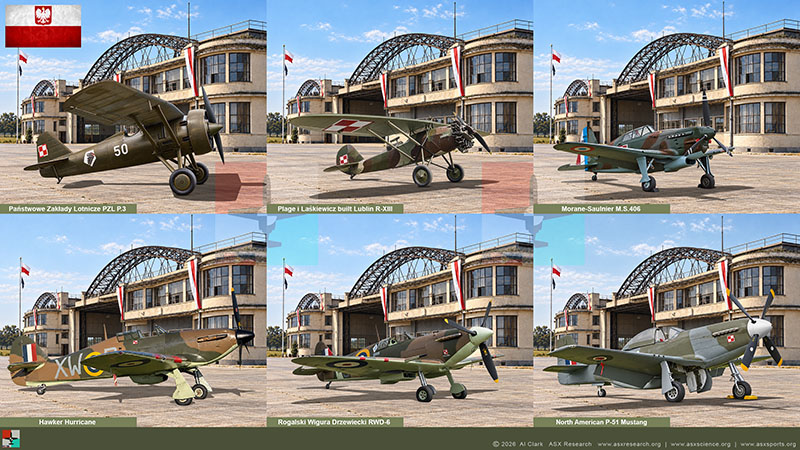
Poland lost its territory, its airfields, and much of its aircraft inventory during the Second World War. What it did not lose was its air force.
In the second installment of his three-part history of Polish aviation, researcher Albert N. Clark examines how Polish military aviation survived repeated national catastrophes, rebuilt itself across international borders, and helped defeat Nazi Germany—only to discover that military victory would not restore the political freedom its airmen had fought to defend.
An Air Force Built From the Wreckage of Empires
When Poland regained independence in 1918, its new military inherited incompatible aircraft, equipment, procedures, and infrastructure from three former empires. Building a functioning air service required extraordinary improvisation while the country was already fighting to secure its borders.
During the Polish-Soviet War of 1920, aircraft conducted reconnaissance and ground attacks against Soviet cavalry formations. The 7th Kościuszko Squadron included American volunteers such as Cedric Fauntleroy and Merian C. Cooper, who later became associated with the 1933 film King Kong.
Through the interwar decades, Poland developed aviation schools, aircraft factories, technical institutions, and experienced pilots. But its modernization programs struggled to produce sufficient numbers of combat aircraft capable of matching Germany’s rapidly advancing technology.
The Myth of September 1939
One of the most persistent stories about the German invasion claims that Poland’s air force was destroyed on the ground during the opening hours of September 1, 1939.
The research challenges that account. Polish commanders had dispersed important operational units to concealed airfields before the invasion. Polish fighters and reconnaissance aircraft continued flying combat missions despite Germany’s overwhelming numerical, technological, and logistical advantages.
Poland’s PZL P.11 fighters had been advanced earlier in the 1930s, but by 1939 they were confronting aircraft from a newer generation. Skilled pilots could sometimes compensate tactically, but they could not eliminate the disadvantages of speed, industrial capacity, and operational support.
When the Soviet Union invaded eastern Poland on September 17, preserving trained aviation personnel became critical. Airmen escaped through Romania, Hungary, and other routes. Their aircraft might be lost, but their experience could be carried into another country’s air force.
Rebuilding in France—and Then Britain
Polish aviation personnel first attempted to reconstruct their fighting force in France. The effort was complicated by equipment shortages, different procedures, political negotiations, and the rapidly deteriorating military situation.
France’s collapse in June 1940 forced another evacuation. Polish airmen reached Britain, where they adapted to RAF aircraft, radio procedures, formations, and command structures.
Importantly, Polish units retained a distinct national military identity under wartime agreements. Their service represented the continued existence of a Polish armed force even while their homeland remained occupied.
303 Squadron and the Battle of Britain
No. 303 Kościuszko Squadron became one of the most celebrated units of the Battle of Britain. The RAF Museum recognizes its exceptional wartime record, and Polish pilots made a substantial contribution to Britain’s air defense.
But Clark’s research distinguishes contemporary victory claims from independently verified enemy losses. The frequently repeated figure of 126 victories must be understood in the context of wartime reporting and subsequent historical examination.
Correcting inflated claims does not diminish the squadron’s achievements. Its actual record remains remarkable without embellishment.
The squadron also included Czech pilot Josef František, illustrating the multinational character of Allied aviation during the war.
Beyond the Famous Fighter Squadrons
Poland’s wartime aviation contribution extended far beyond 303 Squadron. Polish personnel served in bomber, coastal, reconnaissance, transport, training, and special-duty operations.
Bomber crews faced night fighters, anti-aircraft fire, weather, navigation hazards, and severe operational losses. Special-duty flights carried personnel and supplies toward occupied Poland, including dangerous missions associated with the Warsaw Uprising.
Women also contributed through technical, administrative, intelligence, medical, and aviation-support roles. Polish women pilots serving with the Air Transport Auxiliary ferried aircraft through difficult British weather, helping sustain Allied flying operations.
Winning the War, Losing the Peace
Polish airmen fought through the final Allied campaigns of 1945, but Germany’s defeat did not restore the independent political order for which many had fought.
Poland entered the Soviet sphere of influence. Veterans faced the painful choice of returning to a changed homeland or remaining abroad, often separated permanently from their families and former lives.
The Polish Air Force’s traditions survived through veterans, historical records, associations, and military institutions. The return of the Polish airmen’s banner to Warsaw in 1992 became a powerful symbol of that continuity.
The Real Secret of Polish Airpower
The study argues that Poland’s defining wartime aviation achievement was not a particular fighter, ace, or squadron. It was the survival of institutional knowledge.
Aircraft were destroyed. Airfields were occupied. Governments fled. Yet pilots, mechanics, instructors, commanders, and support personnel carried their expertise into new organizations and continued fighting.
The comparison between Poland in 1939 and Polish squadrons operating within Britain’s integrated air-defense system in 1940 also demonstrates a lasting aviation-safety and military lesson: capable people require capable systems.
Poland’s air force survived because its accumulated knowledge, professional culture, and national identity proved more durable than the machines and territory it had lost.
Read the complete 22-page ASX Research paper: The Air Force That Refused to Die: Poland’s Military Aviation from Independence to Victory Without Freedom — ASX Research Journal and Database, September 18, 2026. Second article in the three-part Polish aviation series.