


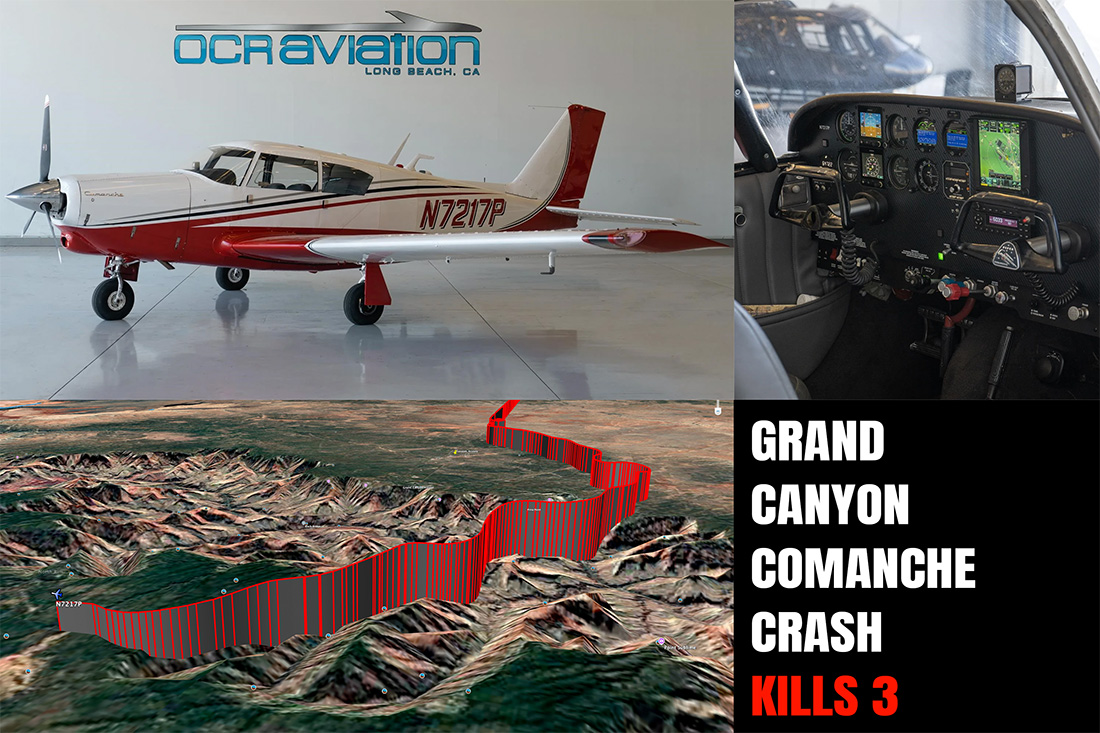
GRAND CANYON NATIONAL PARK, ARIZONA — November 17, 2026 — Three people were killed when a Piper PA-24 Comanche crashed in remote mountainous terrain on the North Rim of Grand Canyon National Park on Sunday evening, November 15. The aircraft was reported missing late that night, triggering a multi-agency search that continued into Monday morning before the wreckage was located.
The Federal Aviation Administration reported that the accident occurred at approximately 7:15 p.m. local time. National Park Service personnel subsequently located the aircraft and its debris field in the Basin area at approximately 10:15 a.m. on November 16. None of the three occupants survived.
Aircraft and Flight
The aircraft has been identified in aviation accident records as a Piper PA-24-250 Comanche 250, registration N7217P, manufactured in 1960 and powered by a Lycoming O-540-A1D5 piston engine.
According to preliminary information published by the Aviation Safety Network, the privately operated aircraft departed Phoenix–Deer Valley Airport at approximately 6:08 p.m. on November 15, reportedly bound for Bountiful–Salt Lake Skypark in Utah.
Flight-tracking information associated with N7217P also records a departure from Phoenix–Deer Valley at 6:08 p.m., with the aircraft subsequently last observed in the Grand Canyon region.
Unusual Flight Path Before the Accident
The Aviation Safety Network’s preliminary account describes the aircraft climbing to approximately 10,800 feet. At around 7:04 p.m., south of Grand Canyon Village, the Comanche reportedly completed a full 360-degree orbit before continuing northward.
Subsequent ADS-B information reportedly showed a meandering flight path, with altitude varying between approximately 10,500 and 10,800 feet and corresponding fluctuations in groundspeed.
As the aircraft approached the North Rim area, the available tracking narrative describes a left-hand turn accompanied by an increasing rate of descent.
These observations describe the reported flight path, not the reason for the accident. Investigators have not established whether the aircraft’s maneuvering, altitude changes, weather conditions, or any other factor contributed to the crash.
Missing Aircraft Report Triggers Overnight Search
According to the National Park Service, the Grand Canyon Regional Communications Center received a report of a missing Piper Comanche carrying three people at approximately 11:30 p.m. on Sunday, more than four hours after the accident time reported by the FAA.
The aircraft’s last known position was believed to be in the vicinity of the Basin area on the North Rim.
During the early morning hours of November 16, the Arizona Department of Public Safety conducted an aerial search using forward-looking infrared equipment and night-vision technology.
The search involved several agencies, including the Arizona Department of Public Safety, Coconino County Search and Rescue, Kane County Search and Rescue, and the Air Force Rescue Coordination Center.
National Park Service personnel located the aircraft and its debris field at approximately 10:15 a.m. Monday. Authorities confirmed that there were no survivors.
Remote Terrain Complicates Search Operations
The Grand Canyon’s North Rim is characterized by elevated terrain, steep topography, and extensive remote areas. Searching for a missing aircraft in such an environment can require coordination between aerial search assets and ground rescue teams.
The use of infrared and night-vision equipment during the initial search reflects the challenges of locating aircraft wreckage in darkness and difficult terrain.
The National Park Service has not publicly detailed the precise condition of the wreckage, the aircraft’s impact sequence, or the circumstances that led to the accident.
Investigation Underway
The National Transportation Safety Board is investigating the accident, with assistance from the Federal Aviation Administration and the National Park Service.
Investigators are expected to examine available flight-tracking information, aircraft maintenance and operational records, weather information, and physical evidence recovered from the accident site as part of the normal accident investigation process.
The cause of the crash has not been determined. Although the available tracking account describes changes in heading, altitude, and groundspeed before the accident, those observations alone do not establish an equipment malfunction, pilot error, loss of control, or any other causal explanation.
The identities of the three people killed had not been released in the National Park Service’s November 16 announcement.
Sources and Reporting
This report draws on the National Park Service’s November 16, 2026, news release, FAA accident information reported by aviation media, flight-tracking information for N7217P, and the Aviation Safety Network’s preliminary accident record. Aircraft-specific flight-path details remain preliminary and may be revised as investigators establish the facts.