


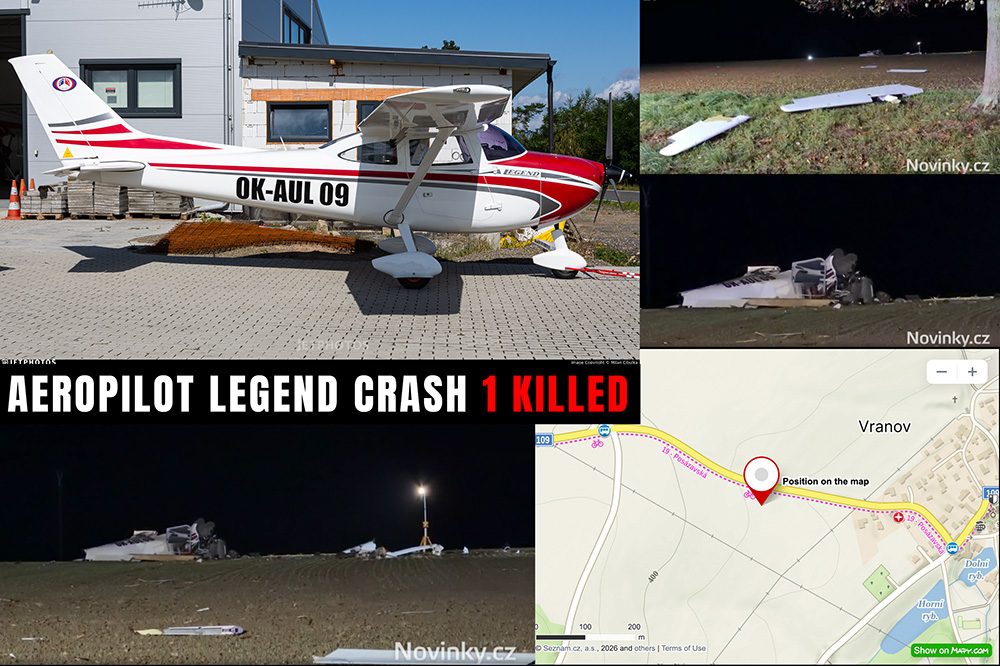
A privately operated Aeropilot Legend 600 ultralight aircraft crashed near Vranov in the Benešov district of the Czech Republic on Saturday, October 31, 2026, killing its sole occupant. The aircraft, registered OK-AUL09, came down near Road 109 between Vranov and Čerčany in Central Bohemia. Preliminary reports suggest that deteriorating weather and an encounter with cloud may have preceded the accident, although investigators have not established an official cause.
Accident Overview
The accident occurred at approximately 4:30 p.m. local time, with flight-tracking coverage placing the end of the flight at approximately 4:34 p.m. Emergency services received multiple reports of a small aircraft crashing near Vranov. Police officers, firefighters, and emergency medical personnel were dispatched to the scene.
The aircraft was a Czech-manufactured Aeropilot Legend 600, a two-seat, high-wing ultralight designed primarily for recreational and sport aviation. Its registration was reported as OK-AUL09. Although the aircraft had two seats, only the pilot was aboard. The pilot sustained fatal injuries, and the aircraft was destroyed.
Police spokesperson Kateřina Sejková confirmed that the pilot died at the accident scene. No additional occupants or ground fatalities were reported.
Departure, Route, and Flight Tracking
Flight-tracking information identified Prague–Letňany Airport (LKLT) as the departure airfield. Czech aviation reporting suggested that the aircraft may have been heading toward Vlašim Airport (LKVL), although its intended destination has not been officially confirmed.
According to reporting based on Flightradar24 data, the aircraft departed Prague–Letňany at approximately 4:22 p.m. local time and proceeded southeast toward the Benešov region. The flight ended in the vicinity of Vranov and Čerčany.
Czech aviation publication Aeroweb reported that flight-tracking information indicated an altitude of approximately 5,000 feet before the accident. This figure should be treated as a reported tracking observation rather than a confirmed impact altitude or a complete reconstruction of the aircraft’s final flight path.
Published flight-tracking accounts contain timing details that are not entirely consistent. Accordingly, the precise takeoff time, duration of flight, and sequence of events immediately preceding impact remain subject to verification.
Wreckage Scattered Near Road 109
The aircraft crashed in an area adjoining Road 109, which connects Vranov and Čerčany. Emergency responders encountered wreckage scattered across a field and the surrounding area near the roadway. Czech police reporting described a debris field extending for several dozen meters.
Firefighters secured and illuminated the accident site as darkness approached, allowing police investigators and aviation specialists to document the wreckage. Reports from the scene indicated that the removal of wreckage would be coordinated with the aviation investigator.
The extent of the debris distribution has been documented in initial reporting, but it does not by itself establish whether the aircraft experienced an in-flight structural failure, an uncontrolled descent, or another accident sequence. Those determinations require examination of the wreckage and associated evidence.
Adverse Weather and Possible Entry Into Cloud
One of the most significant preliminary details concerns the weather encountered during the flight. Czech news outlet Novinky reported that the aircraft apparently entered clouds in deteriorating weather before crashing. Other local reporting similarly identified adverse weather as a possible contributing factor.
These accounts have not been confirmed as an official finding. Investigators have not publicly established whether the pilot inadvertently entered instrument meteorological conditions, experienced spatial disorientation, encountered reduced visibility, or faced another operational or mechanical problem.
The distinction is important. A report that an aircraft entered cloud is not, by itself, proof that cloud penetration caused the crash. Establishing causation requires consideration of meteorological observations, the aircraft’s flight path, pilot qualifications, aircraft equipment, maintenance history, and the physical evidence recovered from the accident site.
The Aviation Safety Implications of VFR Flight Into IMC
Inadvertent flight from visual meteorological conditions into instrument meteorological conditions is a recognized hazard in general aviation. When external visual references disappear, pilots who are not adequately trained and proficient in instrument flight may have difficulty maintaining reliable aircraft attitude and orientation.
Spatial disorientation can occur when the human vestibular system produces sensations that conflict with the aircraft’s actual attitude or motion. In the absence of a visible horizon, a pilot who relies on bodily sensations rather than reliable flight instruments may unintentionally initiate or worsen an unusual aircraft attitude.
However, spatial disorientation has not been established as a factor in this particular accident. It is discussed here as a relevant aviation safety concern because of the preliminary reports involving cloud and reduced visibility.
Late-autumn flying in Central Europe can present additional challenges, including low cloud ceilings, mist, fog, variable visibility, and rapidly diminishing daylight. These conditions can reduce the options available to pilots conducting visual flight, particularly when operating near rising terrain or away from suitable diversion airfields.
Preflight weather assessment, continuous monitoring of changing conditions, conservative diversion decisions, and avoidance of deteriorating visual conditions remain essential safeguards. These principles apply regardless of the eventual findings in the Vranov investigation.
Investigation Underway
The circumstances of the crash are being investigated by Czech criminal investigators in cooperation with the Ústav pro odborné zjišťování příčin leteckých nehod (ÚZPLN), the Czech authority responsible for investigating aviation accidents.
The investigation may examine the aircraft’s maintenance and operational history, pilot qualifications and experience, available flight-tracking information, meteorological conditions, wreckage evidence, and witness accounts. The scope and results of those examinations have not yet been publicly established.
As of November 1, 2026, no final accident report or official determination of probable cause has been identified in the available reporting. The reported encounter with clouds remains a preliminary account rather than an established investigative conclusion.
Accident Details
Date: October 31, 2026.
Approximate time: 4:30–4:45 p.m. local time.
Location: Near Vranov, Benešov district, Central Bohemia, Czech Republic.
Aircraft: Aeropilot Legend 600.
Registration: OK-AUL09.
Operator: Private.
Occupants: One.
Fatalities: One.
Survivors: None.
Aircraft damage: Destroyed.
Departure: Prague–Letňany Airport (LKLT).
Destination: Unconfirmed; Vlašim Airport (LKVL) has been suggested in aviation reporting.
Phase of flight: En route.
Cause: Under investigation.
What Is the Aeropilot Legend 600?
The Aeropilot Legend 600 is a Czech-manufactured, two-seat, single-engine ultralight and light-sport aircraft designed for recreational flying, cross-country transportation, and flight training. It is manufactured by Aeropilot s.r.o., based in Čáslav, Czech Republic. Although considerably smaller and lighter than conventional general aviation aircraft, the Legend 600 resembles a scaled-down Cessna 182, featuring a high-mounted wing, enclosed cabin, conventional tail assembly, and fixed tricycle landing gear in its standard configuration.
The aircraft is an all-composite, strut-braced, high-wing monoplane. Its fuselage and wings employ carbon-fiber composite sandwich construction, which combines structural strength with relatively low weight. The cabin accommodates two occupants seated side by side, with individual doors, adjustable seating, and a small baggage compartment. Its high-wing arrangement provides excellent downward visibility and contributes to its suitability for recreational flying and pilot training.
Aeropilot began developing the original Legend aircraft family in 2010, completing its initial prototype in 2011. The manufacturer subsequently developed the Legend 600 for markets permitting a maximum takeoff weight of 600 kilograms. The aircraft received Czech ultralight type certification in 2021, followed by approvals in several European markets. Versions have also been marketed internationally as light-sport aircraft.
Aircraft Design and Technical Specifications
The Legend 600 has a wingspan of approximately 9.06 meters (29.7 feet), an overall length of 7 meters (23 feet), and a height of approximately 2.6 meters (8.5 feet). Its maximum takeoff weight is 600 kilograms (1,323 pounds). Depending on configuration, the aircraft’s empty weight is approximately 335 kilograms (739 pounds), leaving capacity for occupants, fuel, and baggage within its certified weight limitations.
A common powerplant is the Rotax 912 ULS, a four-cylinder, four-stroke aircraft engine producing approximately 100 horsepower. Other Rotax engine options are available, depending on the aircraft version and configuration. The engine drives a tractor propeller mounted at the front of the aircraft.
According to the manufacturer’s published specifications, a Legend 600 equipped with the Rotax 912 ULS has a typical cruising speed of approximately 185 kilometers per hour (100 knots), a maximum horizontal flight speed of approximately 225 kilometers per hour (122 knots), and a never-exceed speed of 250 kilometers per hour (135 knots). Its published range can reach approximately 1,300 kilometers (703 nautical miles), with an endurance of approximately seven hours under specified operating conditions.
The manufacturer lists a speed with flaps deployed of approximately 65 kilometers per hour (35 knots), a minimum landing speed of approximately 85 kilometers per hour (46 knots), and an initial climb rate of approximately 7 meters per second (1,378 feet per minute). These are published model specifications rather than verified performance figures for the aircraft involved in the October 31 accident.
The Legend 600 incorporates wing-mounted fuel tanks, electrically assisted fuel delivery, hydraulically operated wheel brakes, and trailing-edge wing flaps. Its standard landing gear consists of two main wheels and a steerable nosewheel. Aeropilot also manufactures float-equipped and amphibious versions capable of operating from water.
Safety Equipment and Instrument Flight Capability
The Legend 600 can be equipped with a ballistic aircraft rescue parachute system, designed to deploy a parachute capable of lowering the entire aircraft during certain emergencies. Additional protective features described by the manufacturer include a reinforced Kevlar cabin structure and four-point occupant restraint harnesses.
Available avionics range from conventional analog flight instruments to integrated electronic flight displays manufactured by companies including Garmin, Dynon, and Kanardia. Depending on the configuration, these systems may provide attitude, airspeed, altitude, navigation, engine monitoring, and other flight information.
Aeropilot also advertises specially equipped versions intended for instrument flight operations. However, the availability of instrument-capable equipment on certain Legend 600 variants does not establish that every aircraft of the type is legally approved or appropriately equipped for instrument meteorological conditions. Such operations depend on the individual aircraft’s approved configuration, applicable operating rules, and pilot qualifications.
In the Vranov accident, the specific avionics installation, parachute equipment, operating limitations, and instrument qualifications associated with registration OK-AUL09 have not been independently established. Consequently, no conclusions can presently be drawn about whether the aircraft was equipped for instrument flight or whether any onboard safety equipment was available or activated.
The Legend 600 and the Vranov Investigation
The Legend 600’s lightweight composite construction, comparatively low operating speeds, and recreational aviation mission distinguish it from larger certified general aviation aircraft. Nevertheless, it remains subject to the same fundamental aerodynamic principles and environmental hazards that affect all fixed-wing aircraft, including loss of visual references, turbulence, adverse weather, and loss of aircraft control.
Should investigators confirm that the aircraft entered cloud, the aircraft’s instrumentation, approved operating limitations, pilot experience, and recorded flight path may become particularly relevant. However, the aircraft’s design characteristics alone cannot establish the sequence or cause of the October 31, 2026 accident.
Further technical information about the aircraft type is available from Aeropilot, the aircraft manufacturer, and the Aviation Safety Network’s Legend aircraft type database.
Sources and Continuing Coverage
Novinky.cz — Pavel Jaňurek, October 31, 2026. Initial reporting from the accident scene, including statements from police spokesperson Kateřina Sejková and preliminary accounts concerning deteriorating weather.
Read the Novinky accident report.
Aeroweb.cz — November 1, 2026. Aviation-specific reporting identifying the Aeropilot Legend 600, registration OK-AUL09, departure information, flight-tracking observations, and meteorological safety considerations.
Read the Aeroweb aviation report.
Týdeník Policie — October 31, 2026. Emergency response, police statements, wreckage distribution, and investigation details.
NextNews.cz — October 31, 2026. On-scene reporting, aircraft registration, and flight-tracking information.
iROZHLAS.cz — October 31, 2026. Independent confirmation of the fatality, aircraft occupancy, and investigative involvement.
ASX News will update this report as additional verified information becomes available from Czech aviation investigators and other authoritative sources.