

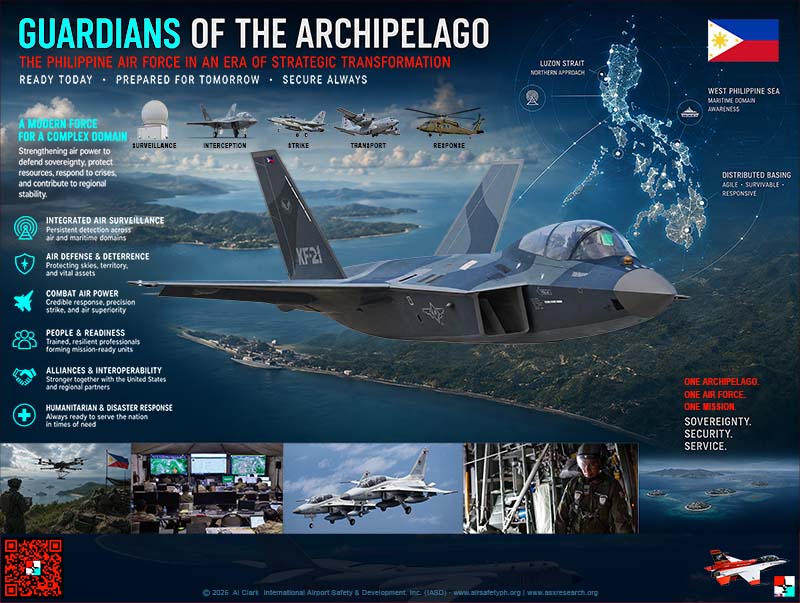
The Philippine Air Force is undergoing one of the most significant transformations in its history. After decades focused largely on internal security, counterinsurgency, transportation, and disaster response, the service is increasingly preparing for territorial defense, maritime surveillance, and the possibility of a major regional security crisis.
A 17-page ASX Research investigation published September 4, 2026, examines the aircraft, technology, strategic partnerships, and operational challenges shaping that transition.
Its central conclusion is that the Philippines does not need to match China’s military aircraft one for one. It needs an air force capable of detecting threats, surviving attacks, responding quickly, protecting national territory, and operating effectively with allied forces.
From Internal Security to Territorial Defense
The Philippine Air Force was formally established on July 1, 1947, inheriting a mission that included national air defense. Its early aircraft included P-51 Mustangs and F-86 Sabre jet fighters.
Over subsequent decades, however, communist insurgency, separatist violence, counterterrorism, and other domestic security demands increasingly shaped the service’s aircraft inventory and operating priorities.
Troop transportation, close air support, helicopters, reconnaissance, and utility aviation became essential missions, while high-end air defense received comparatively limited investment.
China’s growing maritime presence, particularly the 1995 occupation of Mischief Reef and the 2012 Scarborough Shoal confrontation, exposed the limitations of a military primarily organized around internal threats.
The resulting modernization effort represents more than the acquisition of new aircraft. It requires rebuilding the skills, infrastructure, and operational systems necessary to defend a geographically dispersed island nation.
The FA-50 and the Return of Supersonic Fighters
One of the most important steps in that transition was the acquisition of twelve FA-50PH Fighting Eagles from South Korea.
The aircraft restored a supersonic fighter capability that had been absent following the retirement of the Philippine F-5 fleet.
The FA-50 provides interception, precision attack, advanced training, and a foundation for developing the pilots, maintainers, weapons specialists, and tactical procedures required by a modern combat air force.
A June 2025 contract added twelve more FA-50 aircraft. According to information available to the September 2026 research, deliveries were expected to begin in 2028 and conclude by 2030.
Other modernization investments include A-29B Super Tucano attack aircraft, S-70i Black Hawk helicopters, T129 attack helicopters, transport aircraft, modern surveillance radar, and SPYDER ground-based air defense systems.
But possessing these systems is not the same as operating them as an integrated defensive network.
The Technology Behind a Modern Air Defense Network
The research identifies integrated surveillance and communications as essential to Philippine territorial defense.
Radar installations, airborne sensors, unmanned aircraft, fighter patrols, missile batteries, and command centers must exchange reliable information across enormous distances.
Secure data links, electronic warfare protection, cyber resilience, reliable identification systems, and redundant communications become especially important when aircraft and ground units operate far from major bases.
Persistent unmanned surveillance could prove particularly valuable for monitoring the country’s extensive maritime approaches without requiring expensive crewed fighter patrols for every mission.
The Philippines must also prepare for disrupted communications, damaged runways, and attacks on concentrated military facilities.
Why Readiness Matters More Than Aircraft Numbers
A fighter aircraft contributes little to national defense if it cannot be maintained, armed, fueled, and flown when needed.
Modern combat aviation requires spare engines, trained maintenance personnel, munitions inventories, hardened aircraft shelters, secure fuel storage, runway-repair capability, and continuous pilot training.
The challenge becomes greater when aircraft must operate from dispersed locations throughout Luzon, Palawan, the Visayas, and smaller islands.
The study argues that Philippine air power should be measured by operational resilience and the ability to generate repeated sorties, not simply by the number of aircraft displayed in an inventory.
Distributed basing can make an air force more difficult to disable, but only when alternate airfields have the equipment, personnel, supplies, and communications needed to sustain actual operations.
The West Philippine Sea Changes the Mission
Disputes in the West Philippine Sea have placed increasing pressure on Philippine surveillance and defense capabilities.
Chinese naval vessels, coast guard ships, maritime militia, aircraft, and surveillance systems operate within a contested regional environment where incidents can escalate rapidly.
Scarborough Shoal remains particularly sensitive because of its proximity to Luzon and its importance to Philippine maritime and air approaches.
The September 2026 study describes Chinese military activity around the shoal, including reports that Chinese forces tracked and warned three small Philippine aircraft in August 2026.
For the Philippine Air Force, maintaining an air presence is about more than preparing for combat. Surveillance flights can document events, preserve evidence, support coast guard and naval operations, and demonstrate the country’s continued assertion of its maritime rights.
The research advocates a defensive approach built around surveillance, mobility, distributed systems, and credible deterrence rather than attempting an unaffordable symmetrical competition with China.
Could a Taiwan Crisis Reach Philippine Airspace?
The northern Philippine islands lie close to Taiwan and the strategically important Luzon Strait.
A blockade or invasion of Taiwan could therefore create immediate consequences for the Philippines, even if Manila sought to avoid direct involvement.
Potential demands could include evacuating Filipino civilians, monitoring northern airspace, protecting military installations, supporting allied operations, and responding to disruptions in commercial aviation and shipping.
The Batanes islands and nearby maritime approaches could become particularly important because of their geographic position.
The research emphasizes that a Taiwan contingency would not automatically determine Philippine participation in a war, but the country’s geography, alliance commitments, and exposure to regional disruption would make remaining unaffected extremely difficult.
Allied Operations and the Importance of Interoperability
The United States remains the Philippines’ treaty ally, while defense cooperation with Japan, Australia, and other regional partners has expanded.
Balikatan 2026 demonstrated increasingly complex multinational operations, including the movement of advanced anti-ship missile systems to remote northern locations.
For the Philippine Air Force, interoperability means more than participating in exercises.
It requires compatible communications, shared operating procedures, coordinated airspace management, intelligence exchange, logistics familiarity, and the ability to conduct missions alongside allied aircraft and defense systems.
The objective is to strengthen Philippine sovereign capabilities while preserving the option of effective coalition operations during a major emergency.
Could the KF-21 Boramae Become the Next Philippine Fighter?
South Korea’s KF-21 Boramae is among the aircraft attracting attention as the Philippines considers its future multirole fighter requirement.
The September 2026 investigation identifies South Korea as one of several potential suppliers being considered, alongside Sweden, the United States, France, and the Eurofighter consortium.
The KF-21 could offer greater range, payload, radar performance, and long-term development potential than the FA-50, while building upon the Philippines’ existing relationship with Korean aerospace manufacturers.
However, the research found no credible public evidence, as of September 3, 2026, of a formal South Korean proposal to lease KF-21 fighters to the Philippines.
It also cautions against selecting any aircraft on prestige alone.
Acquisition price, maintenance costs, weapons integration, delivery schedules, spare parts, pilot training, electronic warfare capability, and the ability to operate from dispersed airfields are all essential considerations.
Gripen, F-16, Rafale, Eurofighter, and KF-21 aircraft each offer different advantages and limitations. The most suitable fighter is ultimately the one the Philippines can sustainably operate under demanding conditions.
Disaster Response Remains a National Security Mission
Even as territorial defense becomes more prominent, the Philippine Air Force cannot abandon its traditional humanitarian responsibilities.
Typhoons, earthquakes, volcanic eruptions, and other disasters regularly require airlift, helicopters, aeromedical evacuation, emergency communications, and logistical support.
The same transport aircraft, airfields, fuel systems, and maintenance personnel supporting disaster relief may also become essential to national defense during a crisis.
For an archipelago, humanitarian aviation and military readiness are not competing priorities. Both depend on a resilient transportation and support network.
Defending an Archipelago in a Changing World
The future Philippine Air Force will be judged less by its ability to purchase impressive aircraft than by its ability to connect them into a reliable national defense system.
Long-range radar, persistent surveillance, secure communications, mobile air defense, unmanned systems, trained personnel, adequate munitions, and distributed operating bases may collectively provide greater value than concentrating resources on a small number of sophisticated fighters.
The research concludes that the Philippines should seek an air force capable of seeing farther, surviving longer, responding faster, supporting its population during disasters, and imposing meaningful costs on potential aggression.
The guardians of the archipelago are being asked to do more than patrol Philippine skies. They are being asked to make those skies strategically consequential.
Read the complete 17-page ASX Research paper: Guardians of the Archipelago: The Philippine Air Force in an Era of Strategic Transformation — ASX Research Journal and Database, September 4, 2026.