

A pilot can hold every required qualification. An air traffic controller can be fully certified. A maintenance technician can possess every necessary authorization. Yet the aviation system surrounding those professionals may still be losing the experience, judgment, and resilience that make safe operations possible.
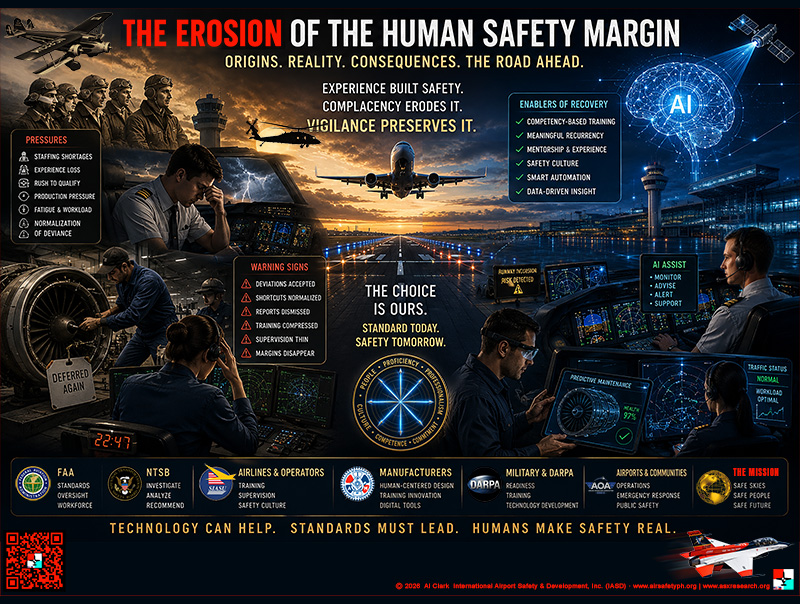
That is the central warning of The Erosion of the Human Safety Margin, a 17-page investigation published by ASX Research on August 31, 2026. The study examines how staffing pressures, accelerated training, automation dependence, fatigue, and weakened institutional knowledge can gradually reduce aviation’s ability to withstand unexpected failures.
The Difference Between Qualified and Experienced
Modern aviation depends on rigorous certification, recurrent training, and standardized procedures. But a certificate establishes that a professional has met a defined standard; it does not necessarily capture the depth of judgment developed through years of operational experience.
As experienced personnel retire and newer employees assume complex responsibilities, organizations face a difficult challenge: replacing credentials is faster than replacing accumulated expertise.
The research identifies this distinction as a growing concern across commercial flight operations, air traffic control, aircraft maintenance, and military aviation. The danger is not that younger professionals are inherently less capable. It is that institutions may expect them to acquire seasoned judgment under increasingly compressed conditions.
Automation’s Hidden Trade-Off
Modern aircraft automation has dramatically improved routine operational stability. However, automation can also reduce opportunities for pilots to practice manual-control skills that become essential when automated systems malfunction or behave unexpectedly.
The study cites research connecting recent manual-flying experience with transport-pilot handling performance. It argues for recurrent training that deliberately exposes crews to unusual, compound, and automation-degraded situations.
The objective is not to reject automation. It is to ensure that human proficiency remains strong enough to manage the aircraft when automated assistance is unavailable or unreliable.
Pressure Beyond the Cockpit
The same vulnerability extends throughout the aviation system. Air traffic controllers must manage complex traffic environments while coping with fatigue, staffing constraints, and demanding schedules. Maintenance technicians face increasingly sophisticated aircraft while experienced mechanics and inspectors leave the workforce.
The paper cites Boeing’s 2026 workforce outlook, which projects demand for approximately 674,000 new commercial pilots and 728,000 new maintenance technicians over the following two decades.
These figures illustrate the scale of the challenge. Recruiting and certifying replacements will be essential, but transferring practical knowledge, preserving mentorship, and maintaining meaningful supervision may prove equally important.
When Unsafe Practices Become Normal
One of the study’s most troubling findings concerns the normalization of deviance: the gradual acceptance of departures from established standards because previous departures did not produce an accident.
A shortcut that succeeds repeatedly can begin to appear safe. A staffing compromise can become routine. A training deficiency can remain uncorrected because daily operations continue without visible consequences.
Over time, an organization may move closer to failure without formally changing its safety standards. Every employee may remain qualified while the system loses the additional protection that experience, oversight, and conservative decision-making once provided.
Accidents Demand Evidence, Not Convenient Blame
The research examines major aviation accidents while carefully distinguishing established findings from unresolved investigations.
In discussing the January 2025 Potomac River midair collision, which killed 67 people, the paper cites the National Transportation Safety Board’s January 2026 conclusions identifying systemic failures involving helicopter-route design, safety-data review, visual separation, and organizational oversight.
Importantly, the investigation did not establish controller fatigue as a causal factor, and the decision to combine tower-control positions that evening was not attributed to insufficient staffing.
The paper also discusses the March 2026 LaGuardia collision involving an Air Canada Express aircraft and an airport rescue vehicle, but does not assign responsibility while the investigation remains unresolved.
The distinction matters: examining systemic safety weaknesses requires evidence, not assumptions about individual incompetence.
Can Artificial Intelligence Restore the Margin?
Artificial intelligence, adaptive training systems, advanced simulation, and competency-based assessment could help aviation identify weaknesses before they contribute to accidents.
Emerging technologies may allow instructors to tailor training, detect deteriorating skills, and expose personnel to scenarios that conventional recurrent programs seldom reproduce.
Military research into human-machine collaboration also suggests opportunities for intelligent systems to monitor, cross-check, and assist human operators during demanding situations.
But the study draws a firm distinction between using technology to strengthen professional competence and using it to justify reduced human capability.
The Standard Must Be More Than a Certificate
The erosion of aviation’s human safety margin is not inevitable. The research points to improvements in military aviation safety following targeted training corrections as evidence that institutions can identify proficiency gaps and reverse them.
Preserving that margin requires meaningful recurrent training, protected mentorship, effective fatigue management, stronger reporting cultures, and organizational leadership willing to recognize problems before accidents expose them.
The fundamental question is whether aviation will use increasingly capable technology to reinforce human excellence—or gradually allow that excellence to decline because machines appear capable of compensating for it.
Read the complete research: The Erosion of the Human Safety Margin — ASX Research Journal and Database, Albert N. Clark, August 31, 2026. The original 17-page publication includes the full analysis, supporting research, and references.