

November 28, 2026 — The world may be approaching one of the most consequential geopolitical intersections in modern human history. Across Europe, the Middle East, the Korean Peninsula and the Western Pacific, military powers are preparing for increasingly complex confrontations. International alliances are evolving, nuclear arsenals are being modernized, economic relationships are becoming instruments of national security, and technologies once celebrated for their potential to unite humanity are acquiring the capacity to fundamentally transform warfare.
These developments are frequently presented to the international public as separate events. Russia and Ukraine. Israel and Iran. China and Taiwan. North Korea and South Korea. China and the Philippines. Each confrontation possesses its own history, political circumstances and strategic objectives. Yet increasingly, the nations participating in these confrontations are connected through military cooperation, economic dependencies, technological partnerships and competing visions of the international order.
The most disturbing question is not whether any one of these confrontations could produce a devastating regional war. That possibility is readily apparent. The greater question is whether these seemingly independent conflicts could converge into a single international emergency of unprecedented complexity.
Humanity may be approaching a period in which the distinction between a collection of regional conflicts and a global war becomes increasingly difficult to establish.
At the geographical center of one of the most consequential potential theaters of that confrontation lies the Republic of the Philippines.
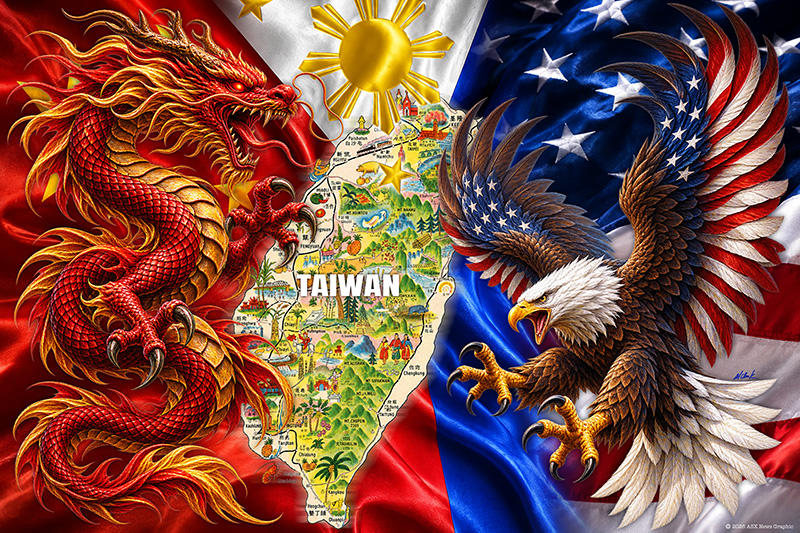
The Chinese dragon and the American eagle are circling one another across the Western Pacific. Between them lies Taiwan. Immediately to the south stands a nation whose geographical circumstances, international defense relationships and independent national sovereignty could place its population at the forefront of a confrontation between two nuclear-armed superpowers.
The Philippines is not watching these developments from the other side of the world. It is living within them.
How World Wars Actually Begin
On June 28, 1914, Archduke Franz Ferdinand of Austria and his wife were assassinated in Sarajevo. Within weeks, Europe was engulfed in a conflict that would fundamentally transform the international political order and eventually become known as the First World War.
It would be historically inadequate, however, to attribute the entirety of that catastrophe to the assassination itself. Europe had already developed an extraordinarily complex environment of military alliances, imperial competition, territorial disputes, nationalism, industrialized military capabilities and deteriorating international trust.
The assassination supplied the immediate catalyst. The conditions that enabled the catastrophe had been developing for decades.
The Second World War similarly emerged from circumstances that extended considerably beyond Germany’s invasion of Poland in September 1939. The Treaty of Versailles, economic depression, authoritarian expansionism, Japanese imperial ambitions, the deterioration of international institutions and the failure of collective security arrangements contributed to the emergence of multiple military confrontations.
For much of Asia, the war had already begun before the conventional European starting date. Japan occupied Manchuria in 1931, and full-scale warfare between China and Japan erupted in 1937. Separate conflicts eventually became components of a much larger international catastrophe.
History has demonstrated that world wars do not necessarily begin as world wars. They can emerge through the convergence of regional confrontations, military commitments, strategic miscalculations and political decisions whose cumulative consequences exceed the original intentions of their participants.
This does not establish that the twenty-first century must reproduce the first half of the twentieth. Nuclear deterrence, international institutions and economic interdependence have fundamentally altered the international environment. Nevertheless, the historical mechanisms through which regional crises become global remain relevant.
The question is whether humanity has learned enough from those catastrophes to recognize the conditions that preceded them.
The End of the Post-Cold War Illusion
The dissolution of the Soviet Union in 1991 produced an extraordinary transformation in international politics. The United States emerged with substantial economic, technological and military advantages, while many governments anticipated that expanding international commerce and political cooperation would reduce the likelihood of direct confrontation among major powers.
Globalization accelerated. Manufacturing became increasingly interconnected. International transportation networks expanded. Digital communications transformed commerce, scientific collaboration and access to information.
At the same time, the foundations of a different international order were developing.
China experienced an extraordinary economic and industrial transformation. Russia struggled through the political and economic consequences of the Soviet collapse before reasserting its military and geopolitical influence. Regional powers pursued greater strategic independence, and technological development provided governments with increasingly sophisticated instruments of military and economic competition.
The international environment of 2026 is no longer adequately described by the assumptions that characterized much of the 1990s.
Economic integration has not eliminated strategic rivalry. In many instances, it has provided governments with additional mechanisms through which that rivalry can be conducted.
The semiconductor, petroleum, rare-earth mineral, telecommunications and artificial intelligence industries have become components of national security policy. International supply chains, once primarily evaluated according to efficiency and profitability, are increasingly examined through their strategic vulnerabilities.
The twenty-first century has not abolished great-power competition. It has provided that competition with an entirely new technological and economic infrastructure.
Europe: The War That Shattered a Continent’s Security Assumptions
Russia’s full-scale invasion of Ukraine on February 24, 2022, fundamentally altered European national security policy.
The conflict followed Russia’s annexation of Crimea in 2014 and years of warfare in eastern Ukraine. Its expansion in 2022 demonstrated that large-scale conventional warfare remained possible on a continent that had invested decades in developing political and economic institutions intended to reduce the likelihood of such devastation.
The consequences extended beyond Ukrainian and Russian territory. European governments reconsidered their military capabilities, energy relationships, industrial preparedness and longstanding assumptions concerning national defense.
Finland joined NATO in April 2023, followed by Sweden in March 2024. Their accession substantially altered the alliance’s geographical relationship with Russia and reflected a fundamental reassessment of national security policy in both countries.
Russia has repeatedly characterized NATO enlargement and Western military assistance to Ukraine as threats to its national security. NATO governments, in contrast, describe their collective defense arrangements as responses to Russian aggression and instruments intended to protect the sovereignty of their members.
These opposing interpretations have contributed to a security environment characterized by deep mistrust and extensive military preparation.
The most consequential danger is the possibility that the war could expand beyond its existing participants. An armed confrontation between Russia and a NATO member would create circumstances requiring consideration of the alliance’s collective defense commitments.
Article 5 of the North Atlantic Treaty does not prescribe an identical military response from every member. It does, however, establish the principle that an armed attack against one member within the treaty’s geographic scope is considered an attack against them all, with each country undertaking the action it deems necessary.
The distinction between a regional European war and an international conflict involving nuclear-armed powers could consequently depend upon political decisions made during a rapidly evolving crisis.
Europe has become a demonstration of how quickly geopolitical assumptions can collapse when deterrence, diplomacy and international expectations fail to prevent military aggression.
The Middle East: The Internationalization of Regional Warfare
The Middle East represents another environment in which regional confrontations possess the capacity to produce consequences extending far beyond national boundaries.
The longstanding confrontation between Israel and Iran encompasses national security disputes, nuclear concerns, ideological divisions, regional military partnerships and competing assessments of political legitimacy.
For decades, elements of that confrontation were conducted indirectly through intelligence activities, cyber operations, economic restrictions and armed organizations operating throughout the region. More recent direct military confrontations have demonstrated that the distinction between indirect competition and open hostilities cannot be assumed to remain permanent.
Israel regards Iran’s nuclear activities and support for armed organizations hostile to Israel as fundamental security concerns. Iran characterizes Israeli military activities and American regional involvement as threats to its own sovereignty and security.
Beyond these competing national perspectives lies the vulnerability of the region’s civilian populations, including Palestinians, Israelis, Iranians, Lebanese, Yemenis and others whose lives have been profoundly affected by violence, displacement and economic disruption.
The strategic significance of the Middle East is amplified by its role in international energy production and maritime transportation.
The Strait of Hormuz connects some of the world’s most important petroleum-producing regions with international markets. The Red Sea and Suez Canal serve as major components of maritime commerce between Asia and Europe.
Disruption within these regions can increase transportation costs, affect the availability of petroleum products and alter economic conditions in countries thousands of miles from the original confrontation.
For the Philippines, which depends considerably upon imported energy and international employment, the consequences of Middle Eastern instability can become an immediate domestic concern.
A major regional military conflict could also impose substantial demands upon American military and diplomatic resources at a time when Washington faces significant security challenges in Europe and the Western Pacific.
The danger is not merely the existence of another war. It is the possibility that simultaneous international crises could place unprecedented pressure upon the institutions responsible for preventing their expansion.
The Korean Peninsula: A War That Never Formally Ended
The Korean War ended in an armistice in 1953 rather than a comprehensive peace treaty. More than seven decades later, the Korean Peninsula remains one of the world’s most militarized and politically divided regions.
North Korea’s development of nuclear weapons and increasingly sophisticated missile capabilities has fundamentally altered the strategic circumstances confronting South Korea, Japan and the United States.
Equally consequential is North Korea’s developing military relationship with Russia. The two countries signed a comprehensive strategic partnership agreement in June 2024 containing provisions for mutual assistance under specified circumstances.
North Korean military support for Russia subsequently demonstrated that the security environments of Europe and Northeast Asia were no longer geographically independent.
On November 26, 2026, Reuters reported Ukrainian military intelligence claims that Pyongyang had temporarily suspended certain military shipments to Russia following diplomatic disagreements. Reuters could not independently verify those claims. Even the reported disagreement, however, illustrates the complexity of relationships that are frequently portrayed as permanent and unconditional strategic alignments.
These partnerships contain their own political differences, competing national interests and vulnerabilities. They should not be interpreted as evidence that Moscow and Pyongyang would necessarily undertake coordinated military action in every international contingency.
Nevertheless, the existence of substantial military cooperation between the two governments creates a direct institutional connection between the security environments of Eastern Europe and Northeast Asia.
A major Korean Peninsula emergency occurring simultaneously with European or Western Pacific hostilities could impose extraordinary demands upon American and allied military resources.
The Korean Peninsula is therefore not merely another unresolved regional confrontation. It is a potential component of a substantially interconnected international security crisis.
China: The Emergence of a Military Superpower
China’s transformation represents one of the most consequential geopolitical developments of the modern era.
Its extraordinary industrial development, manufacturing capacity, technological advancement and international commercial relationships have provided the People’s Republic of China with resources that previous generations of Chinese political leadership could scarcely have imagined.
These achievements have also supported an extensive modernization of the People’s Liberation Army.
Chinese military development encompasses naval capabilities, aerospace systems, intelligence infrastructure, precision weapons, nuclear forces, electronic warfare, uncrewed systems and artificial intelligence.
The significance of this transformation extends considerably beyond the acquisition of additional military equipment. China is developing the institutional and technological capacity to challenge military assumptions upon which American regional strategy has depended for decades.
The United States-China Economic and Security Review Commission’s November 18, 2026, annual report documented continued Chinese military modernization and increased regional pressure despite significant changes within the PLA’s senior leadership.
The same report identified China’s efforts to manage its relationship with Washington and limit the danger of direct confrontation while continuing to pursue its strategic objectives.
These simultaneous developments are important. China possesses the ability to increase its military preparedness while maintaining diplomatic engagement. The two activities are not inherently contradictory.
Military preparedness creates options for national leadership. Diplomacy determines, in part, whether and under what circumstances those options might be exercised.
The central issue confronting the Western Pacific is whether the development of competing military capabilities will successfully deter warfare or eventually produce circumstances in which one or more governments determine that military action offers an acceptable alternative to continued political competition.
Taiwan: The Unresolved War at the Center of the Pacific
The contemporary dispute concerning Taiwan originated in the Chinese Civil War. Following the Communist victory on the mainland in 1949, the government of the Republic of China relocated to Taiwan while Mao Zedong established the People’s Republic of China in Beijing.
For more than three-quarters of a century, the resulting political division has remained unresolved.
Taiwan subsequently developed a multiparty democratic political system, independent administrative institutions, its own military organization and a globally consequential technological economy.
The People’s Republic of China, which has never governed Taiwan, maintains that the island is part of China and that unification constitutes a fundamental national objective.
Beijing’s 2005 Anti-Secession Law established circumstances under which non-peaceful measures could be employed. Although Chinese authorities continue to identify peaceful unification as their preferred outcome, they have refused to renounce the use of military force.
For Taiwan’s approximately 23 million inhabitants, these circumstances represent a continuing question concerning political autonomy, national identity and personal security.
For the United States, Taiwan possesses extraordinary strategic significance because of its geographical position, economic importance and relationship with the wider Western Pacific security architecture.
For the Philippines, Taiwan represents something more immediate: a neighboring society whose proximity creates potentially unavoidable consequences for Philippine national security.
A military confrontation over Taiwan would occur within a geographical environment already occupied by nations possessing interconnected defense agreements, substantial economic relationships and unresolved territorial disputes.
The resulting emergency might not remain confined to the Taiwan Strait.
2027: The Most Misunderstood Date in International Security
The year 2027 has become one of the most widely discussed benchmarks in contemporary geopolitical analysis.
It marks the centenary of the establishment of the People’s Liberation Army and is associated with Chinese military modernization objectives relevant to a potential Taiwan contingency.
This benchmark has frequently been interpreted as a deadline for a Chinese invasion of Taiwan. Such an interpretation confuses the development of military capability with the political decision to employ it.
A military organization may be instructed to develop the capacity necessary to undertake a particular operation without its political leadership having established a date on which that operation will occur.
The November 2026 United States-China Economic and Security Review Commission report identifies the approaching two years as particularly consequential for cross-strait relations. Taiwan’s electoral cycles and China’s advancing military capabilities could affect Beijing’s future assessment of its options.
That assessment does not establish that warfare will begin in 2027 or 2028.
The underlying concern is considerably more complex. A government that concludes its political objectives cannot be achieved peacefully, while simultaneously becoming more confident in its military capabilities, may reassess the relative costs and benefits of alternative strategies.
Economic performance, political stability, military readiness, international diplomatic relationships and the ability of potential adversaries to respond could all influence such calculations.
Humanity possesses no reliable calendar identifying the commencement of World War III. The convergence of multiple strategic timelines nevertheless deserves considerable attention.
The Philippines: Geography’s Unforgiving Reality
The Philippine archipelago occupies one of the most strategically consequential positions on Earth.
Immediately south of Taiwan, between the South China Sea and the Philippine Sea, the Philippines forms an important component of the geographical formation commonly described as the First Island Chain.
Extending through Japan, the Ryukyu Islands, Taiwan and the Philippines, this chain occupies a geographical position separating much of continental East Asia from the wider Pacific Ocean.
Its significance encompasses military mobility, international maritime transportation, territorial defense, commercial access and the strategic relationship between Asian nations and the United States.
The northernmost Philippine islands lie within close geographical proximity to Taiwan. In the event of major regional hostilities, the consequences could reach the Philippine security environment almost immediately.
The United States possesses the geographical advantage of separation from the Western Pacific by an enormous ocean. The Philippines possesses no comparable geographical separation from Taiwan or the South China Sea.
Its population, military facilities, maritime transportation networks, commercial aviation infrastructure and essential civilian services occupy the very region in which a confrontation could unfold.
Philippine neutrality, if pursued under particular circumstances, would constitute a political policy. It would not change the country’s geography.
That distinction must remain at the center of any credible assessment of Philippine national security.
The West Philippine Sea: A Potential Catalyst in Its Own Right
It would be a fundamental analytical error to assume that a military confrontation between China and the United States must begin with Taiwan.
The Philippines and China are already involved in an enduring dispute concerning territorial claims, maritime rights and access to resources within the South China Sea.
In 2013, the Philippines initiated arbitration proceedings under the United Nations Convention on the Law of the Sea. On July 12, 2016, an international arbitral tribunal rejected the legal foundation for China’s claims to historic rights extending beyond the maritime entitlements established by the convention.
The tribunal did not determine sovereignty over disputed land features. Its findings nevertheless established legally significant conclusions concerning maritime rights and Chinese claims.
China rejected the proceedings and their outcome. The Philippines has continued to assert its maritime entitlements under international law.
The confrontation is experienced by Filipino fishermen, Coast Guard personnel and military organizations operating in areas of continuing dispute.
Throughout 2026, reports of confrontations involving Philippine and Chinese government vessels have illustrated the potential for such encounters to produce circumstances of considerably greater international significance.
Research published by the German Marshall Fund in October 2026 examined increasing Chinese pressure at several points throughout the First Island Chain, including contested maritime areas involving the Philippines.
These developments create a potential pathway toward a major confrontation independent of any Chinese decision concerning Taiwan.
A serious armed incident involving Philippine personnel or qualifying public vessels could require the United States and the Philippines to consider their obligations under the 1951 Mutual Defense Treaty.
The event that initiates a wider Western Pacific military emergency might therefore occur not in the Taiwan Strait, but in the West Philippine Sea.
America’s Military Transformation
The United States has spent considerable resources adapting its military organizations to the technological and geographical realities of contemporary great-power competition.
Traditional distinctions between land, maritime, aerospace, space and information operations have become increasingly difficult to maintain as military organizations depend upon interconnected intelligence, surveillance, communications and technological systems.
The United States Army’s development of Multi-Domain Task Forces reflects this institutional transformation.
These organizations are intended to coordinate military capabilities and information across multiple operational environments rather than operate exclusively within conventional ground warfare structures.
Their development reflects a broader recognition that future military effectiveness will depend upon the resilience and integration of complex organizational systems.
The significance for the Philippines arises from the intersection of American military modernization with the country’s geographical importance and defense relationship with Washington.
American preparations for possible Western Pacific contingencies do not establish that the Philippines has authorized its territory to be used for offensive military operations against China.
Nevertheless, as American military organizations become increasingly adapted to regional challenges, the strategic implications of Philippine-American defense cooperation warrant examination beyond the immediate purposes of individual military exercises.
The Philippines is becoming an increasingly important participant in an international security environment undergoing extraordinary technological and organizational change.
EDCA: Nine Locations and the Sovereignty of a Nation
The United States and the Philippines signed their Mutual Defense Treaty in 1951, establishing the foundation of a defense relationship that has endured through numerous political and military transformations.
For decades, American facilities at Clark and Subic Bay occupied important positions within regional American military operations. The termination of those permanent basing arrangements in the early 1990s represented a consequential assertion of Philippine political independence.
The Visiting Forces Agreement subsequently established a legal framework governing visiting American military personnel. The Enhanced Defense Cooperation Agreement of 2014 provided for additional forms of military cooperation and authorized American access to agreed Philippine facilities.
Four additional locations were announced in 2023, increasing the total number of EDCA sites to nine.
These facilities remain Philippine territory. The agreement does not constitute a transfer of national sovereignty or unrestricted American authority to undertake military operations from the Philippines.
Nevertheless, their existence increases the strategic significance of Philippine geography within the broader environment of Western Pacific military cooperation.
The distinction between defensive cooperation, logistical support and offensive military participation could assume extraordinary importance during a Taiwan emergency.
Events could also generate rapidly changing legal and political circumstances. Philippine policies concerning foreign military operations might be evaluated differently following direct aggression against Philippine territory or forces.
The essential question is not simply whether military infrastructure exists. It is who possesses the authority to determine how that infrastructure may be employed.
That authority must remain consistent with Philippine sovereignty, constitutional requirements and the protection of the Filipino people.
The Philippines Could Become the Battlefield Before Becoming a Combatant
One of the most consequential possibilities confronting Philippine national security is that the country could experience major consequences from an international war before making any independent decision to participate in offensive military operations.
Modern international conflict extends beyond conventional exchanges of weapons fire. It encompasses economic pressure, cyber disruption, commercial transportation interruptions, financial instability, intelligence operations and interference with essential infrastructure.
The existence of defense agreements could influence how other governments perceive Philippine activities even when Manila considers those activities entirely defensive or humanitarian.
Furthermore, an emergency involving Taiwan could create overlapping responsibilities involving the defense of Philippine territory, the evacuation of Filipino citizens, the protection of maritime transportation and the maintenance of essential services.
These responsibilities could become exceptionally difficult to fulfill during simultaneous regional military operations.
The Philippines could consequently become a military, economic, technological and humanitarian front line without having independently chosen to become a participant in the original confrontation.
Under circumstances involving direct aggression or authorized collective military action, its role could expand considerably further.
The archipelago’s proximity to Taiwan, its maritime disputes with China and its alliance with the United States create a combination of strategic circumstances unmatched by most other Southeast Asian nations.
This is the geographical reality at the heart of the accompanying ASX News editorial artwork.
The American Eagle and Its Expanding Security Responsibilities
The United States maintains an extensive network of international military relationships encompassing Europe, the Middle East and the Indo-Pacific.
NATO connects American national security with that of European allies. Separate treaties establish security commitments involving Japan, South Korea, Australia and the Philippines.
The Taiwan Relations Act provides a distinct legal framework for American relations with Taiwan, including the provision of defensive capabilities, without establishing an automatic obligation to intervene militarily in every contingency.
These commitments are not identical. Their legal provisions, geographical scope and political implications differ considerably.
Nevertheless, they establish institutional connections among regions that could otherwise appear strategically independent.
A simultaneous emergency in Europe, the Middle East and the Western Pacific would place extraordinary demands upon American military resources, diplomatic institutions, industrial capacity and national political leadership.
Military capabilities cannot necessarily be expanded at the same rate at which international emergencies develop. Industrial production, personnel training, maintenance, transportation and logistical sustainability depend upon resources and institutional processes that require considerable time.
One of the central questions of contemporary international security is whether America’s existing military commitments and industrial capabilities can accommodate several major confrontations occurring simultaneously.
The answer could influence the security calculations of adversaries and allies alike.
The Emerging Architecture of Strategic Competition
International relationships are increasingly influenced by competing military, economic and political interests.
China and Russia have expanded their strategic relationship. Russia has developed substantial military cooperation with North Korea and cultivated relationships with Iran. Western governments have strengthened military coordination through NATO and various Indo-Pacific security arrangements.
These developments have frequently been characterized as the emergence of rival international blocs.
Such a description can be useful provided that it does not obscure important distinctions.
China and Russia are not members of an equivalent to NATO operating under identical collective defense commitments. The economic grouping known as BRICS is not a military alliance. The participating governments possess different economic interests, political objectives and assessments of international security.
Similarly, America’s allies retain their own national sovereignty and do not necessarily support identical policies in every international contingency.
Nevertheless, the existence of increasingly consequential connections among these governments creates the possibility that developments in one region could influence strategic decisions elsewhere.
The November 2026 United States-China Economic and Security Review Commission report examined Beijing’s material and economic support for Russia and Iran while noting China’s efforts to avoid direct participation in their respective confrontations.
This relationship illustrates an important feature of contemporary geopolitical competition: governments can support the strategic capabilities of other nations without independently entering their wars.
The distinction could become increasingly difficult to preserve if several regional conflicts escalate simultaneously.
The Strategic Opportunity Created by Simultaneous Wars
A government contemplating military or coercive action does not evaluate its circumstances in isolation from the rest of the international environment.
Its leadership may consider the political commitments, military resources, domestic stability and competing responsibilities of potential adversaries.
A major military emergency in one geographical region could consequently influence another government’s assessment of the strategic conditions elsewhere.
American involvement in Europe or the Middle East could increase demands upon resources also relevant to the Indo-Pacific. Conversely, an extraordinary Western Pacific emergency could influence European and Middle Eastern expectations concerning American assistance.
This does not establish the existence of a coordinated international plan to initiate simultaneous warfare.
Such coordination might not even be necessary for the dangers to materialize. Independent governments pursuing their own national objectives could make decisions that interact in unforeseen and potentially catastrophic ways.
The international security system could become overwhelmed through the cumulative consequences of individually rational political decisions.
This is one of the most important distinctions between evaluating the probability of a single regional war and assessing the possibility of a global military confrontation.
The whole may become substantially more dangerous than the sum of its individual components.
The War Before the War
The conventional understanding of warfare begins when military forces undertake hostile operations against one another. Contemporary strategic competition increasingly challenges the adequacy of that definition.
Governments already employ economic restrictions, technological controls, intelligence activities, information operations and coercive diplomatic pressure as instruments of national policy.
Critical technologies have become components of strategic relationships. Access to advanced semiconductors, specialized industrial equipment, artificial intelligence infrastructure and essential minerals increasingly influences international political decisions.
Maritime confrontations can impose strategic costs without developing into conventional naval warfare. Cyber operations can threaten essential services without producing the visible physical destruction associated with traditional military operations.
Information manipulation can undermine institutional confidence, influence public perceptions and complicate government decision-making.
These activities should not all be legally characterized as warfare. Economic competition, diplomacy and even severe political disputes remain distinct from armed conflict.
Their cumulative significance, however, is that they provide governments with mechanisms through which strategic confrontation can intensify without the immediate political consequences of conventional warfare.
Modern conflict may therefore develop along a continuum in which the boundaries separating competition, coercion and military engagement become increasingly difficult to identify.
The Nuclear Dimension: Humanity’s Unacceptable Margin for Error
The most fundamental distinction between the geopolitical environment preceding the Second World War and the contemporary international environment is the existence of nuclear weapons.
The United States, Russia, China, France, the United Kingdom, India, Pakistan, North Korea and Israel are generally identified as nuclear-armed states, although Israel maintains a policy of nuclear ambiguity.
Several of these nations participate directly in the unresolved security confrontations shaping contemporary international politics.
Nuclear deterrence has provided powerful incentives for governments to avoid direct military confrontation with one another. The potential consequences of escalation have influenced international strategic decision-making for more than eight decades.
Yet deterrence is fundamentally dependent upon human beings and institutions correctly interpreting the activities, intentions and capabilities of their adversaries.
It requires reliable communications, disciplined political judgment and the ability to distinguish genuine threats from incomplete or misleading information.
A prolonged international military confrontation could undermine precisely those conditions.
As communications deteriorate and governments become increasingly concerned about their national security, the interpretation of otherwise ambiguous events could become substantially more consequential.
A third world war would not necessarily begin with nuclear weapons. It might remain conventional throughout its duration. Nevertheless, the possibility that conventional hostilities could escalate into nuclear confrontation fundamentally changes the consequences of failing to prevent a wider war.
Humanity has never possessed a smaller acceptable margin for strategic error.
Artificial Intelligence and the Acceleration of Human Error
Artificial intelligence is increasingly influencing military intelligence, surveillance, information analysis, logistics, uncrewed systems and institutional decision-making.
These capabilities offer considerable potential advantages, including the ability to process substantial quantities of information and identify relationships that might otherwise escape human attention.
They also introduce significant technical and organizational vulnerabilities.
An automated system may incorrectly interpret incomplete information. A sophisticated analytical model may produce conclusions that appear authoritative despite being based upon inaccurate assumptions. Human operators may place excessive confidence in automated recommendations, particularly when operating under conditions of severe time pressure.
These circumstances are especially concerning when the decisions being supported involve international military escalation.
The increasing speed of information processing could reduce the time available for human judgment without necessarily increasing the reliability of the information being evaluated.
Artificial intelligence does not possess a guarantee of factual correctness, strategic wisdom or an inherent appreciation of the consequences of military action.
The responsibility for consequential military decisions must remain with accountable human leadership operating within robust institutional safeguards.
From a safety science perspective, the challenge is not simply preventing technological failure. It is preventing the interaction of technological limitations, institutional pressures and human decision-making from producing catastrophic systemic consequences.
The greatest threat associated with military artificial intelligence may not be a machine independently deciding to initiate a war. It may be human beings making extraordinarily consequential decisions with excessive confidence in machines that have misunderstood the circumstances before them.
Cyberspace: The Battlefield That Has No Borders
Contemporary civilization depends upon an extraordinary network of interconnected digital infrastructure.
Electricity distribution, telecommunications, banking, commercial aviation, healthcare, maritime transportation, government administration and international commerce depend extensively upon information systems.
The failure of one essential technological service can generate secondary consequences throughout other sectors.
A major electricity disruption can affect telecommunications, water distribution and commercial services. Interruptions to financial infrastructure can compromise the ability of households and businesses to obtain essential goods. Failures within communications systems can hinder emergency response and the coordination of public institutions.
Cyber operations possess the potential to produce significant strategic effects far beyond the geographical boundaries of conventional military operations.
The November 2026 congressional commission report concerning China identified cyber activities targeting American critical infrastructure as a continuing national security concern.
Other governments possess substantial offensive and defensive cyber capabilities of their own.
A future global military confrontation could consequently affect civilian populations before they experience visible evidence of conventional warfare.
For the Philippines, national cybersecurity must encompass considerably more than the protection of government information. It must address the resilience of the interconnected civilian systems upon which the health, safety and economic security of the population depend.
A society whose essential infrastructure has become digitally interconnected must recognize that its national security has become digitally interconnected as well.
Outer Space: Civilization’s Invisible Infrastructure
Satellite systems have become essential components of contemporary civilian and military infrastructure.
International navigation, weather forecasting, communications, financial synchronization, scientific observation and emergency management rely upon capabilities operating beyond Earth’s atmosphere.
Commercial aviation and maritime transportation benefit extensively from satellite-supported navigation and communications. Philippine disaster management institutions also depend upon accurate meteorological observation and communications infrastructure.
Military organizations increasingly rely upon space-based systems for intelligence, navigation, communications and strategic awareness.
The resulting overlap between civilian and military technological dependencies creates significant systemic vulnerabilities.
Disruption to essential satellite services during an international confrontation could affect activities having little direct relationship with military operations.
The consequences could include transportation complications, communications interruptions and reduced situational awareness among organizations responsible for protecting civilian populations.
As international military competition extends into space, governments must recognize that the security of orbital infrastructure has become inseparable from the security of modern civilization.
World War III could involve operational environments that did not exist during either of the previous world wars, while simultaneously affecting billions of people who have never considered themselves dependent upon those environments.
Taiwan’s Semiconductors: The Technological Heart of a Global Crisis
Taiwan occupies an extraordinary position within the international semiconductor industry, particularly in the production of advanced integrated circuits.
These components are fundamental to artificial intelligence, telecommunications, medical equipment, commercial transportation, industrial production, computing and advanced military capabilities.
The interruption of Taiwanese semiconductor production would consequently affect industries throughout the world.
Although substantial investments are being undertaken to diversify semiconductor manufacturing geographically, the development of advanced production capacity requires specialized equipment, highly qualified personnel, considerable financial resources and extensive institutional experience.
Existing production capabilities cannot necessarily be replaced within the timeframes demanded by industrial consumers.
A major Taiwan emergency could therefore produce a technological supply-chain crisis before the full military consequences of the confrontation become apparent.
The Philippines participates in international electronics and semiconductor supply chains. Philippine manufacturing enterprises, industrial employment and export revenues could all experience substantial disruption.
The consequences would extend beyond consumer electronics. The availability and maintenance of equipment used in hospitals, transportation organizations and essential industrial systems could also be affected.
Taiwan’s geopolitical significance is therefore inseparable from the technological infrastructure supporting modern civilization.
The Economic Mutually Assured Destruction of Globalization
During the Cold War, mutually assured destruction generally described the catastrophic consequences of nuclear exchanges between major military powers.
The contemporary international environment has created another form of mutual vulnerability through extensive economic interdependence.
China possesses an extraordinarily important role in international manufacturing. The United States remains a major center of global finance, technological development and consumer demand. Europe participates in advanced industrial production, international finance and extensive commercial networks. Russia and the Middle East occupy consequential positions within international energy and commodity markets.
These relationships encompass countries whose geopolitical interests are increasingly in competition with one another.
Modern economies depend upon the continued availability of industrial components, petroleum products, transportation infrastructure, essential minerals, agricultural commodities and international financial services.
A major military confrontation could disrupt these relationships through sanctions, transportation restrictions, physical destruction, commercial uncertainty and substantial changes in investment behavior.
The resulting economic emergency would not be confined to nations directly participating in warfare.
Countries could experience substantial inflation, unemployment, shortages of essential products and declining industrial output without having become military participants.
For the Philippines, the consequences could appear through increasing food prices, higher electricity costs, disrupted transportation, reduced employment opportunities and interruptions to overseas income.
The economic consequences of World War III could reach ordinary households long before many governments formally acknowledge the global character of the confrontation.
The Philippine Energy and Food Security Emergency
The Philippine archipelago depends upon interconnected maritime, aviation and terrestrial transportation networks to sustain its population and economic activities.
Petroleum products, industrial materials, agricultural commodities, pharmaceuticals and other essential supplies move through these networks continuously.
International military confrontations could substantially disrupt commercial transportation through increasing insurance costs, changes in maritime access, operational restrictions and uncertainty regarding the safety of international shipments.
Petroleum availability possesses particular significance because fuel supports domestic transportation, agriculture, industrial activity and elements of electricity generation.
Disruption to energy supplies could generate cascading economic consequences throughout the Philippine archipelago.
Food transportation could become more expensive. Agricultural production could encounter difficulties obtaining essential materials. Commercial organizations could face increasing operational costs, while households could experience declining purchasing power.
Island communities dependent upon regular maritime deliveries might experience additional vulnerabilities.
The simultaneous occurrence of regional military confrontations could make alternative sources of essential supplies more expensive or less readily available.
National defense must therefore incorporate comprehensive examination of food security, energy availability, domestic transportation and the continuity of essential commercial relationships.
A nation cannot fully protect its independence if the essential requirements of its civilian population become inaccessible during an international emergency.
The Aviation Dimension of World War III
Civil aviation depends upon the extraordinary cooperation of national governments, aviation authorities, aircraft operators, airport organizations, telecommunications providers and international safety institutions.
Safe transportation requires predictable access to airspace, accurate aeronautical information, dependable navigation services, functioning airports and reliable communications.
Large-scale military confrontation could undermine several of these conditions simultaneously.
International airspace restrictions could require substantial changes in commercial aircraft routing. Disruptions to navigation and communications could introduce additional operational risks. The interruption of airport services could compromise the availability of essential transportation.
The Philippines’ insular geography amplifies the national importance of civil aviation.
In addition to commercial passenger transportation, aviation supports emergency medical services, humanitarian assistance, government operations, disaster response and the movement of essential cargo.
During an international emergency, maintaining safe civilian aviation operations could become considerably more difficult precisely when those operations become increasingly necessary.
Aircraft operators, airport organizations, military institutions and Philippine aviation authorities would consequently face extraordinary responsibilities extending beyond conventional transportation management.
Effective preparedness would require robust civil-military coordination, reliable aeronautical information, institutional continuity, resilient communications and appropriate contingency planning.
Aviation safety must occupy a central rather than peripheral position within Philippine national security planning.
The Filipino Diaspora: Millions of Lives Beyond the Archipelago
Few nations possess a more geographically dispersed international workforce than the Philippines.
Filipino citizens live and work throughout the Middle East, East Asia, Europe, North America and numerous other regions. Their employment supports both the economies of their host countries and households throughout the Philippine archipelago.
The simultaneous escalation of international confrontations could place Filipino nationals in multiple geographical regions at risk.
Workers in Taiwan could experience disrupted transportation, restrictions on essential services or direct threats arising from regional warfare. Filipino communities in the Middle East could confront different but equally consequential circumstances associated with regional instability.
The Philippine government could face overlapping responsibilities involving consular assistance, emergency accommodation, medical care, international transportation and the reintegration of displaced workers.
Such operations could become extraordinarily complex if commercial transportation systems were simultaneously experiencing military restrictions, fuel shortages and financial disruption.
The economic consequences of interrupted overseas employment could also extend throughout the Philippine economy through the reduction of household remittances.
For millions of Filipino families, the consequences of a global military confrontation would not be measured through strategic advantages or territorial developments.
They would be measured through the ability to contact their loved ones, the uncertainty of their safety and the possibility of bringing them home.
ASEAN: Collective Sovereignty Without Collective Military Defense
The Association of Southeast Asian Nations encompasses countries possessing different political institutions, military capabilities, economic structures and international relationships.
Vietnam, Malaysia, Brunei and the Philippines possess direct interests in maritime disputes within the South China Sea. Indonesia and Singapore also have substantial interests in regional maritime security and commercial transportation.
Other ASEAN members confront their own economic, political and national security circumstances.
These governments maintain varying relationships with China, the United States and other major international powers.
ASEAN does not constitute a NATO-style collective military defense organization. Membership does not automatically require a government to participate in military operations undertaken by another member.
Nevertheless, the organization’s fundamental relevance to an emerging global crisis involves the preservation of Southeast Asian sovereignty.
Collective sovereignty, in this context, represents the ability of individual Southeast Asian nations to maintain political independence and determine their national futures without external domination.
A major confrontation between China and the United States could create extraordinary pressure upon these governments to adopt positions consistent with the strategic objectives of one power or the other.
The preservation of independent political decision-making may consequently become one of Southeast Asia’s most important collective challenges.
The region’s future should not be determined exclusively by governments located beyond it.
Could the Philippines Really Remain Neutral?
The concept of neutrality possesses immediate political appeal because it appears to provide an alternative to participation in international warfare.
For the Philippines, however, neutrality would involve a substantially more complex collection of practical, legal and geographical circumstances.
A policy rejecting offensive military participation could preserve diplomatic options and reduce certain forms of strategic exposure.
It would not automatically eliminate the consequences of Philippine geographical proximity to Taiwan, existing maritime disputes with China, international economic dependencies or humanitarian responsibilities involving Filipino nationals overseas.
Similarly, the expansion of military cooperation with international partners may strengthen deterrence and territorial defense while creating additional strategic considerations during a regional emergency.
International relations scholars have long identified two potentially competing risks associated with military alliances: entrapment and abandonment.
Entrapment describes the possibility that a country may become involved in a confrontation it did not independently intend to initiate. Abandonment describes the possibility that an ally may fail to provide assistance when that support becomes critically necessary.
Both considerations have relevance to Philippine national security.
The Philippines must preserve its capacity to make independent political decisions without assuming that either unconditional military alignment or declared neutrality can guarantee protection from every conceivable consequence of international warfare.
Its sovereignty must remain the foundation of its security policy rather than a commodity exchanged for the strategic objectives of another government.
The Responsibility of the United States
The geographical significance of the Philippines provides the United States with an important relationship within the Western Pacific security environment.
American military cooperation can provide the Philippines with substantial benefits through institutional development, defense assistance, training, technological resources and international deterrence.
Nevertheless, the geographical risks associated with a major Western Pacific confrontation are not distributed equally between the two nations.
The continental United States is separated from the Philippines and Taiwan by thousands of miles of ocean. Filipino civilians live within the geographical environment where that confrontation could occur.
This disparity must receive serious consideration in the development of American-Philippine defense relationships.
Military interoperability should be accompanied by meaningful attention to civilian healthcare, infrastructure resilience, communications continuity, emergency transportation, economic preparedness and the protection of essential supplies.
The strategic significance of the Philippines cannot legitimately be evaluated exclusively through the advantages its geography provides to American military operations.
An alliance founded upon mutual security should strengthen the ability of both nations to protect their populations.
The lives of Filipino civilians must occupy a position of fundamental importance within any comprehensive assessment of the Philippine-American defense relationship.
The Other Conflicts That the World Must Not Forget
The international security environment encompasses considerably more than confrontations involving the largest military powers.
Sudan, Myanmar and numerous other societies have experienced devastating internal and regional conflicts. Communities throughout Africa confront humanitarian emergencies, political instability and armed violence that receive substantially less international attention than major-power competition.
The people affected by these conflicts are no less significant because their circumstances do not occupy a central position within the strategic calculations of Washington, Beijing or Moscow.
A wider international military emergency could further reduce the resources available for humanitarian assistance, refugee support, economic development and international peacekeeping.
Governments concentrating upon their own strategic security might become less capable of assisting societies already confronting extraordinary humanitarian challenges.
Global warfare would therefore possess consequences extending beyond the military theaters that brought it into existence.
The humanitarian effects of a major international confrontation could be amplified through the deterioration of institutions responsible for assisting some of the world’s most vulnerable populations.
What Would Actually Constitute World War III?
There is no universally accepted numerical threshold defining the transition from multiple regional conflicts to a world war.
The first two world wars acquired their historical identities through their geographical scope, the number and significance of participating nations, their military and economic consequences and the extensive transformation of international society.
A third world war could develop under substantially different technological and political circumstances.
Its military participants might be distributed across several geographical theaters. Its economic consequences could extend across virtually every industrialized society. Its digital effects might reach civilian populations irrespective of whether their governments had formally entered military hostilities.
The defining development would not necessarily be the number of independent conflicts occurring simultaneously.
It would be their strategic integration into a broader international confrontation in which the military and political actions of major powers become directly connected across multiple regions.
Without that connection, the existence of numerous regional wars would not by itself establish that a world war had begun.
This distinction is essential to preserving analytical credibility while examining the potential for an unprecedented global catastrophe.
The Catalyst: Where Does It Begin?
The immediate catalyst of a potential third world war could emerge from any of several unresolved geopolitical confrontations.
A direct armed encounter between Russia and NATO forces could create extraordinary pressure upon European and American political leadership.
A major confrontation involving Israel and Iran could draw additional governments into regional hostilities while disrupting essential international commercial networks.
A military emergency on the Korean Peninsula could involve neighboring powers and American defense commitments.
Chinese military action against Taiwan could generate an international confrontation encompassing the Western Pacific and potentially the wider global economy.
A serious armed incident involving Philippine and Chinese forces could require immediate decisions concerning existing American-Philippine treaty commitments.
The original confrontation could emerge from a deliberate political decision, an unintended incident or the accumulation of actions that initially appeared manageable.
No government would necessarily have to announce its intention to initiate a world war.
A series of governments responding to their own perceived national security requirements could collectively produce circumstances none had originally intended.
The Human Factor: When Safety Science Meets Geopolitics
Complex systems rarely experience catastrophic failures because of a single isolated error.
Major accidents frequently emerge through interactions among technological failures, human limitations, institutional deficiencies, inadequate communication, organizational pressures and circumstances that challenge existing procedural assumptions.
International security systems possess many comparable characteristics.
Military organizations depend upon the accuracy of information, the quality of personnel training, the effectiveness of leadership, the reliability of communications and the ability of individuals to exercise appropriate judgment under pressure.
Political institutions operate within environments influenced by domestic expectations, economic circumstances, historical assumptions and competing interpretations of international developments.
An intelligence failure could produce an inaccurate assessment of another government’s intentions. Organizational expectations could influence the interpretation of ambiguous information. Inadequate communication could prevent political leaders from understanding the significance of another country’s actions.
Technological sophistication does not eliminate these vulnerabilities.
Indeed, increasingly sophisticated and interconnected systems can produce unexpected forms of systemic complexity.
The central concern is not simply whether an individual military or political leader might make an inappropriate decision. It is whether the international system possesses sufficient resilience to prevent an individual error from producing catastrophic consequences.
From a safety science perspective, the prevention of World War III is an exercise in managing interconnected human and organizational risks on a global scale.
The Philippines Must Prepare Beyond Military Modernization
The acquisition of military capabilities is an important component of Philippine national defense. It is not, by itself, a comprehensive national preparedness strategy.
A major Western Pacific confrontation could require the simultaneous mobilization of military, civilian, technological, economic and humanitarian institutions.
Hospitals would require reliable electricity, communications, specialized medical supplies and transportation support. Local governments would need continuity arrangements and access to accurate national information. Essential industries would require contingency plans addressing disruptions to fuel, electricity and imported materials.
Commercial transportation organizations would need to maintain essential services under potentially deteriorating operational conditions.
Communities would require reliable information concerning emergency assistance, public services and the safety of family members.
The Philippines possesses substantial experience addressing natural disasters, including typhoons, earthquakes and volcanic eruptions. Its population has repeatedly demonstrated extraordinary resilience during periods of devastation.
A prolonged international military confrontation would introduce additional complexities. External assistance might become less readily available. International supply chains could remain disrupted for extended periods. Several regions of the world could require humanitarian resources simultaneously.
The country must therefore examine its preparedness for circumstances considerably different from the comparatively localized emergencies around which many traditional disaster response arrangements have developed.
National resilience must become an integral component of national defense.
Can Humanity Still Prevent World War III?
The international environment contains substantial reasons for governments to avoid direct military confrontation.
The economic costs of major warfare would be extraordinary. Military victory would be uncertain. Nuclear escalation could produce catastrophic consequences. Domestic populations could experience extensive disruption irrespective of the original strategic objectives of their governments.
International diplomacy continues to provide mechanisms through which competing interests can be communicated and potentially reconciled.
Even governments engaged in substantial strategic competition maintain relationships through commercial activity, diplomatic exchanges and international institutions.
The existence of military preparations must therefore not be interpreted as conclusive evidence that every participating government intends to initiate warfare.
Deterrence can prevent aggression when governments recognize that military action would produce unacceptable consequences. Diplomatic engagement can reduce misunderstanding and establish mechanisms through which emerging crises might be contained.
Arms control, crisis communications, international law and institutional cooperation remain relevant to the prevention of military escalation.
The challenge is preserving the effectiveness of these mechanisms while political relationships become more adversarial and military capabilities become increasingly sophisticated.
World War III is not scientifically demonstrable as an inevitable future event. The interconnected conditions that could produce it, however, cannot responsibly be ignored.
The Dragon, the Eagle and the Islands Between Them
The accompanying ASX News editorial artwork represents considerably more than a confrontation between two powerful nations.
The Chinese dragon symbolizes an ancient civilization that has emerged as a contemporary economic, technological and military superpower. The American eagle symbolizes a nation whose international military relationships and strategic commitments extend throughout the world.
Between them stands Taiwan, a society whose political future has become one of the most consequential questions confronting contemporary international security.
Behind them shines the Philippine sun.
Its significance is not merely geographical. It represents the independent sovereignty of a nation whose people possess their own identity, aspirations, history and fundamental right to determine their future.
The Philippines must never be reduced to a strategic platform, a logistical convenience or an expendable geographical component of another nation’s military architecture.
Its islands are inhabited by families, communities and generations of people whose lives deserve the same consideration as the populations of the great powers competing across the Western Pacific.
The geographical arrangement portrayed in the artwork captures a potentially consequential reality of the twenty-first century: a confrontation originating between major powers could impose its greatest immediate consequences upon smaller nations positioned between them.
Conclusion: World War III. It’s Not If.
More than a century after the First World War and eight decades after the conclusion of the Second, humanity confronts an international environment possessing extraordinary technological advancement alongside enduring geopolitical instability.
Europe has experienced the return of large-scale conventional warfare. The Middle East remains capable of generating international military and economic emergencies. The Korean Peninsula possesses unresolved political divisions and nuclear capabilities. The Western Pacific has become the geographical intersection of two major military powers and several increasingly consequential regional security relationships.
The world’s technological, industrial and economic systems have become interconnected to a degree unimaginable during either of the previous world wars.
The consequences of international military confrontation have become similarly interconnected.
Global conflict would no longer be defined exclusively by the movement of armies, aircraft and naval formations. Its consequences could extend through cyberspace, orbital infrastructure, industrial supply chains, financial systems, energy markets and the essential technological services supporting modern civilization.
Entire societies could experience the effects of warfare without conventional weapons ever being employed against their territory.
For the Philippines, these global circumstances converge with an extraordinary geographical reality. The country lies adjacent to one of the most consequential potential military theaters of the twenty-first century while maintaining an alliance with the United States and confronting its own unresolved maritime disputes with China.
It could become a principal front line of an international emergency involving Taiwan, the preservation of Southeast Asian sovereignty and the future distribution of geopolitical power throughout the Western Pacific.
Its participation in such an emergency might initially be humanitarian, economic or defensive. Under different circumstances, its involvement could become substantially more extensive.
The future of the Philippines must nevertheless remain in the hands of the Filipino people.
The proposition that humanity is approaching a third world war cannot be established through the repetition of alarming headlines or the arbitrary selection of an invasion date. It must be examined through the convergence of strategic relationships, technological dependencies, military preparations and the unresolved confrontations that increasingly connect the world’s most powerful nations.
The evidence establishes that these interconnected risks are real. It does not establish that governments have lost the ability to prevent their catastrophic convergence.
That distinction may represent humanity’s remaining opportunity.
Perhaps the most dangerous question confronting civilization is whether it will recognize the beginning of a global military confrontation before the opportunity to prevent its expansion has disappeared.
The people who lived through the opening events of the First and Second World Wars did not possess the historical perspective through which those events are understood today.
They witnessed political disputes, territorial confrontations, military mobilizations and regional hostilities. Only later would history recognize the full significance of the circumstances unfolding around them.
We must consider the possibility that future generations could examine the geopolitical developments of the 2020s through a similarly devastating historical perspective.
For the Philippines, the responsibility is clear: prepare for the consequences of a major international confrontation, preserve national sovereignty, strengthen civilian resilience and protect the lives and freedoms of the Filipino people.
For the great powers, the responsibility is considerably greater. Their political and military decisions could determine whether humanity’s extraordinary scientific and technological achievements become instruments of continued civilization or components of its destruction.
The dragon and the eagle are already circling.
The islands between them must never become expendable.
And humanity must never again discover, through the devastation of its own civilization, that it misunderstood the significance of the world unfolding around it.
Sources and Further Reading
United States-China Economic and Security Review Commission. (November 18, 2026). U.S.-China Security and Foreign Affairs: Year in Review.
United States-China Economic and Security Review Commission. (November 2026). 2026 Annual Report to Congress: Executive Summary.
Council on Foreign Relations. (2025). Conflicts to Watch in 2026.
Glaser, B. S. (October 15, 2026). Is China Testing the Limits of a More Permissive Strategic Environment? German Marshall Fund of the United States.
Reuters. (November 26, 2026). Ukraine Says North Korea Temporarily Halted Missile Shipments to Ally Russia.
North Atlantic Treaty Organization. (1949). The North Atlantic Treaty.
United Nations. (1945). Charter of the United Nations.
United Nations. (1982). United Nations Convention on the Law of the Sea.
Republic of the Philippines and United States of America. (1951). Mutual Defense Treaty.
Republic of the Philippines and United States of America. (1998). Visiting Forces Agreement.
Republic of the Philippines and United States of America. (2014). Enhanced Defense Cooperation Agreement.
Republic of the Philippines. (1987). Constitution of the Republic of the Philippines.
Permanent Court of Arbitration. (2016). The South China Sea Arbitration: Republic of the Philippines v. People’s Republic of China. PCA Case No. 2013-19.
United States Congress. (1979). Taiwan Relations Act. Public Law 96-8.
People’s Republic of China. (2005). Anti-Secession Law.
Association of Southeast Asian Nations. (1995). Treaty on the Southeast Asia Nuclear-Weapon-Free Zone.
ASX News — Special International Geopolitical and National Security Investigation. November 28, 2026.