


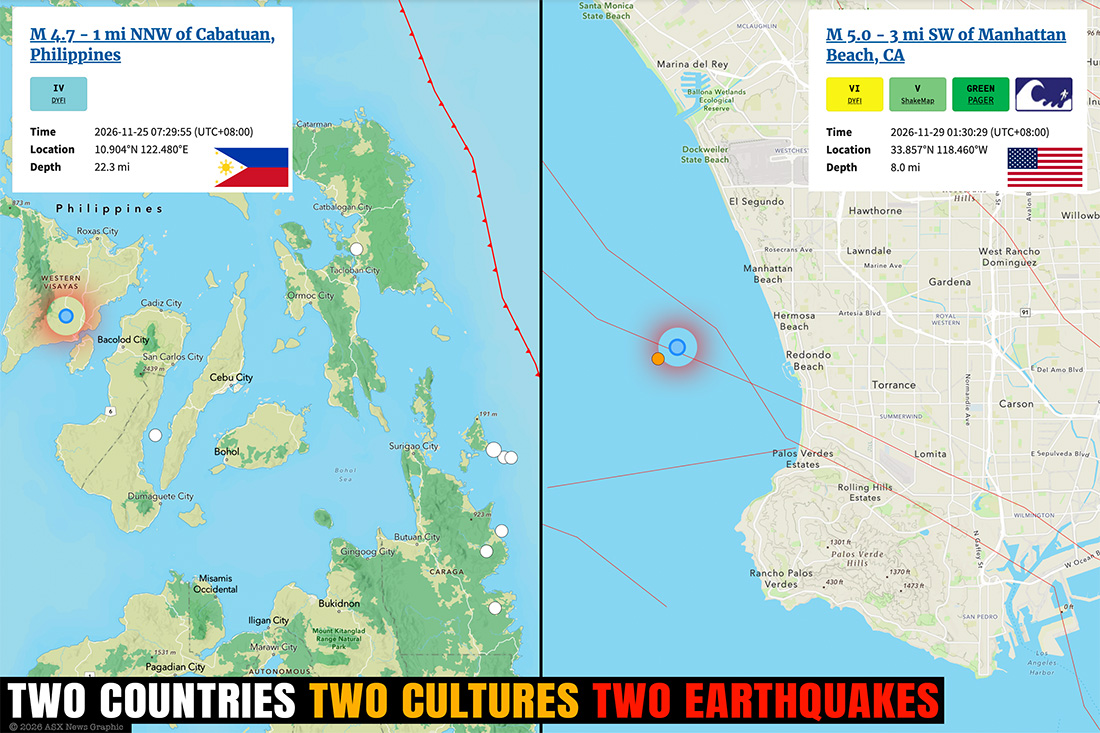
In the Philippines, a magnitude 5.0 earthquake might interrupt breakfast just long enough for someone to secure their coffee mug. In Los Angeles, a comparable earthquake can dominate television broadcasts, ignite social media, and send an extraordinary number of people scrambling toward Google. Same planet. Same geological phenomenon. Two seemingly different cultural responses.
On November 29, 2026, Philippine Standard Time, a Google Trends snapshot showed more than one million searches associated with a Southern California earthquake, with search interest increasing by more than 1,000 percent. For someone accustomed to living in the seismically active Philippine archipelago, the extraordinary volume of attention surrounding a moderate earthquake raises an entertaining but scientifically legitimate question: Why do people living on opposite sides of the Pacific Ocean appear to respond so differently to similar natural phenomena?
Is it fear? Is it familiarity? Is it the media? Or have Filipinos developed a fundamentally different relationship with the unpredictable planet beneath their feet?
Welcome to the Philippines. The Earth Moves Here.
Living in the Philippines means accepting a number of geological and meteorological realities that are largely beyond human control. Earthquakes, volcanic eruptions, tropical cyclones, flooding, landslides, and occasionally an unfortunate combination of several of these phenomena are part of the country’s environmental landscape.
Situated within the Pacific Ring of Fire, the Philippines occupies one of the world’s most geologically dynamic regions. The interaction of tectonic plates, active faults, and volcanic systems generates persistent seismic activity throughout the archipelago. Earthquakes are not necessarily extraordinary interruptions to Philippine life. They are recurring reminders of where Filipinos live.
For residents accustomed to moderate seismic activity, the initial response to a brief shaking event may be remarkably practical. Is the shaking getting stronger? Is anything falling? Are the children safe? Has anything been damaged? Once the disturbance ends and immediate danger appears to have passed, ordinary life frequently resumes.
From an American perspective, such a reaction might appear astonishingly casual. From a Filipino perspective, repeatedly surrendering an entire day to anxiety over every minor geological disturbance would make getting anything accomplished rather difficult.
California Is No Stranger to Earthquakes
The irony is that California is hardly an inexperienced participant in the seismic theater. The state’s geological history includes the devastating 1906 San Francisco earthquake, the 1989 Loma Prieta earthquake, the 1994 Northridge earthquake, and the 2019 Ridgecrest earthquake sequence.
California possesses sophisticated earthquake monitoring systems, extensive scientific expertise, advanced engineering capabilities, building regulations, emergency management infrastructure, and public education programs. Its residents are regularly reminded that another destructive earthquake is inevitable, although its timing remains unpredictable.
Yet even a moderate earthquake occurring near a major California population center can generate an immense digital reaction. Millions of residents, businesses, journalists, international observers, and concerned relatives are connected through an extraordinary communications infrastructure capable of transforming several seconds of geological activity into hours of continuous public discussion.
California also occupies a particularly prominent position in the global media environment. An earthquake near Los Angeles is not merely a regional event. It occurs near the center of the American entertainment industry, within one of the world’s most recognizable metropolitan areas, virtually guaranteeing international attention.
The Million-Search Earthquake
One million Google searches is an extraordinary expression of collective curiosity, but it is not a scientifically valid measurement of collective fear. Some individuals may be frightened, while others simply want to know the magnitude, location, or potential consequences of the earthquake. Journalists, businesses, scientists, travelers, and people living thousands of kilometers away may contribute to the same surge in online activity.
Nevertheless, the phenomenon illustrates how modern communications technologies can magnify the perceived significance of a natural event. The earthquake itself may last only seconds, while its digital aftershocks continue throughout the day.
A shaking building becomes a smartphone notification. The notification becomes a television headline. The headline becomes a social media post. The post generates searches, and those searches become another indication that the subject deserves additional media coverage.
The geological event has ended, but the information event is just getting started.
Filipino Resilience: Learned Behavior or Cultural Identity?
One of the more recognizable characteristics of Philippine society is its ability to incorporate adversity into ordinary life. Humor, family relationships, religious faith, community cooperation, and practical adaptation frequently emerge during periods of considerable hardship.
The Philippines offers particularly interesting cultural concepts through which these behaviors can be examined. Bayanihan, associated with communal assistance and collective responsibility, describes a tradition in which individuals contribute to the welfare of their neighbors and communities. In disaster environments, this cooperative orientation can become an important component of recovery.
Another familiar expression, bahala na, is considerably more complicated. Frequently interpreted as an acceptance of uncertainty, the expression may communicate anything from resignation to determination in the face of circumstances that cannot be entirely controlled. Its meaning depends heavily upon the situation and the individual expressing it.
For some Filipinos, uncertainty is not necessarily something that must be eliminated before life can continue. It is something that must be accommodated. The earthquake may occur, the typhoon may arrive, and the electricity may disappear, but the practical obligations of daily life remain.
There is an important distinction between accepting the existence of danger and surrendering to it. The ability to remain composed during an unexpected event can be psychologically and operationally advantageous, particularly when clear thinking and immediate decision-making are necessary.
What Does the Science Say?
A 2021 study published in the International Journal of Disaster Risk Reduction examined earthquake preparedness intentions among 727 Filipino respondents. The researchers identified media exposure, individual attitudes, perceived earthquake severity, and social influences as important factors affecting intentions to prepare for a major earthquake.
The findings challenge the simplistic notion that Filipinos are unconcerned about earthquakes. Their responses to seismic hazards are influenced by a combination of psychological and social variables, rather than by nationality alone. Familiarity with earthquakes does not necessarily eliminate concern, nor does awareness automatically translate into preparedness.
A separate 2020 investigation published in Health Sciences Journal examined 752 households across two Metro Manila communities representing different levels of earthquake risk. The research illustrates the importance of examining household awareness and preparedness within specific communities rather than assuming that an entire population shares a uniform approach to seismic danger.
American research has identified similarly complicated relationships between earthquake experience and risk perception. A 2005 study by Richard Celsi, Mary Wolfinbarger, and David Wald, published in Earthquake Spectra, examined how Californians interpreted earthquake magnitude, personal experience, and potential consequences.
The researchers found that personal interpretations of previous earthquakes could contribute to an underestimation of future earthquake risk. Respondents’ understanding of earthquake measurements also influenced how they interpreted their own experiences.
In other words, familiarity with earthquakes can distort risk perception in California just as readily as it can anywhere else. The person casually protecting a coffee mug and the person urgently searching Google may both possess an incomplete understanding of their actual exposure to danger.
When the Media Becomes Part of the Earthquake
American media organizations operate within an intensely competitive attention economy. Breaking news notifications, continuous television coverage, dramatic headlines, and social media algorithms reward immediacy and public engagement.
An earthquake is particularly well suited to this environment. It is unexpected, geographically identifiable, physically experienced by numerous people, and accompanied almost immediately by scientific measurements and eyewitness accounts. It provides news organizations with a rapidly developing subject that can be reported, discussed, illustrated, and repeatedly updated.
The Philippines is certainly not immune to sensationalized journalism. Philippine media organizations also compete for audiences, and major earthquakes can generate extensive national coverage. However, personal familiarity with recurring natural hazards may influence how individual Filipinos interpret that coverage.
There is also a difference between information that is operationally useful and information that merely sustains attention. Knowing whether a tsunami warning has been issued, whether infrastructure has been damaged, or whether additional emergency measures are necessary has obvious practical value. Repeatedly watching footage of a swinging ceiling lamp may have considerably less.
When a news organization transforms a moderate earthquake into an extended spectacle, does it improve public understanding of seismic hazards, or does it merely extend the commercial life of the earthquake?
A Magnitude 5.0 Is Not Necessarily Another Magnitude 5.0
Before awarding the Philippines an international trophy for earthquake composure, an important geological distinction must be addressed. Earthquake magnitude describes the size of the seismic event at its source. Earthquake intensity describes the shaking and associated effects experienced at a particular location.
Two earthquakes of identical magnitude can produce substantially different consequences depending upon their depth, distance from populated areas, geological conditions, and the vulnerability of surrounding infrastructure.
A relatively shallow earthquake occurring beneath a densely populated urban environment can produce considerably more disruptive shaking than an earthquake of identical magnitude occurring deep beneath the ocean or far from major population centers.
The United States uses the Modified Mercalli Intensity Scale to communicate observed earthquake effects, while the Philippines utilizes the PHIVOLCS Earthquake Intensity Scale. Both provide information that magnitude alone cannot adequately communicate.
Interestingly, the Philippine intensity scale specifically incorporates the behavior of household objects and liquids into its descriptions of ground shaking. At lower intensities, water in containers begins to move. At higher intensities, liquids can spill and unstable objects can overturn.
Perhaps the Filipino coffee mug deserves greater scientific recognition than previously imagined.
When Resilience Becomes Complacency
Within aviation safety, medicine, industrial operations, and disaster management, repeated exposure to a hazard without experiencing a catastrophic consequence can gradually alter an individual’s perception of acceptable risk. Familiarity can become confidence, and confidence can eventually become complacency.
This phenomenon is particularly concerning when previous encounters with a hazard have been relatively benign. Surviving numerous moderate earthquakes does not establish that a building will survive the next destructive earthquake. Nor does the absence of previous injuries demonstrate that existing emergency preparations are sufficient.
The Philippines has experienced devastating seismic disasters, including the 1990 Luzon earthquake and the 2013 Bohol earthquake. These events demonstrated that geological forces are entirely indifferent to cultural resilience, personal confidence, and previous experiences.
Filipino composure is admirable when it supports effective action. It becomes dangerous when it discourages preparation or creates an unjustified sense of invulnerability. The same principle applies to Californians whose familiarity with smaller earthquakes may lead them to underestimate a much larger event.
Conversely, remaining frightened long after a moderate earthquake has passed does not necessarily make an individual safer. Effective preparedness requires appropriate action, not prolonged anxiety.
Two Societies, Two Information Environments
There is another cultural dimension worth considering: the relationship between individuals and the systems upon which they depend.
American society places enormous emphasis on institutional reliability, technological connectivity, infrastructure continuity, and predictable access to essential services. Interruptions to these systems can strike directly at expectations of everyday stability.
In many Philippine communities, residents regularly encounter environmental and infrastructural disruptions that require immediate personal adaptation. Temporary electricity interruptions, severe weather, transportation difficulties, and other unexpected circumstances can encourage the development of alternative routines and informal support networks.
Where such disruptions are familiar, adaptation may be perceived as an ordinary responsibility rather than an extraordinary emergency. Where uninterrupted services are expected, similar disruptions may attract considerably more immediate attention.
This is not a universal distinction between Americans and Filipinos, and comparable experiences exist within both societies. It is, however, a compelling explanation for why different communities might assign different levels of significance to physically comparable events.
A rigorous comparison would need to account for actual shaking intensity, population exposure, socioeconomic conditions, internet usage, previous disaster experiences, media consumption, and access to emergency information. Without such controls, the cultural contrast remains an intriguing observation rather than an established scientific conclusion.
The Filipino Sense of Humor
Perhaps one of the most enjoyable dimensions of Philippine culture is the ability to find humor in situations that outsiders might regard as entirely inappropriate occasions for laughter.
Humor can create psychological distance from frightening circumstances, reduce tension, reinforce social relationships, and restore a sense of personal control. Laughing about an earthquake does not necessarily mean that someone fails to recognize its destructive potential. It may simply mean that fear is not being permitted to dominate the remainder of the day.
There is something refreshing about the ability to recognize that the planet has just done something entirely beyond one’s control, confirm that everyone is safe, exchange a joke with the neighbors, and return to whatever was happening before the geological interruption.
It is a reminder that human beings need not transform every encounter with uncertainty into a psychological catastrophe.
What Americans and Filipinos Can Learn From Each Other
California’s investment in seismic science, structural engineering, emergency communications, and earthquake preparedness provides valuable lessons for communities throughout the Philippines. The Philippine experience, meanwhile, offers opportunities to examine the importance of adaptability, community cooperation, and emotional composure during recurring environmental disturbances.
Neither fear nor indifference represents the ideal response to seismic activity. The most effective approach combines an accurate understanding of the hazard with practical preparedness and the ability to remain calm when circumstances demand immediate action.
During significant shaking, protecting oneself by dropping, covering, and holding on takes precedence over protecting household possessions. Afterward, assessing immediate hazards and obtaining reliable information is considerably more valuable than either unnecessary panic or unjustified dismissal.
The objective is not to become fearless. It is to become capable of functioning effectively despite the existence of danger.
Back to the Coffee Mug
The enormous public attention surrounding a moderate Southern California earthquake offers an amusing opportunity to compare two societies occupying opposite sides of the same seismically active ocean.
It also raises an uncomfortable question about the modern information environment. Have technological connectivity and continuous media exposure improved our ability to respond to natural hazards, or have they encouraged us to experience every disturbance as a potential catastrophe?
The Earth does not monitor Google Trends. It does not distinguish between Americans and Filipinos. It does not care whether an earthquake generates one million searches or whether someone in the Philippines barely interrupts breakfast.
It simply moves.
Perhaps the most valuable lesson is not how differently people respond when the ground begins shaking, but how effectively they can continue living when it stops.
Now, where did we put that coffee mug?
Scientific References and Resources
Celsi, R., Wolfinbarger, M., & Wald, D. (2005). The effects of earthquake measurement concepts and magnitude anchoring on individuals’ perceptions of earthquake risk. Earthquake Spectra. Published research.
Factors affecting intention to prepare for mitigation of “the big one” earthquake in the Philippines: Integrating protection motivation theory and extended theory of planned behavior. (2021). International Journal of Disaster Risk Reduction, 63, 102467. Published research.
See, J. A. O., et al. (2020). A comparison of the levels of earthquake awareness and preparedness in a high risk and low risk barangay. Health Sciences Journal, 9(2), 31–37. Published research.
Philippine Institute of Volcanology and Seismology. PHIVOLCS Earthquake Intensity Scale.
U.S. Geological Survey. Earthquake Magnitude, Energy Release, and Shaking Intensity.
Google Trends. Trending Now.