


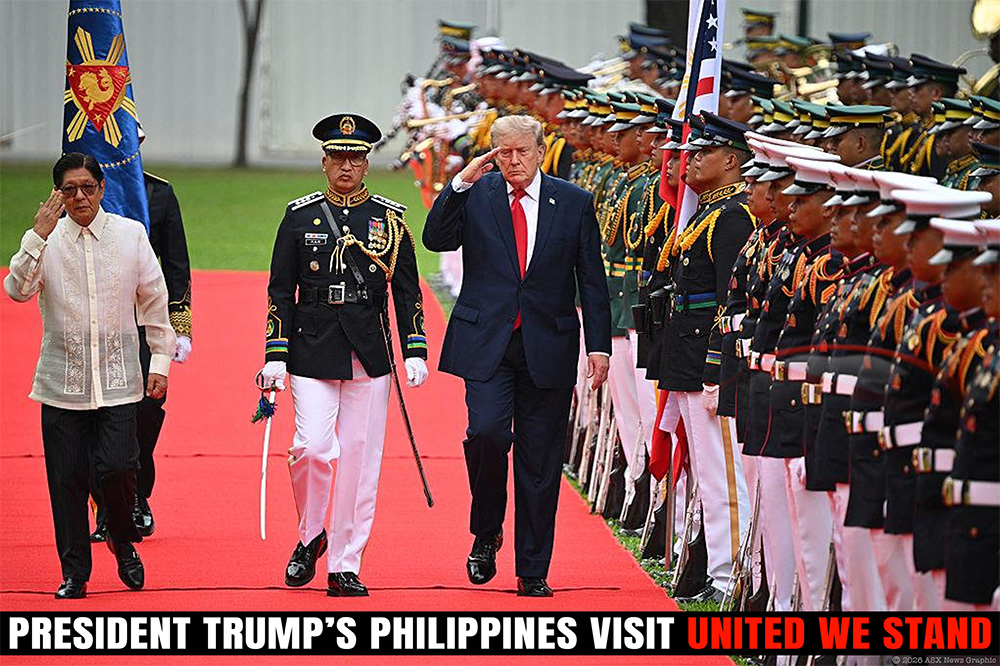
MANILA, PHILIPPINES — When United States President Donald J. Trump arrived in Manila on November 17, 2026, his visit represented far more than another appearance at an international summit. For the Philippines, it was an opportunity to reaffirm an eight-decade diplomatic relationship, advance its national defense, pursue major economic opportunities, and demonstrate its growing importance in the political and strategic future of the Indo-Pacific.
Over two days, Trump participated in high-level regional diplomacy, met Philippine President Ferdinand R. Marcos Jr., received the formal honors of a state visit, and announced initiatives involving defense financing, commercial aviation, energy, advanced technology, satellite communications, and infrastructure. The White House described more than $17 billion in commercial deals and strategic investments associated with the visit, although that figure encompasses transactions at different stages of development and is not equivalent to $17 billion invested directly in the Philippines.
The visit also placed the Philippines at the center of discussions involving some of the world’s most influential economies and military powers. Manila hosted a meeting of the Quadrilateral Security Dialogue, or Quad, bringing together the leaders of the United States, Japan, India, and Australia. At the ASEAN-United States Special Summit, Southeast Asian leaders and Washington adopted measures to strengthen cooperation against international online scams.
For the Philippines, the significance extended beyond the announcements themselves. The country had secured the attention of an American president at a moment when its maritime security, economic resilience, technological development, and international partnerships were becoming increasingly consequential.
The Genesis: Eighty Years of Diplomatic Relations
The foundations of Trump’s November visit reach back to the establishment of diplomatic relations between the Philippines and the United States in 1946. Their shared history includes the Second World War, Philippine independence, the 1951 Mutual Defense Treaty, and decades of political, military, commercial, and personal connections.
In 2026, the two countries marked 80 years of diplomatic relations. That anniversary provided a particularly meaningful setting for a presidential visit intended to demonstrate the durability of the relationship.
Trump had previously visited the Philippines in November 2017 during his first administration, when he attended the 31st ASEAN Summit. His return nine years later came under substantially different geopolitical circumstances, with maritime confrontations in the South China Sea, competition over critical technologies, and concerns about global supply-chain security occupying prominent positions in regional diplomacy.
The groundwork for the 2026 visit had been developing well before Air Force One landed in Manila. Trump and Marcos met at the White House on July 22, 2025, where they discussed bilateral relations, trade, and defense cooperation. The two leaders also spoke by telephone in July 2026 about economic developments and regional security, including the South China Sea.
Meanwhile, the Philippines was preparing to host the 49th ASEAN Summit under its chairship theme, “Navigating Our Future, Together.” The gathering provided an opportunity for Manila to engage the United States while strengthening relationships across Southeast Asia.
The Philippines’ diplomatic efforts were consequential in securing Trump’s participation. The ASEAN summit schedule was adjusted to accommodate the wider calendar of regional meetings, including the Asia-Pacific Economic Cooperation summit in China. Although Trump arrived on the final day of ASEAN’s principal proceedings, his presence enabled a separate ASEAN-U.S. engagement, a Quad leaders’ meeting, and bilateral talks with Marcos.
For Philippine diplomacy, securing those engagements demonstrated Manila’s ability to convene important international discussions on its own territory.
A Presidential Welcome in Manila
Air Force One arrived at Ninoy Aquino International Airport in Pasay City at approximately 5:37 p.m. on November 17. Trump was welcomed by senior Philippine officials, including Executive Secretary Ralph Recto, Ilocos Norte Representative Sandro Marcos, Philippine Ambassador to the United States Jose Manuel Romualdez, and U.S. Ambassador Lee Lipton.
The arrival ceremony reflected the formal importance assigned to the visit. Trump inspected an honor guard, and photographs captured a particularly memorable moment when he waved American and Philippine flags presented to him by a child.
The following day, President Marcos welcomed Trump to Malacañang Palace, the official residence and principal workplace of the Philippine president. The visit included an arrival ceremony, bilateral discussions, the signing of the palace guest book, and a state banquet luncheon.
Official White House photographs document the extensive ceremonial program, including the two presidents meeting inside the palace, greeting participants, and attending the luncheon alongside Philippine First Lady Louise Araneta-Marcos.
The hospitality was unmistakable at the governmental level. Marcos publicly emphasized the shared history and human connections between the two countries, including the millions of Filipinos and Filipino-Americans whose lives bridge the Pacific.
The reception also featured a distinctly Filipino touch. According to reporting by Foreign Policy, Marcos arranged for food from Jollibee, the country’s internationally recognized restaurant chain, to be delivered to Trump during his visit.
The ceremonial welcome should not be confused with universal public approval. Demonstrations also occurred in Manila, including protests against American foreign policy and the proposed Pax Silica technology initiative. Nevertheless, the Philippine government’s reception was formal, extensive, and demonstrably focused on strengthening bilateral relations.
Defense Cooperation: A Major Philippine Priority
Among the most consequential announcements was a proposed expansion of American military financing for the Philippines.
On November 18, the White House announced that the two countries would pursue a Foreign Military Financing loan package exceeding $2 billion. The proposed financing would support Philippine acquisition of defense and security capabilities from American suppliers.
The United States also identified $400 million in Foreign Military Financing intended to strengthen the operational reach and deterrence capabilities of the Armed Forces of the Philippines in the South China Sea.
The announced priorities included long-range fires, command-and-control systems, critical infrastructure, and multidomain drones. These capabilities address several of the practical challenges facing an archipelagic nation responsible for defending widely separated islands, monitoring extensive maritime approaches, and maintaining operational awareness across enormous stretches of ocean.
For the Philippines, stronger surveillance, communications, and defensive capabilities can improve its ability to detect and respond to threats. Better coordination between Philippine and American forces can also contribute to deterrence by making military operations more integrated and predictable.
Trump reaffirmed the importance of the U.S.-Philippine defense alliance during his meeting with Marcos. Reuters reported that he also referred to more than $5 billion in approved arms sales, while emphasizing Washington’s intention to expand defense cooperation.
These figures describe different financing and procurement categories and should not be added together as though they were separate amounts of cash transferred to Manila. The larger loan package remains a proposed financing arrangement, while approved arms sales do not necessarily represent equipment already delivered.
Nevertheless, the announcements identify concrete areas in which the Philippines could strengthen its military capabilities. Their eventual significance will depend on financing terms, procurement contracts, delivery schedules, training, and integration into Philippine defense operations.
The South China Sea: Strengthening Deterrence Without Abandoning Diplomacy
The South China Sea remains one of the Philippines’ most sensitive national security concerns. Philippine vessels and personnel have faced repeated confrontations in waters where Manila asserts rights under international law, including the United Nations Convention on the Law of the Sea.
China continues to assert extensive maritime claims that conflict with the Philippines’ interpretation of its exclusive economic zone and the 2016 South China Sea arbitral award. Beijing rejects that ruling.
Against this background, the Trump administration’s renewed emphasis on defense cooperation carried direct strategic relevance for Manila.
The Philippines has increasingly pursued a combination of diplomatic engagement, international legal arguments, defense modernization, and security partnerships. Stronger capabilities do not eliminate the need for negotiation, but they can improve the country’s ability to protect its personnel and operate in contested waters.
During the ASEAN meetings, negotiations between ASEAN and China did not produce a completed South China Sea code of conduct. Philippine officials nevertheless reported progress in the negotiating process, even as substantial disagreements remained over important provisions.
The absence of a final code reinforces the practical importance of the Philippines’ existing alliances and defense partnerships. The November visit did not resolve maritime disputes, but it provided additional political support and announced potential resources for Philippine security.
Manila Hosts the Quad: Four Major Powers Meet on Philippine Soil
One of the visit’s most internationally significant events occurred on November 17, when Trump met Australian Prime Minister Anthony Albanese, Indian Prime Minister Narendra Modi, and Japanese Prime Minister Sanae Takaichi in Manila.
The meeting brought together the leaders of the Quad, a diplomatic partnership focused on maintaining a free, open, stable, and prosperous Indo-Pacific.
The joint statement addressed maritime security, freedom of navigation and overflight, economic coercion, critical supply chains, emerging technologies, and disaster response. The leaders expressed opposition to unilateral attempts to change the regional status quo through force or coercion.
Among the initiatives discussed were enhanced maritime surveillance cooperation and measures to improve the security of critical mineral supply chains. The leaders also outlined plans for a Quad Business Leaders’ Forum in 2027.
The Philippines is not a Quad member, and the meeting did not create a new Philippine treaty obligation. Its importance to Manila was diplomatic and strategic: four influential Indo-Pacific governments met in the Philippine capital to address issues directly affecting Philippine security and economic interests.
For a country seeking stronger international recognition of its maritime concerns, hosting such a gathering represented a meaningful opportunity to keep regional security on the diplomatic agenda.
Commercial Aviation: A $12 Billion Announcement
The White House identified commercial aviation as one of the largest economic components of the visit.
According to its November 18 fact sheet, Boeing and GE Aerospace finalized a transaction valued at approximately $12 billion involving Philippine Airlines and up to 20 Boeing 787 aircraft equipped with GE Aerospace engines.
The administration stated that the transaction would support approximately 47,000 American jobs. For the Philippines, the commercial significance lies in the potential modernization and expansion of the country’s international airline capabilities.
Modern long-range aircraft can support international connectivity, route development, passenger comfort, and fleet efficiency. Such investments may contribute to the competitiveness of Philippine aviation, particularly as airlines seek to serve long-distance markets and growing travel demand.
However, the announced value should be interpreted carefully. Aircraft transactions frequently involve previously negotiated orders, options, delivery schedules, and financing arrangements. The White House announcement establishes the administration’s description of the transaction, but it does not establish that every aircraft was newly ordered during the presidential visit.
The longer-term benefits for the Philippines will depend on the aircraft ultimately delivered, the airline’s network decisions, operating economics, and passenger demand.
Energy Security: New Possibilities for Philippine Development
Reliable and affordable energy remains essential to Philippine industrial development, household prosperity, transportation, and technological modernization.
During the visit, Trump and Marcos discussed expanding energy cooperation, including increased Philippine imports of American energy products.
Trump also identified the Philippines as a potential partner in an Alaska natural gas export project. Such cooperation could diversify Philippine energy supply options and create additional commercial relationships between the two countries.
Energy diversification has particular importance for an island nation vulnerable to international fuel-price volatility and disruptions in maritime supply chains.
The two governments also announced plans to explore an intergovernmental agreement on civil nuclear technology. The White House described the initiative as a potential pathway toward significant future electricity generation using American technology.
For the Philippines, civilian nuclear power could eventually provide another source of electricity capable of supporting industrial operations and large-scale infrastructure. Any such program would require extensive regulatory preparation, financing, safety oversight, environmental review, and public engagement.
The November announcement represented an exploratory commitment rather than authorization to construct a nuclear power plant. Even so, it placed long-term Philippine energy development among the priorities of bilateral cooperation.
Advanced Technology, Artificial Intelligence, and Secure Communications
The visit also produced announcements concerning defense technology and digital infrastructure.
The Philippine Department of National Defense announced a $37 million contract with an American company for artificial intelligence-enabled mission support. The White House also identified a $63 million initiative involving modernization of Philippine defense cloud infrastructure in cooperation with trusted U.S. technology providers.
These initiatives are intended to strengthen technological interoperability and provide improved digital capabilities for defense operations.
Modern military effectiveness increasingly depends on secure communications, reliable information processing, resilient computer systems, and the ability to coordinate operations across multiple environments. For the Philippines, investments in these areas could complement conventional military modernization.
Another announcement concerned satellite communications. American company Astranis offered connectivity services through its U.S.-manufactured AGILA satellite, with a potential commercial value of up to $200 million.
Satellite connectivity is especially relevant to the Philippines because of its geography. An archipelago of more than 7,000 islands faces substantial challenges in providing reliable communications to remote communities, government facilities, maritime operations, and disaster-response organizations.
Improved satellite infrastructure could support communications resilience when terrestrial networks are damaged or unavailable. The commercial opportunity, however, remains distinct from a completed nationwide deployment.
The governments also committed to further cooperation in critical technologies, including areas connected to semiconductor supply chains and emerging digital industries.
Subic Bay and Basco Airport: Infrastructure with Strategic Value
Two additional announcements illustrated the connection between infrastructure development, commercial activity, and national security.
Subic Grain announced plans for a $40 million fuel storage depot at Subic Bay. The proposed facility would support military and commercial operations and strengthen logistical capacity in a location with a long history of maritime and aviation activity.
Fuel storage infrastructure can improve operational flexibility by providing additional capacity for transportation, logistics, and emergency support. The ultimate economic benefits will depend on construction, employment, utilization, and the facility’s integration with existing infrastructure.
The United States and the Philippines also announced plans to modernize Basco Airport in Batanes, near the country’s northern maritime approaches.
The White House identified operational access, disaster response, and commercial supply chains as intended benefits of the modernization.
Basco’s location gives the project particular relevance to emergency preparedness and regional connectivity. Improved airport facilities could strengthen the movement of personnel and supplies during natural disasters while supporting legitimate civilian transportation requirements.
For Philippine aviation and infrastructure development, the announcement represents an opportunity to connect strategic investment with practical national needs.
Trade: An Ambitious Announcement, with Implementation Still Ahead
During the November 18 state luncheon, Trump announced what he described as an exceptionally large trade agreement between the United States and the Philippines.
He characterized the understanding as beneficial to both countries and later highlighted opportunities for American agriculture and energy producers.
Philippine officials provided a more limited description. The Office of the President indicated that the governments had reached an understanding concerning economic cooperation and that their trade representatives would work to translate commitments into concrete initiatives.
Philippine Ambassador Jose Manuel Romualdez confirmed that no trade agreement had been signed at that point.
The distinction matters. A political understanding can establish direction for negotiations and future commercial arrangements, but it does not automatically create enforceable tariff commitments, investment obligations, or immediate changes in market access.
For the Philippines, the opportunity is to use the renewed dialogue to pursue improved trade conditions, reliable energy supplies, investment, and access to American technology while protecting domestic economic priorities.
The eventual benefits will be determined by the specific terms negotiated and implemented after the visit.
A Practical Regional Achievement: Cooperation Against Online Scams
One of the clearest multilateral outcomes associated with Trump’s participation in Manila concerned international online fraud.
At the ASEAN-United States Special Summit on November 17, Marcos announced the adoption of 10 public-private partnership principles and a comprehensive work plan to combat online scams.
The measures had been developed through coordination between ASEAN and American officials ahead of Trump’s arrival.
Online fraud is a serious cross-border problem affecting consumers, businesses, financial institutions, and law-enforcement agencies. Criminal networks frequently exploit differences between national jurisdictions, financial systems, and digital platforms.
Regional cooperation can improve information sharing and coordination between governments and private companies, including financial and technology organizations.
For the Philippines, which maintains extensive international financial and personal connections through its overseas communities, stronger cooperation against online fraud offers a practical public-interest objective.
The adoption of the principles and work plan was a documented diplomatic result. Their effectiveness will depend on subsequent implementation, enforcement cooperation, and measurable reductions in criminal activity.
Philippine Diplomacy and the Wider ASEAN Agenda
Trump’s visit occurred against the backdrop of a broader Philippine diplomatic undertaking: the conclusion of the country’s 2026 ASEAN chairmanship.
At the close of the summit, Marcos reported that ASEAN leaders had acted on more than 100 outcome documents across the organization’s principal areas of cooperation.
Among the developments he highlighted were initiatives involving maritime cooperation, the digital economy, regional institutional development, and protection of children from online sexual exploitation and abuse.
These were accomplishments of the wider ASEAN process, not agreements attributable solely to Trump’s visit. Their inclusion in the same diplomatic week nevertheless demonstrated the scale of international activity Manila had organized.
The Philippines also helped advance negotiations concerning the ASEAN Digital Economy Framework Agreement and participated in efforts to strengthen regional maritime cooperation.
Hosting major international meetings requires substantial diplomatic preparation, logistical coordination, security planning, and institutional capacity. The November gathering provided an opportunity for the Philippines to demonstrate those capabilities before regional and international leaders.
What the Visit Accomplished — and What Comes Next
The immediate record of Trump’s visit contains several identifiable outcomes: the formal reaffirmation of the U.S.-Philippine alliance; announcements concerning military financing and defense technology; commercial aviation and infrastructure initiatives; exploration of civilian nuclear cooperation; commitments to further trade negotiations; and a regional work plan against online scams.
It also included the first in-person Quad leaders’ meeting of Trump’s second administration, held in Manila, and a highly visible state visit hosted by Marcos.
Not every announcement represents a completed project. Some involve finalized commercial transactions, others are proposed financing arrangements, and still others are preliminary agreements to explore future cooperation.
That distinction does not diminish the importance of the visit. It identifies where diplomatic commitments must now become measurable results.
For Philippine policymakers, the next stage will involve translating announcements into contracts, infrastructure, operational capabilities, regulatory agreements, and economic opportunities that can be evaluated over time.
The visit also demonstrated the continued relevance of Philippine diplomacy in a region where major powers compete for influence and where smaller and middle-sized countries must protect their national interests through carefully maintained partnerships.
A Philippine Opportunity, Not Merely an American Visit
Perhaps the most important way to understand the November 2026 visit is through the Philippines’ own national objectives.
Manila sought stronger defense capabilities, more reliable economic relationships, improved technological infrastructure, greater energy security, and continued international attention to the security of its maritime territory.
The American president’s presence provided a high-profile occasion to advance those objectives. The Philippine government used the visit to host bilateral and multilateral discussions, reaffirm its principal defense alliance, and place national development priorities before American decision-makers.
The ceremonial reception at Malacañang reflected the importance Philippine leaders attached to that relationship. The commercial and defense announcements demonstrated areas where cooperation could produce practical benefits. The ASEAN and Quad meetings reinforced Manila’s role as a venue for consequential regional diplomacy.
The Philippines did not emerge from the visit with every challenge resolved. Its maritime disputes remain unsettled, major infrastructure projects still require implementation, and important economic negotiations remain unfinished.
But the visit left the country with a renewed set of diplomatic commitments, announced investment and financing opportunities, and a stronger public reaffirmation of its relationship with the United States.
For a nation determined to improve its security, expand its economy, and strengthen its position in the Indo-Pacific, those developments represent opportunities worth pursuing.
Ultimately, the enduring significance of Trump’s return to Manila will be measured not simply by the welcome he received or the agreements announced, but by the benefits the Philippines is able to secure for its people in the years ahead.
Sources and Further Reading
White House. (2026, November 18). Fact sheet: President Donald J. Trump secures historic economic deals for American workers and strengthens America’s leadership in Asia. Official White House fact sheet.
White House. (2026). President Donald J. Trump visits the Philippines, November 17–18, 2026. Official photographic record.
Philippine News Agency. (2026, November 17). Trump in PH for ASEAN Summit, bilateral meet with PBBM. PNA report.
Philippine News Agency. (2026, November 17). Marcos announces ASEAN, US agreement vs. online scams. PNA report.
Philippine News Agency. (2026, November 19). White House: US eyes $2B in military financing for PH, SCS deterrence. PNA report.
Presidential Communications Office. (2026, November 17). Press conference by His Excellency Ferdinand R. Marcos Jr., President of the Republic of the Philippines. Official transcript.
Ministry of Foreign Affairs of Japan. (2026, November 17). Quad Leaders’ Summit joint press release. Official joint statement.
Center for Strategic and International Studies. (2026, November 18). ASEAN outcomes and Trump’s Manila visit. Regional analysis.
Reuters. (2026, November 18). Trump lauds defence alliance with Philippines ahead of China talks. Reuters reporting.