


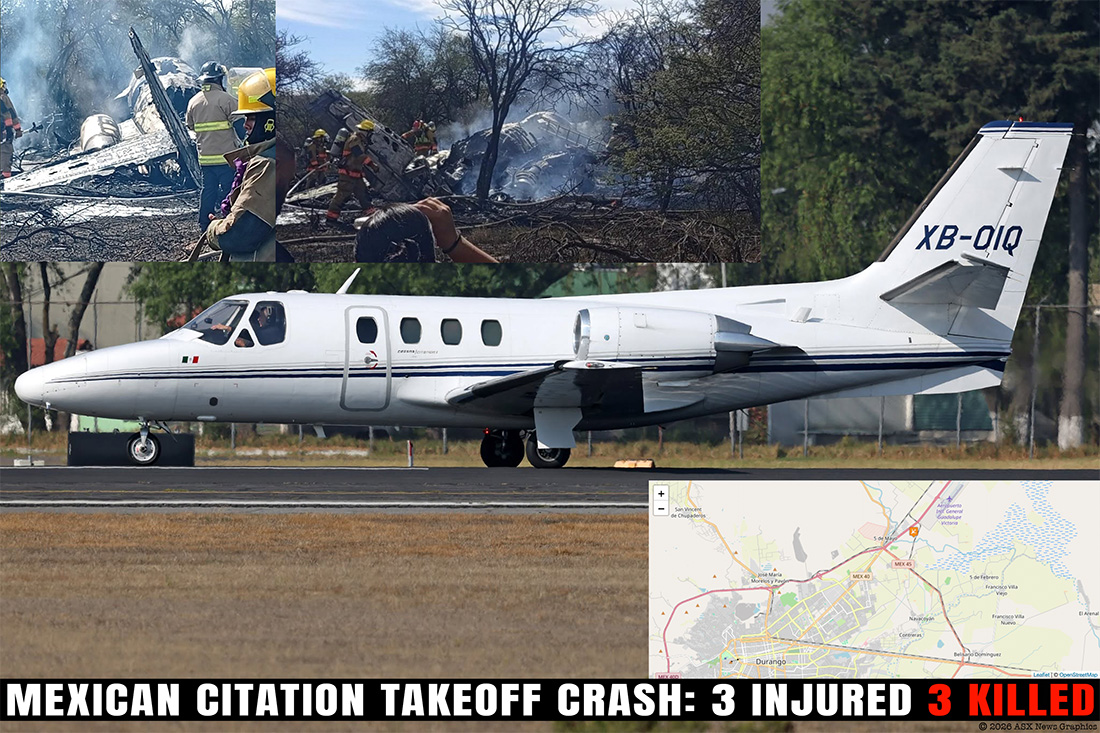
ASX NEWS | AVIATION ACCIDENTS | NOVEMBER 18, 2026
DURANGO, MEXICO — Three people have reportedly been killed after a privately operated Cessna 500 Citation I business jet crashed shortly after takeoff from General Guadalupe Victoria International Airport in Durango, Mexico, on Tuesday, November 17, 2026.
The aircraft, registered XB-OIQ, was carrying six people on a flight bound for Toluca International Airport in the State of Mexico when it went down near the departure runway at approximately 11:40 a.m. local time.
The aircraft was destroyed in the accident and subsequent fire.
Mexico’s Federal Civil Aviation Agency (Agencia Federal de Aviación Civil, AFAC) confirmed the accident, the number of occupants, the intended destination, and the approximate crash location. An investigation has been initiated to determine the circumstances surrounding the loss of the aircraft.
Three Fatalities Reported as Rescue Operations Continue
The accident initially generated conflicting casualty reports as emergency personnel responded to the crash site.
Early local accounts reported one or two fatalities, along with several injured survivors. Subsequent reporting by Mexican news organization N+ indicated that the death toll had risen to three, citing Durango Governor Esteban Villegas Villarreal.
According to the governor, the number of confirmed deaths increased as additional information became available from the emergency response.
Other local reporting described injured occupants being transported for medical treatment while emergency personnel continued searching the wreckage.
The official AFAC statement did not specify a final casualty count or provide a complete accounting of the condition of the six occupants.
Consequently, the reported three fatalities should be considered provisional pending confirmation of the final casualty figures by the responsible authorities.
AFAC Confirms Six Occupants and Location of the Crash
In an official statement dated November 17, 2026, Mexico’s Federal Civil Aviation Agency confirmed that the Cessna 500 crashed during departure operations at Durango International Airport.
According to the flight plan information reviewed by AFAC, the aircraft was carrying two crew members and four passengers.
The agency stated that the aircraft was destined for Toluca International Airport and crashed approximately 500 meters from the threshold of Runway 03.
The accident occurred at approximately 11:40 a.m. local time.
AFAC confirmed that the airport’s Emergency Operations Center was immediately activated to coordinate the response.
An administrative investigation was also initiated.
The agency did not identify a probable cause in its initial announcement.
Aircraft Identification: Cessna 500 Citation I, XB-OIQ
The aircraft involved was identified as a Cessna 500 Citation I, a light twin-engine business jet developed by Cessna for private and corporate transportation.
Aviation Safety Network identifies the aircraft as registration XB-OIQ, manufactured in 1976, with manufacturer’s serial number 500-0338.
The aircraft was approximately 50 years old at the time of the accident.
The original Citation series represented an important development in business aviation, offering operators access to relatively short runways and smaller airports while providing the speed and operational advantages of jet propulsion.
The Cessna 500 is powered by two Pratt & Whitney Canada JT15D turbofan engines mounted on the rear fuselage.
The aircraft’s conventional tail configuration, straight wing, and comparatively modest approach and departure speeds distinguished the original Citation family from many other business jets of its era.
Although the aircraft’s age is relevant to its maintenance and operational history, there is no established evidence that its age contributed to this accident.
The aircraft’s maintenance records, airworthiness status, and recent operational history have not been publicly established in the information reviewed for this report.
Aircraft and Accident Information
| Detail | Information |
|---|---|
| Date | November 17, 2026 |
| Time | Approximately 11:40 a.m. local |
| Aircraft | Cessna 500 Citation I |
| Registration | XB-OIQ |
| Serial number | 500-0338 |
| Year manufactured | 1976 |
| Operator | Private |
| Occupants | 6 |
| Crew | 2 |
| Passengers | 4 |
| Reported fatalities | 3, provisional |
| Departure | Durango International Airport (DGO/MMDO) |
| Destination | Toluca International Airport (TLC/MMTO) |
| Flight phase | Initial climb/departure |
| Aircraft damage | Destroyed |
| Investigation | AFAC investigation initiated |
Reports of an Open Baggage Compartment Emerge
One of the most significant preliminary developments concerns reports that a baggage compartment door may have opened during the departure sequence.
Durango Governor Esteban Villegas Villarreal discussed the possibility while speaking with reporters following the accident.
According to his preliminary account, a baggage compartment may have opened during takeoff, prompting the flight crew to attempt an emergency landing.
The aircraft subsequently crashed and caught fire.
This account has not been established as the official cause of the accident.
The AFAC statement did not confirm that a baggage compartment door opened, nor did it establish that the pilots attempted to return to the airport.
Nevertheless, the possibility introduces several important questions for investigators.
If a compartment door opened during takeoff, investigators would need to determine whether it affected aircraft handling, generated unusual aerodynamic forces, distracted the flight crew, or contributed to an attempted return to the airport.
They would also need to establish whether the door was properly secured before departure and whether any mechanical or procedural deficiencies existed.
An open baggage compartment does not necessarily make an aircraft uncontrollable.
The consequences depend upon the aircraft’s design, the location of the compartment, airspeed, aerodynamic effects, and the crew’s response.
Until investigators examine the wreckage and relevant evidence, any connection between the reported baggage-door problem and the subsequent crash remains unconfirmed.
Aircraft Crashes Near Runway 03 and Erupts in Flames
The accident occurred close to the airport, during one of the most operationally demanding phases of flight.
According to AFAC, the aircraft came down approximately 500 meters from the threshold of Runway 03.
Local news reports described a post-impact explosion and fire that consumed the aircraft.
Emergency personnel, firefighters, medical teams, and security authorities responded to the scene.
The accident area was secured while rescue and recovery operations were conducted.
The proximity of the crash site to the airport allowed emergency resources to be mobilized rapidly, although the severity of the impact and resulting fire complicated the response.
Photographs and local reporting indicate that the aircraft sustained catastrophic damage.
The extent of the wreckage and post-impact fire will be important considerations for investigators attempting to reconstruct the accident sequence.
Fire damage can complicate the examination of aircraft structures, control systems, engines, and mechanical components.
Investigators will need to distinguish damage caused by the initial impact from damage resulting from the subsequent fire.
Why the Initial Climb Is a Critical Phase of Flight
The accident occurred during the departure phase, when an aircraft is transitioning from ground operations to sustained flight.
During initial climb, pilots must maintain adequate airspeed, manage aircraft configuration, monitor engine performance, and respond quickly to any abnormal indications.
Unlike an aircraft operating at cruising altitude, a departing aircraft has limited altitude and time available to diagnose problems and execute corrective actions.
If a malfunction occurs immediately after liftoff, the crew may face difficult decisions concerning whether to continue climbing, maintain the departure flight path, or attempt an emergency landing.
Those decisions depend upon aircraft performance, runway availability, terrain, weather conditions, and the nature of the malfunction.
For business jets operating from airports surrounded by developed areas or challenging terrain, the margin for recovery can be particularly limited.
The reported circumstances of the Durango accident make the departure sequence a central focus of the investigation.
However, no evidence currently establishes whether the aircraft experienced an aerodynamic stall, engine malfunction, flight-control problem, structural failure, or another emergency before impact.
Weather Conditions at Durango
Aviation Safety Network includes meteorological observations from Durango International Airport around the time of the accident.
The available METAR reports indicate generally light winds, unrestricted visibility, and no significant reported weather phenomena.
MMDO 171649Z 11003KT 9SM BKN200 17/04 A3037
MMDO 171751Z 16005KT 9SM BKN200 19/05 A3033
These observations indicate winds from approximately 110 degrees at three knots and 160 degrees at five knots, respectively, with visibility of nine statute miles and a broken cloud layer at approximately 20,000 feet above the airport.
The reported temperatures were 17°C and 19°C.
The observations suggest that widespread low visibility or severe surface weather was not present during the period covered by these reports.
Nevertheless, weather conditions alone cannot establish whether environmental factors contributed to the accident.
Investigators must consider the precise conditions encountered by the aircraft, including runway winds, temperature, pressure altitude, aircraft loading, and actual departure performance.
Durango International Airport is located at a relatively high elevation, making aircraft performance calculations particularly important.
At higher elevations, reduced air density can affect engine thrust, acceleration, takeoff distance, and climb performance.
Whether any such factors contributed to this accident remains unknown.
Investigation Must Reconstruct the Final Moments
The investigation will need to establish the aircraft’s actual departure path, the sequence of events preceding impact, and the condition of its mechanical and flight-control systems.
Particular attention may be directed toward the reported baggage-compartment issue, if supported by physical evidence or witness testimony.
Other important investigative areas include the aircraft’s maintenance history, preflight inspection, loading and weight distribution, engine performance, crew communications, and any available airport surveillance recordings.
Investigators may also examine air traffic control communications, radar information, flight tracking records, and evidence recovered from the wreckage.
Whether the aircraft carried any recording equipment capable of assisting the investigation has not been established.
The investigation must also determine whether the crew attempted to return to the runway or whether the aircraft’s final trajectory resulted from another developing emergency.
No official probable cause has been released.
A Fatal Accident Involving One of Business Aviation’s Early Jet Designs
The Cessna Citation family has played a major role in the development of business aviation, providing private operators and corporations with access to jet transportation for decades.
The original Cessna 500 entered service during the early 1970s and helped establish a market for smaller business jets capable of operating from airports that could not accommodate larger corporate aircraft.
Many early Citation aircraft have remained in service for decades under continuing maintenance and airworthiness requirements.
The loss of XB-OIQ underscores the importance of examining individual aircraft condition, operational procedures, and the circumstances of a specific flight rather than drawing conclusions solely from aircraft age or model.
For the families of those aboard, the immediate concern is the loss of life and the condition of the survivors.
For aviation investigators, the priority is determining precisely what occurred during the aircraft’s final moments and whether the findings identify safety lessons relevant to other operators.
As of November 18, 2026, the accident remains under investigation, with three fatalities reported and the final casualty accounting awaiting authoritative confirmation.
ASX News will continue monitoring developments from AFAC and Mexican aviation authorities as additional findings become available.
Sources and References
1. Aviation Safety Network — Aviation Safety WikiBase. Accident record for Cessna 500 Citation I, XB-OIQ, November 17, 2026.
2. Agencia Federal de Aviación Civil (AFAC), Mexico — Official accident statement dated November 17, 2026, reproduced in the supplied reporting.
3. N+ — Accidente Aéreo en Durango Deja Tres Muertos Tras Desplomarse Aeronave.
5. El Financiero — Se Desploma Jet Privado en Durango.
6. El Siglo de Durango — Identifican al Piloto que Perdió la Vida.
7. El Informador — Avioneta con Seis Personas a Bordo se Desploma en Durango.
Editorial note: Casualty figures and reports concerning a possible baggage-compartment malfunction remain preliminary. The official AFAC statement confirms the accident circumstances and six occupants but does not establish the final death toll or probable cause.