


ASX NEWS | SPECIAL REPORT | NOVEMBER 18, 2026
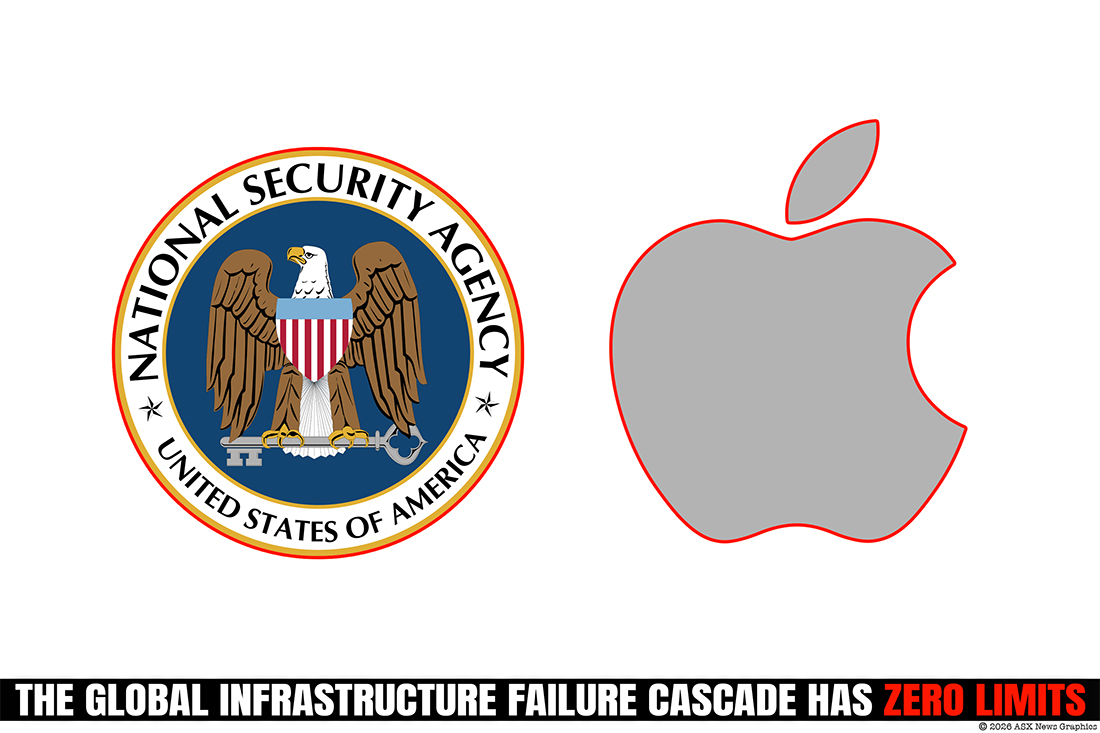
Two of the most consequential technology disruptions of the week unfolded on November 17, 2026, when the United States National Security Agency experienced an interruption affecting its highly classified internal communications network, while Apple struggled with widespread outages involving services used by millions of consumers and businesses.
The incidents occurred against an extraordinary backdrop of technological failures affecting American aviation, banking, government communications, and some of the world’s largest digital service providers.
Within hours, public interest surged. Google Trends recorded more than 200,000 searches each for the National Security Agency and Apple’s outage, with both topics registering increases exceeding 1,000 percent.
The developments raise an increasingly urgent question: Are these simply unrelated technical failures occurring within an enormously complex technological environment, or are they exposing a deeper structural vulnerability in the digital infrastructure upon which modern civilization depends?
There is currently no verified evidence establishing that the NSA and Apple incidents were connected, coordinated, or caused by hostile cyber operations. Both organizations have attributed their respective disruptions to internal maintenance or software-related activity.
Nevertheless, the concentration of significant disruptions across multiple critical sectors deserves examination, particularly in light of recent international cybersecurity investigations and growing concern about the resilience of interconnected infrastructure.
The NSA: A Classified Communications Network Goes Offline
On Tuesday, November 17, the National Security Agency experienced a disruption affecting NSANet, a highly classified internal network used by agency personnel to exchange sensitive information.
According to reporting by the Associated Press and CNN, the interruption affected internal communications and prompted adjustments to personnel arrival schedules at the agency’s headquarters in Fort Meade, Maryland, and other locations.
The NSA attributed the disruption to scheduled routine maintenance.
An American official explained that some internal systems experienced temporary degradation, but that mission-critical capabilities remained operational and the agency’s ability to protect national security had not been compromised.
Officials also emphasized that the NSA maintains multiple layers of redundancy designed to preserve essential operations during planned maintenance and unexpected disruptions.
Reporting indicated that the incident occurred during routine network patching, an essential process used to maintain, update, and protect computer systems.
No publicly verified evidence has established that the disruption resulted from a cyberattack.
But the incident is significant because of the institution involved.
The NSA is one of the world’s most sophisticated intelligence and cybersecurity organizations. Its responsibilities include foreign signals intelligence, support for American national security operations, and the protection of sensitive communications infrastructure.
When an organization possessing such extensive technical expertise experiences an interruption involving classified communications, the event illustrates a fundamental reality: Even exceptionally well-protected networks remain dependent upon software, maintenance procedures, communications architecture, and the successful coordination of complex technical systems.
Redundancy can preserve essential capabilities without preventing every interruption to supporting infrastructure.
That distinction is central to understanding what happened at the NSA.
Apple: An Internal Update Disrupts Services Across Its Ecosystem
While questions surrounding the NSA incident were circulating, Apple was confronting its own major technology disruption.
Thousands of users reported difficulties accessing services including Apple Pay, iCloud, the App Store, Apple Account authentication, and other applications.
Some users reported being unexpectedly signed out of their accounts and encountering difficulties signing back in. Others experienced problems accessing cloud services, downloading applications, completing transactions, or activating devices.
Apple’s system status information identified disruptions involving multiple services, including iCloud Mail, iCloud Web Apps, AppleCare, and business-related platforms.
According to Reuters, Downdetector recorded approximately 2,300 user reports involving Apple Pay around 12:20 p.m. Eastern Time, while iCloud reports reached approximately 1,800 near their peak.
These figures represent submitted outage reports rather than a verified count of all affected customers.
Apple subsequently acknowledged that an internal update had caused the disruption.
The company said many systems had returned to operation and that engineers were working to restore the remaining affected services.
Apple also indicated that the incident was not caused by a cyberattack.
The explanation may be straightforward, but the consequences reveal the extraordinary reach of modern digital platforms.
Apple’s infrastructure supports far more than entertainment, messaging, and personal convenience.
Its services are integrated into electronic payments, business operations, identity authentication, software distribution, education, communications, and cloud-based information management.
A failure affecting a centralized authentication or service-management component can therefore interfere with numerous functions that users experience as separate products.
The physical devices may remain operational. The underlying telecommunications networks may continue functioning. Yet the digital services required to perform ordinary activities can become temporarily unavailable.
This is the infrastructure behind the infrastructure.
A Troubling Sequence of Technology Failures
The NSA and Apple incidents did not occur in isolation.
During the preceding days, several major American institutions and technology providers experienced operational disruptions affecting essential services.
Microsoft users encountered problems accessing Outlook and other Microsoft 365 applications.
A communications-system malfunction involving the Federal Aviation Administration contributed to a nationwide ground stop, disrupting American air transportation and generating widespread delays.
United Airlines subsequently experienced an internal technology failure affecting flight departures.
JPMorgan Chase reported a technical problem associated with software operating on its internal hardware infrastructure, temporarily interfering with banking services.
Additional reports involved Google services, while Marriott International acknowledged a technical issue affecting customer sign-in capabilities.
These incidents involved different organizations, different technical environments, and different reported causes.
Microsoft, the FAA, JPMorgan Chase, Apple, and Marriott have not publicly established that their respective disruptions resulted from a common cyberattack.
Indeed, several organizations specifically reported finding no evidence of malicious cyber activity.
It would therefore be inaccurate to describe the incidents as a confirmed coordinated attack against American infrastructure.
But another observation is equally important.
Within a relatively short period, the public witnessed disruptions involving aviation, financial services, consumer technology, corporate communications, hospitality systems, and classified government networks.
Each incident illustrates how dependent modern institutions have become upon the uninterrupted availability of supporting digital systems.
And when failures occur across several sectors in rapid succession, the resulting picture can be more consequential than any individual outage.
Google Trends: Public Concern Surges
Google Trends data captured on the morning of November 18, 2026, showed extraordinary interest in the NSA and Apple disruptions.
Searches involving the National Security Agency exceeded 200,000, with interest increasing more than 1,000 percent.
Search activity related to Apple’s outage also exceeded 200,000, recording a similarly dramatic increase.
Related search terms included questions about whether NSA networks were down, the status of national security communications systems, Apple Pay failures, iCloud availability, and broader concerns about cyberattacks.
Both search trends exhibited sharp increases followed by declining but continuing interest.
The figures demonstrate the scale of public attention rather than the number of people directly affected or the technical severity of the incidents.
They also reveal something important about the psychological consequences of infrastructure instability.
When ordinary consumer services fail, people naturally search for explanations.
When classified national security communications experience disruptions during the same period, those questions can acquire an entirely different dimension.
Is the problem local or national?
Is it an ordinary software failure?
Is a cyberattack underway?
And perhaps most importantly, which system might fail next?
Those questions do not establish that a larger crisis exists. They demonstrate how quickly confidence in technological reliability can become a public concern.
ASX News Warned About Interconnected Infrastructure Vulnerabilities Before These Outages
The latest developments closely intersect with two investigations published by ASX News before the November 17 disruptions.
On November 11, ASX News published Black Sky Event: Is Something Sinister and Enormous Unfolding Before Us Just Beyond Public View?
That investigation examined the possibility of catastrophic infrastructure failures spreading through interconnected electrical, financial, transportation, telecommunications, and emergency-response systems.
The report explained that modern civilization depends upon networks whose operations are closely intertwined, creating the possibility that failures in one sector could produce secondary disruptions elsewhere.
The investigation also examined the concept of a Black Sky Event: an exceptionally severe infrastructure emergency capable of producing prolonged, widespread interruptions to essential services.
Four days later, on November 15, ASX News published A Japanese-Led International Investigation Has Just Identified Approximately 1,000 Servers Suspected of Facilitating AI-Driven Cyberattacks Worldwide.
That report examined findings by the Japan Computer Emergency Response Team Coordination Center, JPCERT/CC, and international cybersecurity investigators concerning infrastructure suspected of supporting artificial intelligence-assisted attacks.
Investigators identified approximately 1,000 suspected servers, with hundreds remaining under observation.
The investigation documented the use of AI-assisted tools capable of accelerating vulnerability assessment, software analysis, and attempted unauthorized access to digital systems.
The discovery did not establish that all identified servers were operated by a single organization or that every server had successfully compromised a target.
Nevertheless, it highlighted the increasing scale and sophistication of infrastructure potentially available to malicious cyber operators.
ASX News also examined Japan’s emergency cybersecurity measures, including approximately 10 billion yen in initial government funding intended to strengthen defensive capabilities.
These investigations preceded the NSA and Apple disruptions.
They did not predict the specific incidents of November 17, and no evidence currently connects the suspected attack infrastructure identified by Japanese investigators to either outage.
The connection is instead conceptual and operational: Both investigations examined the growing dependence of governments, businesses, and the public upon digital systems whose failures can have consequences far beyond their immediate technical origins.
The Black Sky Event Horizon: When Separate Failures Become a Systemic Crisis
In its continuing examination of infrastructure resilience, ASX News has introduced the concept of the Black Sky Event Horizon.
The concept describes a potential threshold at which cascading infrastructure disruptions become sufficiently widespread and interconnected that conventional recovery mechanisms struggle to restore essential services.
It is an analytical framework, not a formally established scientific threshold or a prediction that catastrophic failure is imminent.
Consider a hypothetical sequence.
A major communications network becomes unavailable.
Financial institutions lose access to authentication or transaction-processing services.
Transportation operators encounter failures involving scheduling, dispatch, or communications.
Emergency responders experience difficulties coordinating personnel and resources.
Meanwhile, the technical teams responsible for restoring these systems discover that their own communications, cloud platforms, or administrative services are also impaired.
In such circumstances, the problem is no longer merely the failure of individual systems.
It becomes the failure of the infrastructure required to repair other infrastructure.
That is the central danger associated with cascading disruption.
There is no evidence that the November 17 incidents crossed such a threshold.
There is no verified indication that Apple, the NSA, Microsoft, the FAA, or the affected financial institutions were experiencing a common systemic collapse.
But their recent disruptions provide concrete examples of the different technological dependencies that infrastructure planners must consider when evaluating resilience.
The critical question is not whether every outage signals an approaching catastrophe.
It is whether the systems designed to contain and recover from failures are sufficiently independent, redundant, and resilient to withstand multiple disruptions occurring simultaneously.
Why Aviation Should Be Paying Particular Attention
For the aviation industry, the recent sequence of failures carries particular significance.
Commercial aviation depends upon highly coordinated communications, surveillance, navigation, meteorological, operational, and administrative systems.
Aircraft possess independent systems and multiple layers of protection, but the broader aviation network also depends upon extensive ground-based infrastructure.
Air traffic control facilities, airline operations centers, airport management systems, flight-planning platforms, passenger-processing networks, and fuel-distribution operations must function together to maintain safe and efficient transportation.
A disruption involving a ground communications network can therefore affect flight operations even when the aircraft themselves remain technically airworthy.
Likewise, a failure involving an airline’s internal information systems can prevent departures without involving any malfunction of an aircraft’s flight-control systems.
The recent FAA and United Airlines incidents demonstrate the operational consequences of failures affecting supporting systems.
They also reinforce a principle central to aviation safety research: The reliability of an individual component cannot be evaluated independently of the larger system in which it operates.
For aviation authorities, airlines, and airport operators, the challenge is to ensure that essential capabilities remain available when individual networks, software platforms, communications links, or external service providers become unavailable.
That requires more than cybersecurity defenses.
It requires robust operational contingency planning, independent backup capabilities, tested recovery procedures, and a clear understanding of dependencies across the entire aviation system.
Cyberattack or Technical Failure? The Evidence Matters
One of the most dangerous mistakes during a period of widespread technological disruption is to confuse temporal coincidence with proof of coordination.
Several major outages occurring within days of one another may appear suspicious.
But modern technological systems experience failures for numerous reasons, including defective software updates, configuration errors, equipment malfunctions, maintenance complications, network congestion, and human error.
Cyberattacks represent another potential cause, but establishing malicious activity requires evidence.
That evidence may include unauthorized network access, malicious code, attacker-controlled infrastructure, compromised credentials, forensic indicators, or verified findings from technical investigations.
As of this report, no publicly verified evidence establishes that the NSA and Apple disruptions were connected to one another or to the suspected AI-assisted cyberattack infrastructure identified by Japanese investigators.
The NSA attributed its incident to routine maintenance.
Apple attributed its outages to an internal update.
Those explanations must be distinguished from speculation about coordinated cyberwarfare.
At the same time, the absence of a confirmed attack does not make the underlying operational vulnerabilities irrelevant.
A software update capable of disrupting a major consumer technology ecosystem demonstrates one kind of dependency.
A maintenance-related interruption affecting classified government communications demonstrates another.
Both deserve examination because infrastructure resilience must account for accidental failures as well as deliberate attacks.
What Should Governments and Infrastructure Operators Be Watching?
The immediate priority is determining whether the latest disruptions have been fully resolved and whether the affected organizations identify additional technical or operational weaknesses during their investigations.
Beyond the individual incidents, several broader indicators deserve attention.
Shared dependencies: Whether apparently unrelated organizations depend upon common software components, cloud services, authentication platforms, or communications infrastructure.
Recovery capability: Whether critical services can continue operating when primary networks become unavailable, and how quickly normal operations can be restored.
Maintenance-related risk: Whether software updates, security patches, and configuration changes are being introduced with sufficient testing, rollback capabilities, and operational safeguards.
Cyber-threat intelligence: Whether investigators identify common malicious infrastructure, attack techniques, or indicators of compromise across otherwise separate incidents.
Cross-sector consequences: Whether failures in communications, financial services, transportation, or government systems begin producing measurable secondary disruptions in other sectors.
Institutional resilience: Whether organizations can maintain essential operations independently when external technology providers experience prolonged outages.
No single indicator establishes that a catastrophic infrastructure event is developing.
Together, however, these factors provide a more meaningful basis for evaluating systemic risk than simply counting the number of outages appearing in the news.
The Real Warning May Be Our Dependence on Systems We Cannot See
There is something profoundly revealing about the events of November 17.
One disruption involved a classified communications network belonging to one of the world’s most sophisticated intelligence agencies.
Another involved the consumer technology ecosystem of one of the world’s most influential corporations.
Elsewhere, recent failures affected banking transactions, airline operations, government aviation communications, and enterprise software.
The organizations were different.
The technologies were different.
The reported causes were different.
But the underlying lesson was remarkably consistent.
Modern society increasingly depends upon digital infrastructure that most people never see, rarely understand, and generally assume will remain available.
Until it doesn’t.
The latest disruptions do not establish that a Black Sky Event is underway.
They do not prove that an international cyberattack campaign is targeting American infrastructure.
And they do not demonstrate that the world is approaching an irreversible technological collapse.
What they do demonstrate is that even sophisticated organizations can experience consequential interruptions in the systems supporting their operations.
That reality deserves serious attention at a time when artificial intelligence is accelerating both the development of defensive technologies and the capabilities available to malicious cyber operators.
ASX News will continue examining these developments within its broader investigation of global infrastructure resilience, cyber threats, and the potential for cascading failures across interconnected systems.
Because the most consequential question emerging from this extraordinary week may not be whether the NSA and Apple were attacked.
It may be something much more fundamental.
If the world’s most technologically sophisticated institutions can experience significant disruptions during ordinary maintenance and software updates, how resilient will our interconnected infrastructure prove to be when confronted by a truly extraordinary emergency?
ASX News | Independent Aviation and Global Security Reporting
Sources and Further Reading
1. Reuters — Apple Works to Restore Services After Outage Caused by Internal Update. November 17, 2026.
2. Associated Press, via The Washington Post — Classified Communications Network at the National Security Agency Goes Down. November 17, 2026.
3. The Guardian — Apple Outage: iPhone Apps Suffer Disruption Days After Major Microsoft Issues. November 17, 2026.
4. San Francisco Chronicle — Apple Users Hit by Widespread Service Outage Affecting iCloud, App Store and More. November 17, 2026.
5. The National News Desk — NSA Says Classified Network Experienced Temporary Disruption During Routine Maintenance. November 17, 2026.
6. Google Trends — Trending Searches, United States, November 18, 2026, approximately 7:37 a.m.; NSA and Apple outage search trends. Screenshots reviewed by ASX News.
7. ASX News — Black Sky Event: Is Something Sinister and Enormous Unfolding Before Us Just Beyond Public View? November 11, 2026.
8. ASX News — A Japanese-Led International Investigation Has Just Identified Approximately 1,000 Servers Suspected of Facilitating AI-Driven Cyberattacks Worldwide. November 15, 2026.
Editorial disclosure: The November 17 NSA and Apple incidents have not been publicly established as coordinated cyberattacks. The Black Sky Event Horizon is an analytical concept used by ASX News to examine potential cascading infrastructure failures, not a prediction of an imminent catastrophe. Information reflects reporting available at the time of publication.