


November 17, 2026 | ASX News Investigative Report
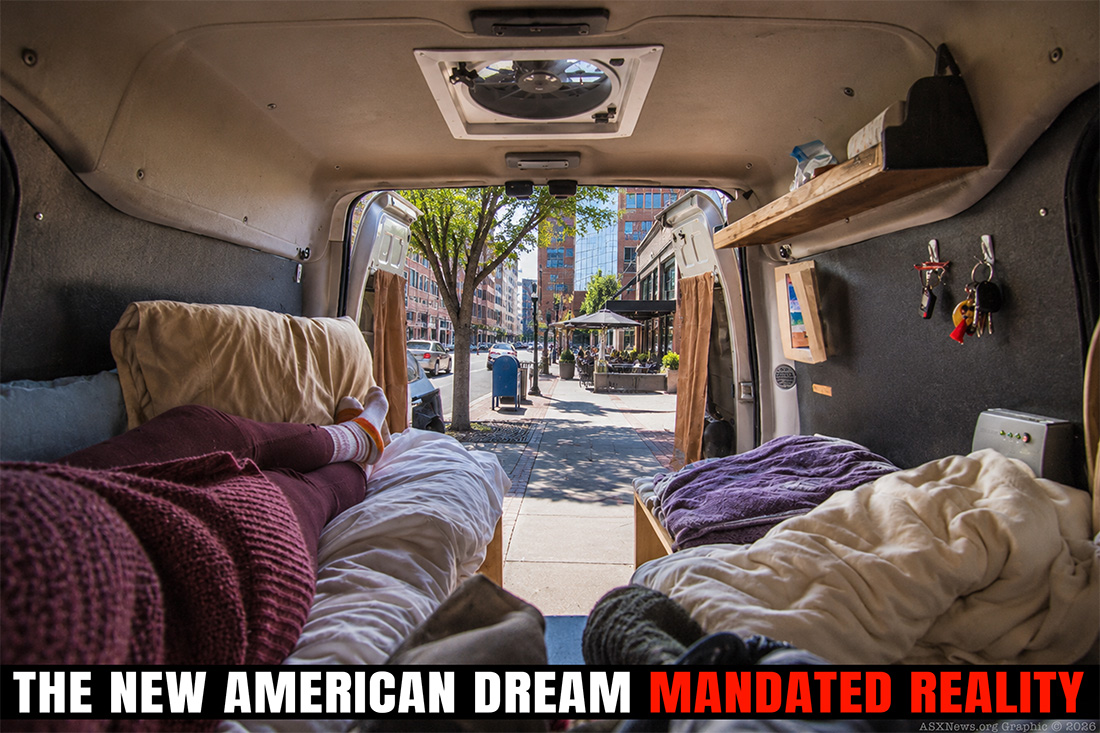
Somewhere in America tonight, a man will finish an eight-hour shift, walk past the parking lot where his coworkers are getting into their cars, and climb into the vehicle he calls home.
He will arrange his belongings, cover the windows, check that the doors are locked and try to find a position comfortable enough to sleep. Tomorrow morning, he will shave, change his clothes, perhaps shower at a gym, and return to work.
His employer may never know.
His coworkers may never suspect.
And the country that taught him that hard work was the pathway to financial independence may have no idea that he is homeless.
This is not a hypothetical economic contradiction. Americans living in vehicles have documented their experiences publicly, describing the difficulty of maintaining employment, personal hygiene, physical safety and a semblance of normal life while sleeping in automobiles that were never designed to be permanent residences.
Some are young. Some are approaching retirement. Some have children. Others have pets they refuse to surrender. Some are unemployed, but others work regular jobs and still cannot qualify for an apartment they can afford.
They are not all living the same story. They do, however, expose a common and profoundly uncomfortable question:
What happens to the American promise of economic opportunity when working for a living no longer guarantees the ability to afford somewhere to live?
For millions of renters, that question is no longer philosophical.
It is mathematical.
The Numbers That Should Shame a Prosperous Nation
In July 2026, the National Low Income Housing Coalition released its annual Out of Reach report, examining the relationship between American wages and the cost of modest rental housing.
Its findings are difficult to reconcile with the familiar proposition that full-time employment should provide a reasonable foundation for independent living.
The average hourly wage earned by American renters was $24.84.
To afford a modest one-bedroom rental home at the applicable national Fair Market Rent without spending more than 30 percent of income on housing, a full-time worker needed to earn $29.19 an hour.
For a modest two-bedroom rental, the required wage increased to $34.73 an hour.
Those figures are not estimates of what a luxury apartment costs. They are based on the federal government’s Fair Market Rent framework and a widely used affordability standard.
At 40 hours per week and 52 weeks per year, the average renter wage translates into approximately $51,667 in gross annual earnings.
The one-bedroom housing wage translates into approximately $60,715.
The two-bedroom housing wage translates into approximately $72,238.
In other words, the average renter’s earnings fall short of the income considered necessary to afford even a modest one-bedroom home under the conventional 30-percent standard.
And that standard is only a measure of affordability. It does not mean a household spending 31 percent of its income on rent will necessarily become homeless, nor does it account for every family’s circumstances.
But it does demonstrate the scale of the mismatch.
According to the same report, 17 of America’s 25 most common occupations paid median wages below the one-bedroom housing wage.
The problem is not confined to people who refuse to work. It reaches directly into the occupations upon which the American economy depends.
Source: National Low Income Housing Coalition, Out of Reach 2026.
When $50,000 a Year Is Not Enough
Consider a worker earning $50,000 annually.
That is approximately $4,167 per month before federal and state income taxes, payroll taxes, health insurance, retirement contributions and other deductions.
Now consider an apartment renting for $1,600 per month.
At that price, the annual rent alone is $19,200, or 38.4 percent of the worker’s gross income.
Under the common landlord screening requirement that an applicant demonstrate monthly gross income equal to three times the rent, the applicant would need to earn $4,800 per month, or $57,600 annually.
The worker earning $50,000 would fail that particular qualification standard before the landlord even considered credit history, rental references or other screening criteria.
And there is an important distinction between what an applicant can afford and what a landlord will approve.
The three-times-rent standard is a common private screening practice, not a universal federal law. Landlords and property managers use different income thresholds, and some consider guarantors, subsidies, savings or other financial circumstances.
Nevertheless, rigid income requirements can create a formidable obstacle for people whose earnings fall just below a property’s threshold.
A worker may have enough money to pay the advertised rent and still be rejected because a screening formula considers that income insufficient.
The calculation becomes even more difficult when an application requires fees, a security deposit, advance rent and the expense of moving.
For a person already spending most of their income on basic necessities, the cost of obtaining housing can become a barrier separate from the cost of maintaining it.
One woman featured in the video that prompted this investigation described precisely this dilemma: she could see apartments advertised at prices she might conceivably manage, but the income demanded to qualify for them was beyond her reach.
Her experience is testimony, not a representative national survey. Yet the financial mechanism she describes is real and readily reproducible.
A paycheck can be large enough to survive on and still be too small to qualify for a lease.
America’s Rental Crisis Is Not an Illusion
The Harvard Joint Center for Housing Studies provides some of the clearest evidence of how deeply rental affordability has deteriorated.
Its 2026 report, America’s Rental Housing, found that 22.7 million renter households were cost burdened in 2024, the latest year measured in the report.
That means they spent more than 30 percent of household income on rent and utilities.
Of those households, 12.1 million were severely cost burdened, spending more than half their income on housing.
Nearly 48.3 million people lived in cost-burdened renter households, including approximately 13 million children and 5.8 million older adults.
These are not 22.7 million homeless households. They are households still occupying rental housing but facing financial pressures that can make continued occupancy precarious.
That distinction matters because the progression from housing instability to homelessness is not inevitable.
It is, however, a risk that becomes increasingly serious when households have little money left to absorb emergencies.
Harvard found that renters earning under $30,000 annually had a median of just $210 per month remaining after housing costs in 2024, compared with approximately $410 in 2019, adjusted for inflation.
That remaining amount must compete with food, transportation, healthcare, clothing, communication services and countless other necessities.
One unexpected expense can overwhelm such a budget.
A medical bill.
A broken transmission.
A reduction in working hours.
A family emergency.
None of these events requires financial irresponsibility. They are ordinary hazards of living.
Yet for households without meaningful savings, an ordinary hazard can become a housing emergency.
Source: Harvard Joint Center for Housing Studies, America’s Rental Housing 2026.
The Missing Seven Million Homes
One of the most revealing findings in the national housing data concerns the supply of homes affordable to people with the lowest incomes.
In March 2026, the National Low Income Housing Coalition reported a shortage of 7.2 million rental homes that were both affordable and available to extremely low-income households.
Across the country, approximately 11 million extremely low-income renter households were competing for just 3.8 million homes meeting those criteria.
That translates into only 35 affordable and available homes for every 100 extremely low-income renter households.
No state had an adequate supply.
The words affordable and available are essential.
A rental unit may be inexpensive but already occupied by a higher-income household. Another may be vacant but priced beyond the means of the people who need it most.
Neither necessarily represents a realistic housing opportunity for a struggling worker.
This helps explain why the existence of new apartment buildings does not automatically resolve the housing crisis.
Construction adds supply, and additional supply can relieve pressure in housing markets over time. But the private market does not necessarily produce homes affordable to households with the least purchasing power.
Developers face land prices, financing costs, insurance expenses, construction labor costs, materials, permitting requirements and the need to generate sufficient revenue to support a project.
Those pressures can encourage development aimed at renters who can afford higher prices.
Meanwhile, older, lower-cost housing may disappear through demolition, conversion, deterioration or rent increases.
Harvard’s 2026 housing research documents a shrinking stock of low-rent units alongside growth in higher-rent housing.
The outcome is not necessarily evidence of a coordinated effort to exclude poor Americans. It is evidence that the incentives governing housing production do not reliably meet the needs of people with the least money.
That distinction does not make the outcome less serious.
A housing market can function profitably for investors while failing to provide adequate housing for a substantial portion of the people who work within it.
Sources: The Gap 2026 and Harvard, The State of the Nation’s Housing 2026.
The People Who Disappear Into Their Vehicles
For some Americans, the final alternative to an unaffordable apartment is a vehicle.
A minivan becomes a bedroom.
A sedan becomes a shelter.
A station wagon becomes a place to store everything a person has managed to keep.
The people who live this way are not a single demographic group.
Some deliberately choose vehicle-based living for travel, flexibility or personal preference. Others enter it because they have lost housing and cannot obtain a replacement.
Those experiences must not be confused.
Voluntary van life can involve financial planning, specialized equipment, recreational travel and the freedom to choose where to go.
Involuntary vehicle homelessness can involve inadequate sanitation, unsafe temperatures, lack of privacy, restricted parking, financial insecurity and the constant threat of losing the vehicle itself.
One is a lifestyle choice. The other is a housing failure.
The video examined for this report presents firsthand accounts of people sleeping in cars while attempting to preserve their employment, personal safety and dignity.
One woman describes organizing her clothing inside a Toyota Sienna and creating a sleeping space for herself and her pet.
Another describes the importance of tinted windows, privacy covers and access to a gym shower.
Others describe waking in parking lots, finding places where overnight parking is tolerated, and preparing for work without revealing where they slept.
Their accounts convey a reality that national housing statistics cannot fully express.
When someone lives in a vehicle, the tasks that most housed Americans take for granted become logistical problems requiring daily attention.
Where can they shower?
Where can they use a restroom?
Where can they safely sleep?
Where can they receive mail?
Where can they store medication?
Where can they prepare food?
And how do they answer the ordinary question, Where do you live?
Each of these challenges consumes time, money and emotional energy that might otherwise be devoted to employment, education, family or recovery from financial hardship.
The National Homelessness Count Cannot Tell the Entire Story
The Department of Housing and Urban Development’s 2025 Annual Homelessness Assessment Report estimated that 745,652 people experienced homelessness on a single night in January 2025.
Of those, approximately 266,320 were counted as unsheltered.
The total represented a decrease from the 2024 point-in-time estimate, although homelessness remained substantially higher than it had been in 2013.
These numbers deserve careful interpretation.
A point-in-time count is a snapshot, not a complete annual census of everyone who experiences housing instability.
People who lose housing for a short period, move between temporary arrangements or remain difficult for outreach workers to identify may not appear in a particular night’s count.
People living in vehicles may qualify as unsheltered under federal homelessness definitions, but identifying occupied vehicles and determining who is living inside them presents practical challenges.
The available national data therefore cannot establish precisely how many employed Americans are sleeping in vehicles on any given night.
It would be irresponsible to manufacture that number from anecdotal videos or individual local studies.
But the absence of a complete national count is itself a serious limitation.
A country cannot fully understand a housing crisis if some of the people experiencing it are deliberately trying not to be seen.
Source: U.S. Department of Housing and Urban Development, 2025 Annual Homelessness Assessment Report.
The Second Job Nobody Pays Them For
Imagine finishing a demanding workday and beginning another shift that does not appear on any payroll.
You must locate a place to sleep.
You must determine whether parking there is legal, tolerated or likely to result in a confrontation.
You must arrange window coverings, organize your belongings and prepare for the possibility that someone will knock on the glass during the night.
In the morning, you must restore the interior of the vehicle to a condition suitable for driving, locate restroom facilities and prepare yourself to appear at work as though you had slept in a conventional home.
This routine is particularly punishing because employment itself depends upon many of the resources that housing normally provides.
Sleep is essential to concentration, judgment and physical health.
Reliable transportation is essential to reaching many workplaces.
Clean clothing and access to sanitation can affect workplace expectations.
A stable address can be important for financial accounts, documentation and administrative correspondence.
When a vehicle becomes both shelter and transportation, the loss of either function threatens the other.
A mechanical failure that would ordinarily be a costly inconvenience can become an immediate housing emergency.
The transcript includes the account of a man trying to determine whether his vehicle could survive a long drive to obtain a cheaper alternator replacement.
His choice was not merely between two repair bills.
It was between maintaining the vehicle that sheltered him and risking the breakdown of the transportation system on which his survival depended.
That is the economic vulnerability of vehicle homelessness in its starkest form.
The engine is not simply a means of transportation. It is part of the roof over someone’s head.
When Sleeping Becomes a Legal Problem
There is another contradiction facing Americans who live in vehicles.
They may be unable to afford a conventional home while also being prohibited from sleeping in many of the public places where they can park.
In June 2024, the United States Supreme Court decided City of Grants Pass v. Johnson, a case concerning the enforcement of public-camping restrictions against people experiencing homelessness.
In a 6–3 decision, the Court held that the Eighth Amendment’s prohibition on cruel and unusual punishment did not prevent the city from enforcing its generally applicable public-camping ordinances.
The decision did not establish a nationwide prohibition on sleeping in vehicles. Nor did it require municipalities to adopt such restrictions.
It resolved a particular constitutional question while leaving other legal issues and policy choices to be addressed through separate proceedings and local government decisions.
Nevertheless, the underlying case is directly relevant to vehicle homelessness.
The two named plaintiffs slept in their cars, and the challenged ordinances included restrictions that could apply to people using vehicles as temporary living spaces.
Supporters of restrictions on public camping argue that local governments must be able to protect public spaces, maintain sanitation, preserve access and address safety concerns.
Those are legitimate public responsibilities.
Critics argue that imposing penalties on people who have no realistic alternative place to sleep can deepen poverty without creating additional housing.
That concern is also legitimate.
The practical problem remains whether enforcement is accompanied by accessible alternatives.
A parking citation does not create an apartment.
A vehicle impoundment can eliminate a person’s transportation and shelter simultaneously.
And forcing someone to move from one parking lot to another does not necessarily resolve the circumstances that made them homeless.
Source: Supreme Court of the United States, City of Grants Pass v. Johnson, June 28, 2024.
Winter: When a Car Becomes a Dangerous Place to Sleep
Living in a vehicle can become particularly hazardous during extreme weather.
In cold conditions, occupants may struggle to maintain a safe sleeping temperature. In hot conditions, vehicle interiors can reach dangerous temperatures even when the outside air feels relatively tolerable.
The transcript includes a woman preparing for a night in temperatures around 19 degrees Fahrenheit.
She describes warming the vehicle before bed, arranging blankets and using a sleeping bag to protect herself from the cold.
Such accounts reveal the improvisation required to survive in an environment that was not designed for residential use.
Running an engine for heat introduces additional expense and safety concerns, including the risk of carbon monoxide exposure if exhaust ventilation is compromised.
Portable heating devices can also create fire or combustion hazards when used improperly inside enclosed vehicles.
Leaving windows open for ventilation may reduce privacy and expose occupants to cold, rain or unwanted attention.
Families face additional difficulties when children are involved, particularly when a shelter’s eligibility rules, capacity or accommodation arrangements do not meet their circumstances.
Pets can create another barrier when shelters cannot accept animals.
For some people, surrendering a pet may mean giving up one of the few stable emotional relationships remaining in their lives.
These are not trivial inconveniences.
They are the daily consequences of a society in which housing insecurity can force people to use emergency improvisation as a long-term living arrangement.
The Crisis Is Moving Up the Income Ladder
One of the most troubling aspects of the American housing problem is that financial pressure is no longer confined to households with the lowest incomes.
Harvard’s 2026 housing research found that the share of renters earning between $45,000 and $74,999 who were cost burdened increased by 9.5 percentage points between 2019 and 2024, reaching approximately 49 percent.
That means housing costs were consuming more than 30 percent of income for nearly half the renters in this income category.
For renters earning between $30,000 and $44,999, the cost-burden rate reached approximately 72 percent.
Higher-income households generally possess greater financial flexibility, but rising housing costs, childcare expenses, insurance premiums and healthcare obligations can still create substantial pressure.
These circumstances are not equivalent to living in a car.
A family struggling to save while paying a mortgage is not in the same immediate position as a worker sleeping in a parking lot.
But the pressures can arise from overlapping economic forces.
When housing costs consume a larger share of earnings, households have less money available to build savings, replace vehicles, manage emergencies or prepare for retirement.
The loss of financial flexibility can increase vulnerability to future disruption.
And for people already near the bottom of the housing market, there may be no cheaper conventional option remaining.
That is where the distinction between housing stress and homelessness becomes critically important.
Not everyone experiencing housing stress will become homeless.
But many people who become homeless have experienced housing stress first.
Retirement Without a Roof
America’s housing crisis also raises difficult questions about retirement security.
Older Americans may have limited opportunities to increase their earnings, particularly when health conditions, caregiving responsibilities or age-related employment barriers restrict their options.
For retirees who rent, Social Security benefits and modest savings may have to cover housing, food, transportation, medication and other essential expenses.
A substantial rent increase can disrupt a budget that has little room to adjust.
Unlike homeowners who have accumulated equity, renters may reach retirement without a major housing asset.
Harvard’s research found that renter households had a median net wealth of approximately $10,400, compared with approximately $396,200 for homeowner households, using data from the 2022 Survey of Consumer Finances.
That comparison reflects substantial differences in assets and financial circumstances; it does not establish that renting alone causes the wealth gap.
Nevertheless, it illustrates why older renters may have fewer resources available to absorb major financial shocks.
For someone approaching retirement, the prospect of losing housing is especially frightening because the time available to rebuild financial security is limited.
A worker in their twenties may hope to recover from a period of homelessness through future earnings.
A person in their seventies may not have that option.
When an older American is forced to choose between rent, medication and food, the question is no longer whether they planned adequately for retirement.
It is whether the economic and social systems around them provide a realistic means of maintaining basic security.
Who Is Responsible?
There is no single explanation for America’s housing affordability crisis, and assigning every consequence to one political party, corporation or government policy would conceal the complexity of the problem.
Housing supply is influenced by local zoning, land-use restrictions, construction costs, interest rates, insurance, infrastructure availability and the time required to approve and complete new development.
Demand is influenced by population changes, household formation, migration, employment opportunities and the geographic concentration of economic activity.
Wages depend upon labor-market conditions, productivity, bargaining power, occupation and regional economic differences.
Federal housing programs, state regulations and local policies affect how much assistance is available and who qualifies for it.
These forces interact.
Restrictive zoning can limit the construction of additional housing. High financing costs can make projects difficult to build. Insufficient assistance can leave the poorest renters unable to compete for available homes. And wages that fail to keep pace with local housing costs can leave employed households struggling even in communities experiencing economic growth.
Some argue that reducing regulations and allowing substantially more housing construction would improve affordability by increasing supply.
Others emphasize the need for rental assistance, deeply affordable housing, stronger tenant protections and targeted public investment.
These approaches are not necessarily mutually exclusive.
Increasing housing supply may improve market conditions, but it does not guarantee that households with extremely low incomes will be able to afford the resulting units.
Direct assistance may protect vulnerable renters, but it cannot fully resolve shortages if the underlying supply of homes remains inadequate.
Tenant protections can reduce certain forms of displacement, while their design and effects on investment and housing availability require careful consideration.
Any serious response must confront both the availability of housing and the ability of people to pay for it.
And it must confront the fact that the burden of failure is not distributed equally.
People with substantial savings can survive temporary market disruptions.
People with family support may find somewhere to stay.
People with neither may find themselves sleeping in a vehicle.
Safe Parking: An Immediate Response, Not a Permanent Solution
Some American communities have developed safe-parking programs intended to provide people living in vehicles with a lawful place to sleep.
Depending on the program, participants may receive access to restrooms, security, case management, housing referrals or other support services.
Such programs address a real problem: people living in vehicles need safe places to park while seeking stable housing.
They may reduce the immediate risks associated with repeated displacement, unsafe parking locations and lack of access to services.
But safe parking should not be confused with a permanent housing solution.
A parking space is not a bedroom.
A restroom shared by dozens of people is not a substitute for a home.
And a temporary program cannot compensate indefinitely for a rental market that excludes people earning ordinary wages.
The effectiveness of individual programs must be assessed through measurable outcomes, including participant safety, housing placements, duration of participation and the availability of follow-up support.
Claims that safe-parking programs consistently move large percentages of participants into permanent housing require program-specific evidence. There is no single national success rate that can responsibly be applied to every community.
The appropriate goal is not to make vehicle homelessness more comfortable as a permanent condition.
It is to create a practical route out of it.
The Economic Cost of Keeping People Homeless
Homelessness is often discussed as though the principal public-policy question is how much assistance society can afford to provide.
But instability also creates costs.
People without secure housing may experience interruptions in employment, greater difficulty managing medical conditions and increased exposure to emergency situations.
Local governments may incur costs associated with emergency medical responses, sanitation, policing, temporary shelter, vehicle enforcement and repeated displacement.
Employers may lose otherwise capable workers when housing instability disrupts transportation, sleep or attendance.
Children experiencing housing instability may face educational interruptions and difficulties maintaining consistent routines.
These consequences vary considerably across individuals and communities. They should not be converted into invented national cost estimates.
Nevertheless, the economic principle is straightforward.
Failing to provide pathways to stable housing does not necessarily eliminate public expenditure.
It may redirect spending toward the management of crises that stable housing could help prevent.
The question is not simply whether assistance costs money.
It is whether the current system is using available resources effectively to reduce the conditions that produce homelessness.
The American Dream Has a Qualification Requirement
For generations, Americans have been encouraged to believe that hard work, financial discipline and personal responsibility provide a pathway toward stability.
That belief has never been universally realized. Economic opportunity has always varied according to family circumstances, geography, discrimination, education and countless other factors.
But the promise of advancement through work remains central to the country’s understanding of itself.
It is difficult to preserve that promise when an employed person can work full-time and remain unable to afford a modest apartment.
It is more difficult still when the person can afford to make monthly payments but cannot satisfy the income requirements imposed by a landlord.
And it becomes extraordinarily difficult when losing housing creates additional obstacles to keeping the job that might eventually make housing possible again.
The result can become a self-reinforcing cycle.
Without stable housing, employment becomes harder to maintain.
Without reliable employment, qualifying for housing becomes harder.
Without housing, saving money becomes harder.
Without savings, every emergency becomes more dangerous.
The familiar advice to work harder does not address that cycle when the person is already working as much as their circumstances allow.
Nor does the advice to move somewhere cheaper always provide a realistic solution. Relocation requires money, transportation, employment opportunities and access to housing in the destination community.
Some Americans have managed to improve their circumstances by relocating to less expensive regions or countries.
Others cannot leave because of family obligations, employment requirements, health needs, immigration restrictions or the expense of moving.
The ability to escape an unaffordable housing market is itself an economic advantage.
The Human Cost of Being Invisible
There is a particular cruelty in a form of homelessness that depends upon concealment.
People who live in vehicles may feel compelled to hide their circumstances from employers, coworkers, customers and even friends.
They may fear embarrassment, discrimination, unwanted intervention or the loss of professional credibility.
Some may have spent years building careers and reputations that they worry will be damaged if others discover where they sleep.
Others may simply want to preserve a measure of privacy during an extraordinarily difficult period.
Whatever the reason, concealment carries its own burden.
It requires constant vigilance.
It can discourage people from seeking assistance.
It can isolate them from the very relationships that might help them recover.
And it makes the problem easier for the wider public to ignore.
A person sleeping on a sidewalk is visibly homeless.
A person sleeping in a parked sedan may appear to be an ordinary motorist.
By morning, that same person may be wearing a uniform, answering customer calls, repairing equipment, caring for patients or performing any number of jobs essential to everyday life.
They may be contributing to the economy while having no secure place within it to sleep.
That is what makes this form of homelessness so difficult to confront. The people experiencing it can be standing directly in front of us, and we may never know.
What Would Meaningful Accountability Look Like?
A serious national response would begin by measuring the problem more accurately.
How many Americans are living in vehicles because they cannot afford conventional housing?
How many are employed?
How many have children or dependent family members?
How many have been denied housing because of income screening, credit requirements or the inability to assemble move-in funds?
How many have lost employment because vehicle homelessness disrupted their transportation or physical health?
And how many could return to stable housing with relatively modest, targeted assistance?
Answers to those questions would help distinguish the different forms of housing instability that are often grouped together under the broad label of homelessness.
Policy responses could then be evaluated against specific objectives: increasing affordable supply, preventing displacement, improving access to rental housing, expanding effective assistance and reducing the time people spend without stable shelter.
Those efforts require scrutiny.
Public programs should be assessed for cost, effectiveness, unintended consequences and the actual number of people they help obtain and retain housing.
Private-sector solutions should be evaluated with equal seriousness, including whether new construction produces meaningful affordability improvements and whether screening practices unnecessarily exclude financially viable tenants.
Success should not be measured merely by how many dollars are spent or how many units are announced.
It should be measured by whether more people can afford safe, stable places to live.
A Country That Can Build Almost Anything
The United States possesses extraordinary engineering, scientific, industrial and financial capabilities.
It develops spacecraft, builds advanced aircraft, operates immense logistics networks and creates technologies that transform the global economy.
It has the resources to undertake projects that would have been unimaginable to previous generations.
Yet within that same country, some employed Americans sleep in parking lots because they cannot afford apartments.
The contradiction should command national attention.
It does not mean that every person experiencing homelessness has been failed by precisely the same institution or policy.
It does mean that a prosperous society should examine the conditions under which ordinary employment ceases to provide a realistic pathway to basic shelter.
The people living this reality do not need to be portrayed as helpless, irresponsible or heroic merely because they are enduring hardship.
They deserve to be understood as individuals with skills, obligations, ambitions, relationships and dignity.
They deserve accurate reporting rather than exaggerated statistics.
They deserve policies evaluated by outcomes rather than slogans.
And they deserve a public conversation that does not treat their suffering as an embarrassing inconvenience to be moved out of sight.
Tonight, somewhere in America, another worker will finish a shift and return to a vehicle.
They will prepare for sleep, hoping not to be disturbed.
Tomorrow, they will go back to work.
And the country around them may continue to call that economic participation a success.
But a nation should ask itself what success means when people can do everything expected of a working American and still have nowhere to call home.
They are working hard. They are homeless. And they are hiding in plain sight.
Primary Sources and Further Reading
1. National Low Income Housing Coalition — Out of Reach 2026: The High Cost of Housing. July 23, 2026. National housing wages, average renter earnings and affordability comparisons. Read source.
2. Harvard Joint Center for Housing Studies — America’s Rental Housing 2026. Cost-burdened renter households, severe affordability burdens, children and older adults affected, and trends across income groups. Read report.
3. Harvard Joint Center for Housing Studies — The State of the Nation’s Housing 2026. Low-cost rental housing supply, renter wealth, income pressures and the decline in income remaining after housing expenses. Read report.
4. National Low Income Housing Coalition — The Gap 2026: A Shortage of Affordable Homes. March 5, 2026. National shortage of 7.2 million affordable and available rental homes for extremely low-income households. Read report.
5. U.S. Department of Housing and Urban Development — 2025 Annual Homelessness Assessment Report, Part 1. Released May 29, 2026. National point-in-time estimates of sheltered and unsheltered homelessness. Read release and report.
6. Supreme Court of the United States — City of Grants Pass v. Johnson. June 28, 2024. Decision concerning public-camping ordinances and the Eighth Amendment, including circumstances involving individuals living in vehicles. Read decision.
Editorial methodology: This investigation was prompted by a documentary-style video compiling personal accounts of Americans living in vehicles. Those accounts are treated as individual testimony, not a statistically representative sample. National claims were independently checked against published research and government records. Unsupported transcript figures concerning the precise employment rate of vehicle residents, the proportion of vehicle households with children or pets, and the frequency of rental delinquency among particular income groups have not been reproduced as verified findings. Calculations involving wages and rental qualification requirements are illustrative and use gross income unless otherwise specified.