

November 16, 2026 — ASX News Investigative Report
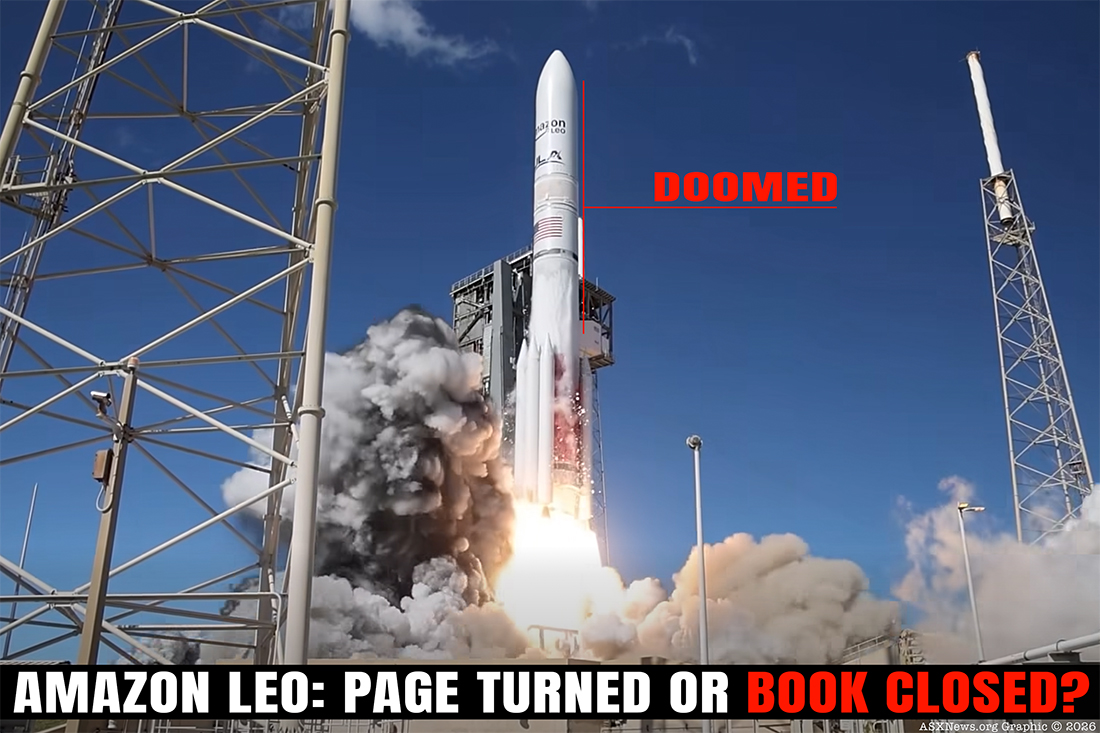
At 12:40 p.m. Eastern Standard Time on November 15, a United Launch Alliance Vulcan rocket rose from Space Launch Complex 41 at Cape Canaveral Space Force Station, carrying 40 Amazon Leo broadband communications satellites and the expectations of one of the most ambitious commercial space infrastructure programs ever undertaken.
Approximately ten minutes later, those expectations collided with reality.
Vulcan suffered an in-flight anomaly and failed to deliver its payload into orbit. All 40 satellites were lost. For United Launch Alliance (ULA), the Boeing–Lockheed Martin joint venture that has spent two decades building its reputation around assured access to space, the event represented its first complete mission failure since the company’s formation in 2006.
For Amazon, the loss was considerably more complicated.
The satellites were not simply another shipment of hardware. They represented the opening mission of a 38-launch agreement with ULA, the first operational use of newly developed launch infrastructure financed by Amazon, and the beginning of what was supposed to become a high-frequency deployment campaign capable of placing approximately half of Amazon’s first-generation satellite constellation into orbit.
For the thousands of engineers, technicians, manufacturing personnel, construction workers and suppliers whose livelihoods are connected to this emerging industrial ecosystem, the failure introduces an entirely different dimension of uncertainty.
And for Elon Musk’s SpaceX, whose Starlink network already dominates the low Earth orbit satellite broadband market, the failure potentially extends an extraordinary competitive advantage.
The loss of Vulcan was not merely the loss of a rocket. It was the interruption of an industrial strategy involving billions of dollars, thousands of employees, multiple aerospace companies, federal regulatory obligations and the future competitive structure of commercial space communications.
The question now is not simply what happened ten minutes after liftoff. It is what happens to everything on Earth that was depending upon the rocket reaching orbit.
A Launch That Was Supposed to Restore Confidence
The November 15 mission, designated Leo Vulcan 1, or LV-01, was particularly important because it represented Vulcan’s return to flight following approximately nine months of inactivity.
During the February 12, 2026, USSF-87 national security mission, one of Vulcan’s Northrop Grumman GEM 63XL solid rocket boosters experienced a nozzle anomaly shortly after liftoff. Although the vehicle compensated for the malfunction and successfully delivered its payload, the incident was the second significant solid rocket booster anomaly in Vulcan’s first four flights.
A similar problem during the rocket’s October 2024 certification mission had already demonstrated the ability of Vulcan’s propulsion and flight-control systems to compensate for unexpected performance degradation.
That ability to recover was encouraging. The recurrence of the underlying booster problem was not.
The United States Space Force subsequently suspended further national security missions aboard Vulcan while ULA, Northrop Grumman and government specialists investigated the anomalies and evaluated corrective measures.
The November Amazon mission was therefore more than a commercial launch. It was an opportunity to demonstrate that Vulcan’s revised booster hardware could perform reliably in an operational flight environment.
According to Northrop Grumman’s preliminary assessment following the November failure, all six solid rocket boosters performed as expected and separated successfully before the subsequent anomaly.
That distinction is important. The component that had previously raised concerns may have performed correctly, while a different part of the vehicle or its associated systems encountered a mission-ending problem.
Vulcan may have successfully addressed one major technical challenge only to expose another.
Additional background on the vehicle’s return to flight and earlier booster anomalies is available in Spaceflight Now’s prelaunch coverage.
Three Launch Attempts and a Fatal Ten Minutes
The mission’s difficulties began before the rocket left the ground.
The original November 13 launch attempt was postponed following an electrical power interruption at an Air Liquide gaseous nitrogen production facility supporting launch operations. The interruption affected high-pressure pumps necessary to maintain the supply of nitrogen used in rocket and ground-system operations.
A second launch attempt on November 14 was postponed because of a communications problem between the launch vehicle and ground equipment.
During the November 15 countdown, launch controllers halted the sequence approximately 20 seconds before liftoff. The countdown was recycled, and the launch was ultimately conducted near the end of the available window.
The rocket initially appeared to perform successfully. Its six solid rocket boosters completed their burns and separated. The first-stage BE-4 engines continued the ascent before the Centaur upper stage separated and began its own propulsion sequence.
Approximately ten minutes after liftoff, however, the mission encountered the anomaly that prevented orbital insertion.
Independent reporting indicates that the failure occurred during the planned first burn of the Centaur upper stage. ULA has not yet released sufficient engineering information to establish the initiating failure, the sequence of subsequent events or the precise mechanism by which the mission was lost.
Questions remain regarding the performance of the first stage, the upper-stage propulsion system, vehicle orientation and the relationship, if any, between the final countdown interruption and the subsequent in-flight anomaly.
At this stage, there is no established causal connection between the prelaunch difficulties and the loss of the vehicle.
It would be premature to identify a particular engine, valve, software system or manufacturing defect as the cause. It would be equally premature to assume that the problem is confined to the upper stage merely because the mission-ending event became apparent during that portion of the flight.
Investigators must distinguish the initiating event from the point at which its consequences became unrecoverable.
ULA’s initial confirmation and the known flight sequence are documented in Reuters’ reporting and Spaceflight Now’s mission analysis.
The Engineering Gamble Behind Amazon’s Vulcan
LV-01 was not a routine flight of an established launch configuration.
It was the first Vulcan mission to employ six solid rocket boosters, together with a shortened, low Earth orbit-optimized version of the Centaur V upper stage. The configuration, designated VC6L, was designed to maximize the amount of payload Vulcan could deliver into the orbital environment required by Amazon Leo.
The commercial logic was straightforward. A rocket capable of carrying more satellites on each mission can reduce the number of launches required to establish a constellation, accelerate deployment and potentially lower the average transportation cost per satellite.
But the engineering consequences of modifying a launch vehicle extend beyond its advertised payload capacity.
Changes to stage dimensions, propellant loading, structural characteristics, vehicle mass distribution and mission profiles must be evaluated as part of an integrated system. Individual components can possess extensive operating histories while the particular configuration in which they are employed remains relatively new.
The Centaur family has a distinguished history in American spaceflight. Nevertheless, the heritage of a propulsion system does not eliminate the need to validate its performance within a new vehicle configuration.
Amazon had also indicated before the launch that subsequent Vulcan missions would introduce additional hardware improvements intended to increase payload capacity further.
The resulting investigation must therefore determine not only why LV-01 failed, but whether the underlying problem has implications for other Vulcan configurations, future hardware upgrades or vehicles already under construction.
If the failure proves unique to the low Earth orbit configuration, the consequences for other Vulcan missions could be more limited. If investigators identify a common component, design assumption or production issue, the implications could extend across the entire launch program.
Amazon’s description of the new configuration and its planned role in the constellation is available in the company’s November 9 mission announcement.
Who Actually Pays for the Loss?
One of the least understood aspects of a commercial launch failure is the distribution of its financial consequences.
The loss of a rocket and its payload does not necessarily mean that the launch provider is financially responsible for replacing everything that was destroyed.
Commercial spaceflight involves a complex allocation of risk through launch service agreements, insurance policies, liability limitations, contractual warranties, indemnification provisions and arrangements between launch providers and spacecraft manufacturers.
In this case, at least three major categories of direct financial exposure exist.
The launch vehicle: ULA expended a Vulcan rocket, its engines, six solid rocket boosters, the Centaur upper stage, payload fairing and associated mission hardware without completing the contracted orbital delivery.
The payload: Amazon lost 40 completed broadband satellites, together with associated payload deployment hardware that had been manufactured, tested, transported and integrated for the mission.
The recovery program: Both companies must now commit engineering resources, management attention and potentially additional hardware to determine what happened and restore confidence in the launch system.
The actual financial allocation depends on the terms of the launch agreement between Amazon and ULA. Those terms have not been publicly disclosed in sufficient detail to establish whether Amazon is entitled to a replacement launch, a partial refund, other contractual compensation or no reimbursement for particular categories of loss.
Similarly, the existence, coverage limits, exclusions and deductibles of any mission-specific insurance policy have not been established publicly.
Launch insurance can protect against certain spacecraft and mission losses. However, commercial satellite constellation operators may also retain some or all of the risk internally, particularly when they possess the financial resources and manufacturing capacity to replace lost spacecraft.
It would therefore be inaccurate to assign a definitive dollar value to the LV-01 failure or to declare that ULA, Amazon or a particular insurer will absorb the entire loss.
What can be established is that the economic consequences extend considerably beyond the hardware destroyed during the flight.
Amazon’s Financial Exposure: The Cost of Waiting
Amazon possesses a financial advantage that many emerging satellite operators do not: the ability to support an enormous capital-intensive project through the resources of a diversified global corporation.
In a January 2026 submission concerning its satellite deployment obligations, Amazon disclosed that it had committed well over $10 billion to its satellite broadband system, including billions of dollars in launch agreements.
That figure places the loss of 40 satellites into perspective. The destruction of a single batch of spacecraft is serious, but it does not, by itself, threaten the financial survival of Amazon.
The more consequential exposure is the potential interruption of the timetable through which those investments are supposed to become a functioning revenue-generating network.
Every month that a satellite remains on Earth is another month in which it cannot provide broadband capacity, serve customers or contribute to the recovery of the capital invested in manufacturing it.
Meanwhile, the associated costs continue.
Manufacturing facilities require maintenance. Employees require compensation. Completed spacecraft require storage, monitoring and handling. Ground infrastructure must remain operational. Software development, regulatory compliance and customer-terminal production cannot necessarily be suspended simply because a launch vehicle has become unavailable.
Amazon may also face costs associated with renegotiating launch schedules, reallocating payloads, modifying integration hardware or purchasing additional transportation capacity from alternative providers.
There is an important distinction between the financial loss associated with destroyed assets and the opportunity cost associated with delayed deployment.
The first is an immediate event. The second can accumulate for months or years.
For a business entering a market in which its principal competitor is already operating at global scale, time is not merely an administrative consideration. It is an economic asset.
Amazon’s regulatory filing describing the scale of its investment and manufacturing operations is available here.
United Launch Alliance: The Loss of a Twenty-Year Distinction
For ULA, the November failure introduces a different kind of financial and strategic challenge.
Since its establishment in 2006, the company has operated in a market where reliability, rather than simply launch price, has been central to its commercial identity.
ULA’s Atlas and Delta heritage supported some of the most consequential missions undertaken by the United States, including national security spacecraft, scientific exploration missions and commercially valuable satellites.
Customers purchasing launch services for exceptionally expensive or irreplaceable spacecraft have historically been willing to pay a premium for confidence in mission success.
Vulcan was developed to replace the Atlas V and Delta IV families while allowing ULA to compete more effectively in a launch market increasingly shaped by SpaceX’s reusable Falcon vehicles.
That transition was already difficult. The November failure makes it more so.
ULA must now investigate a major anomaly while continuing to support its workforce, manufacturing facilities, suppliers and existing customer commitments. Rockets already under construction may require additional inspections or modifications, depending on the eventual findings.
Revenue associated with future missions may also be affected if launches are delayed or contractual milestones cannot be completed on schedule.
However, ULA’s financial exposure cannot be measured simply by multiplying an assumed launch price by the number of delayed missions. Customer payments, manufacturing expenditures and revenue recognition may occur at different stages of a contract.
The company’s ownership structure introduces another layer of complexity. ULA is a joint venture between Boeing and Lockheed Martin, both of which have extensive aerospace and defense operations.
Those parent companies provide a broader industrial and financial foundation than an independent startup would possess. Nevertheless, their willingness to provide additional financial support, and the terms under which such support might be provided, cannot be assumed.
The investigation will influence more than Vulcan’s technical recovery. It could influence customer confidence, future contract negotiations, financing decisions and the strategic value of ULA itself.
For a company whose commercial proposition has been built around mission assurance, restoring confidence may prove as important as repairing the vehicle.
The Vertical Integration Facility That Was Built for a Launch Revolution
One of the most revealing aspects of the LV-01 failure is visible not in the sky above Cape Canaveral, but on the ground.
Amazon has financed dedicated infrastructure intended to transform ULA’s ability to prepare and launch Vulcan rockets.
The investment includes a dedicated Vertical Integration Facility, designated VIF-A, and a second mobile launch platform customized for Amazon’s Vulcan missions.
These facilities are designed to allow ULA to assemble and prepare multiple rockets simultaneously rather than requiring one mission to clear the integration process before the next vehicle can be prepared.
Amazon’s November 9 announcement explained that the second Leo Vulcan mission, LV-02, was already undergoing preparations in the separate VIF-G integration facility while LV-01 was being readied for launch.
The objective was to reduce the time between missions to weeks, and potentially days, as Vulcan’s production and launch operations matured.
That ambition now confronts an uncomfortable reality.
A launch facility designed to eliminate scheduling bottlenecks cannot compensate for the unavailability of the rocket it was built to support.
The buildings, platforms, electrical systems, cryogenic infrastructure, control equipment and specialized personnel remain necessary even when the launch manifest is interrupted.
Depending on the findings of the investigation, vehicles already assembled could require partial disassembly, additional testing, replacement components or changes to established integration procedures.
These activities could occupy facilities that would otherwise be preparing additional missions.
The result is a potential industrial bottleneck in reverse: instead of rockets waiting for launch infrastructure to become available, expensive launch infrastructure may be waiting for rockets to become safe to fly.
Amazon did not merely purchase 38 launches. It invested in the industrial capacity necessary to conduct those launches at an unprecedented pace for ULA.
The distinction is central to understanding why the loss of the inaugural mission matters so much.
What Happens to the Employees?
Behind the launch statistics and corporate announcements is a workforce that has spent years building an entirely new American satellite manufacturing and deployment system.
Amazon’s regulatory submissions indicate that its satellite manufacturing operations employ more than 1,500 full-time personnel working across multiple shifts. Thousands of additional employees are involved in the broader program.
The company’s Kirkland, Washington, manufacturing operation has been developed to produce as many as five satellites per day at peak capacity.
Completed spacecraft are transported across the United States to Florida, where technicians perform electrical checks, prepare onboard propulsion systems and integrate the satellites into launch dispensers.
Amazon has invested approximately $140 million in its Florida payload processing site and associated expansion. The company reported that the operation had already generated more than 130 Space Coast jobs by July 2025.
At full capacity, the Florida operation is intended to process more than 100 satellites per month and support three simultaneous launch campaigns.
These are not interchangeable warehouse positions. The work requires specialized knowledge of spacecraft systems, electrical testing, contamination control, mechanical integration, propulsion hardware, safety procedures and the handling of expensive flight-qualified equipment.
For employees, a prolonged interruption in launches can create uncertainty even when the underlying program remains financially viable.
Management may need to revise production targets, shift employees between projects, alter overtime schedules, postpone recruitment or redirect engineering personnel toward investigations and corrective work.
Contractors and smaller suppliers could face more immediate exposure if their revenue depends upon particular launch campaigns or manufacturing milestones.
But a critical distinction must be maintained: neither Amazon nor ULA has announced mission-related mass layoffs as a consequence of LV-01 in the public statements reviewed for this report.
Indeed, the recovery effort itself could increase the immediate demand for engineers, technicians, quality-assurance specialists and test personnel.
Amazon’s manufacturing workforce also remains essential to the company’s ability to replace the lost satellites and prepare spacecraft for launches aboard other providers.
The greater long-term employment risk would arise if a prolonged shortage of launch capacity forced Amazon to reduce the rate of satellite production or fundamentally restructure its deployment strategy.
Such an outcome is possible, but it is not an established consequence of the November failure.
Amazon’s description of its Florida operations and employment commitments can be found in its report on the Kennedy Space Center processing facility.
The Space Coast: Does Vulcan’s Failure Threaten Cape Canaveral’s Expansion?
Florida’s Space Coast is undergoing a transformation unlike anything seen since the development of the Apollo program and the subsequent Space Shuttle era.
But unlike those earlier periods, much of the current expansion is being driven by multiple commercial enterprises rather than by a single dominant government space program.
Amazon, SpaceX, Blue Origin, ULA and numerous supporting companies are investing in manufacturing, processing, launch, transportation and communications infrastructure throughout the region.
The consequences of the Vulcan failure must therefore be considered within two distinct geographical and economic contexts.
The first is the infrastructure directly associated with Vulcan and Amazon Leo.
The second is the broader Space Coast aerospace economy.
Amazon’s dedicated ULA integration facilities could experience reduced launch-related utilization while the investigation proceeds. Suppliers supporting Vulcan-specific operations could experience scheduling changes. Additional capital expenditures associated with increasing Vulcan’s launch cadence might be reassessed if the recovery becomes prolonged.
However, the failure occurred during flight. There has been no announcement that Space Launch Complex 41 suffered physical damage requiring reconstruction.
That makes the situation fundamentally different from a launchpad explosion that destroys ground equipment and forces the rebuilding of an entire launch complex.
Amazon’s separate satellite processing facility at Kennedy Space Center was also designed to support multiple launch providers, giving it operational flexibility that a single-vehicle facility would not possess.
The broader Space Coast economy retains substantial activity associated with SpaceX, government missions, spacecraft manufacturing, research and other commercial programs.
Florida’s aerospace development strategy has deliberately encouraged a diverse industrial base. Space Florida, the state’s aerospace development authority, has supported Amazon’s processing facilities through its financing and infrastructure arrangements.
That diversification provides a measure of regional resilience.
Nevertheless, it would be a mistake to assume that the failure has no local economic significance. The concentration of major launch programs in the same geographical region creates a network of shared suppliers, specialized labor and infrastructure that can experience cascading scheduling pressures when multiple programs encounter difficulties simultaneously.
The most immediate question is not whether Cape Canaveral’s growth will stop. It is whether the pace, distribution and timing of that growth will change.
Further information on Amazon’s Florida investment is available through Space Florida’s Amazon Leo project overview.
The Blue Origin Problem: Amazon’s Other Heavy-Lift Alternative
The Vulcan failure would be easier for Amazon to absorb if its other contracted heavy-lift launch vehicles were operating at full capacity.
They are not.
On May 28, 2026, Blue Origin’s New Glenn rocket was destroyed during a static-fire test at Launch Complex 36 at Cape Canaveral. The explosion caused substantial damage to the launch infrastructure.
Blue Origin subsequently identified the origin of the failure as a problem involving the main oxygen valve of one of the rocket’s seven BE-4 engines.
The incident has delayed New Glenn’s return to flight. A regulatory filing reported in November identified a possible operational period beginning in January 2027, but such a filing does not establish a guaranteed launch date.
For Amazon, the importance of New Glenn is considerable. The company has contracted for 24 launches aboard the vehicle, making it another major component of the Leo deployment architecture.
There is also a significant technological relationship between New Glenn and Vulcan.
Both vehicles employ Blue Origin’s BE-4 engines in their first stages. Vulcan uses two; New Glenn uses seven.
Following the New Glenn accident, the BE-4 engines installed on Vulcan received modifications addressing the valve-related concern.
The November Vulcan launch therefore represented the first flight of BE-4 engines following the New Glenn accident and the introduction of those corrective measures.
Preliminary information suggests that Vulcan’s first stage completed its propulsion sequence before the mission-ending event. That information does not establish that the BE-4 engines were responsible for the failure, nor does it eliminate every possible first-stage contribution to the subsequent anomaly.
The two accidents must be investigated on their individual evidence.
However, from an industrial perspective, Amazon’s exposure is clear. Two of the principal heavy-lift vehicles upon which its deployment strategy depends have encountered major setbacks within the same year.
Launch-provider diversification offers less protection when multiple providers experience simultaneous availability problems, particularly when their vehicles share important propulsion technology.
The Arithmetic of Amazon’s Launch Strategy
Amazon’s constellation was never intended to depend upon a single rocket.
Its launch procurement strategy incorporates multiple vehicles and companies, providing access to different payload capacities, launch sites and operational schedules.
The reported major launch commitments include:
- 38 launches aboard United Launch Alliance’s Vulcan.
- 24 launches aboard Blue Origin’s New Glenn.
- 24 launches aboard Arianespace’s Ariane 6.
- 13 launches aboard SpaceX’s Falcon 9.
- Eight Atlas V missions already completed by ULA for the constellation.
Amazon has described its broader future manifest as exceeding 100 missions. The individual contract figures reported publicly represent major elements of that portfolio rather than a definitive accounting of every future launch opportunity.
The Vulcan agreement alone is expected to deliver more than 1,500 satellites.
That represents nearly half of the approximately 3,200-satellite first-generation constellation.
Combined with the New Glenn agreement, the two heavy-lift vehicles account for a substantial portion of Amazon’s planned deployment capacity.
The significance of their simultaneous technical difficulties is therefore not captured by counting the 40 satellites lost on November 15.
It is captured by examining the hundreds or potentially thousands of satellites whose transportation schedules could be affected if those vehicles remain unavailable for extended periods.
A single lost launch can be replaced. A prolonged shortage of heavy-lift transportation is a much more difficult problem.
Amazon Has Solved the Manufacturing Problem. Now It Faces a Transportation Problem.
In early September 2026, Amazon completed its 1,000th Leo satellite.
Before the failed Vulcan mission, however, fewer than 400 production satellites had been launched successfully into orbit.
Amazon’s published mission history identifies 396 production satellites launched across 14 successful deployment missions beginning in April 2025. Some independent reporting places the cumulative figure at 398, reflecting differences in how the program’s earlier spacecraft are counted.
Regardless of the precise counting convention, the central finding is unmistakable.
Amazon has manufactured substantially more satellites than it has been able to launch.
The company has invested in manufacturing capacity designed to produce multiple spacecraft every day. Hundreds of completed satellites are awaiting transportation into orbit.
That manufacturing achievement was supposed to provide Amazon with a competitive advantage by ensuring that satellites would be ready whenever a launch opportunity became available.
Instead, the constraint has increasingly shifted from spacecraft production to rocket availability.
Completed satellites cannot simply be stored indefinitely without consequence. They require controlled environments, periodic inspections, electrical maintenance and management of components with finite storage or service-life characteristics.
Engineering changes introduced into newer production batches may also create decisions about whether older spacecraft should be modified before launch.
These considerations become increasingly important when production continues while launch opportunities are delayed.
Amazon’s manufacturing success gives the company the ability to replace the 40 lost spacecraft. It does not give the company the ability to replace the launch opportunity automatically.
In the satellite broadband industry, a finished satellite is inventory. A functioning satellite in orbit is infrastructure.
The distinction between the two is the transportation system that connects the factory to space.
Amazon’s deployment history is available through its official mission updates.
The Federal Communications Commission: A Deadline That Cannot Be Ignored
Amazon’s launch schedule is not governed solely by commercial ambitions.
It is also subject to federal regulatory requirements.
Under the original Federal Communications Commission authorization granted in July 2020, Amazon’s first-generation satellite constellation was subject to deployment milestones requiring approximately half of the authorized spacecraft to be deployed within six years and the complete constellation within nine years.
Those milestones were intended to ensure that valuable orbital and spectrum resources would be used rather than held indefinitely by companies unable to deploy their systems.
Amazon encountered substantial launch availability difficulties as the initial 2026 milestone approached and requested regulatory relief.
On June 5, 2026, the FCC granted a conditional, limited waiver concerning the first-generation deployment milestone.
The existence of that waiver is significant. It demonstrates that Amazon’s difficulties in obtaining sufficient launch capacity were already a regulatory issue before the November Vulcan failure.
However, a limited waiver should not be interpreted as an unrestricted extension of every deployment obligation.
The original authorization contemplated completion of the constellation by July 2029, and the conditions attached to the FCC’s relief remain relevant to Amazon’s deployment strategy.
The November failure introduces another event that could affect Amazon’s ability to satisfy its remaining obligations.
Should launch availability deteriorate further, the company may need to seek additional regulatory accommodations, depending on the progress of its deployment and the applicable authorization conditions.
Such requests could become contentious.
Competing satellite operators have commercial interests in the allocation and use of spectrum and orbital resources. Regulatory flexibility granted to one operator can have implications for the competitive environment in which others operate.
The FCC must balance its interest in encouraging broadband competition against its obligation to manage scarce communications resources and enforce the conditions attached to satellite authorizations.
For Amazon, the challenge is therefore both physical and regulatory: it must place satellites into orbit while retaining the legal authority necessary to operate the network it is building.
The FCC’s June 2026 decision is available in Order DA 26-553.
Elon Musk’s Extraordinary Competitive Position
There is perhaps no more unusual corporate relationship in the commercial space industry than the relationship between Amazon Leo and SpaceX.
Amazon intends to compete directly with Starlink, the satellite broadband network developed and operated by SpaceX.
Yet Amazon also purchases launch services from SpaceX.
The same company that Amazon hopes to challenge in the satellite communications market is helping transport Amazon’s satellites into orbit.
This arrangement illustrates the extraordinary position SpaceX has established within the commercial space economy.
Its Falcon 9 launch system has become a central transportation mechanism not only for SpaceX’s own satellite network but also for commercial, scientific and government customers whose interests may compete with those of SpaceX.
Before the Vulcan failure, Starlink already possessed more than 11,000 satellites in orbit, according to orbital tracking figures cited in contemporary reporting.
Amazon had deployed fewer than 400 production satellites.
Although satellite counts alone do not determine network performance, customer capacity or profitability, the difference demonstrates the scale of Starlink’s existing deployment advantage.
Starlink is already serving customers across numerous markets, collecting revenue, refining its terminals, expanding network capacity and developing additional commercial relationships.
Amazon is still establishing the physical infrastructure required to compete at comparable scale.
Every delay in Amazon’s deployment potentially gives Starlink additional time to establish customer relationships, negotiate distribution agreements and expand its service offerings.
That does not mean Amazon cannot compete successfully. Its financial resources, cloud infrastructure, enterprise relationships, global distribution network and experience in consumer technology remain formidable advantages.
But those advantages cannot substitute for satellites that have not yet reached orbit.
Could SpaceX Become the Solution to Amazon’s Launch Crisis?
Amazon’s existing relationship with SpaceX provides a potential route around some of the deployment difficulties associated with Vulcan and New Glenn.
Three Falcon 9 missions successfully launched Amazon satellites in 2025, demonstrating that Amazon’s spacecraft can be integrated with SpaceX’s operational launch architecture.
Additional Falcon 9 launches could, in principle, help Amazon compensate for delays involving its heavy-lift providers.
But there are several practical limitations.
Falcon 9 does not necessarily carry the same number of Amazon satellites as the larger Vulcan configuration. The previous Falcon 9 missions carried 24 spacecraft each, compared with the 40 aboard LV-01.
Replacing the transportation capacity of one 40-satellite Vulcan mission with Falcon 9 would therefore require approximately two launches using the previously demonstrated payload configuration.
Replacing a substantial portion of Vulcan’s planned contribution to the constellation would require considerably more launch opportunities.
SpaceX must also accommodate its own Starlink deployment and replenishment requirements, government contracts, commercial customers and other missions.
Additional Amazon launches would require commercially acceptable agreements, available production and launch capacity, appropriate integration schedules and regulatory coordination.
Nevertheless, the strategic implications are remarkable.
If Amazon purchases additional Falcon 9 launches because Vulcan and New Glenn cannot meet their deployment schedules, SpaceX could benefit financially from helping its own broadband competitor enter the market.
SpaceX would effectively be selling the transportation required to challenge one of its most important businesses.
There is no evidence that SpaceX intends to exploit the Vulcan failure by withholding launch services from Amazon. Nor is there evidence of any announced post-failure agreement to expand Amazon’s Falcon 9 launch commitments.
The possibility is commercially logical, but it remains a potential development rather than an established outcome.
Jeff Bezos and Elon Musk: Rivalry, Interdependence and Corporate Reality
The personalities associated with Amazon Leo, Blue Origin and SpaceX have become almost inseparable from public discussion of the commercial space race.
But the corporate distinctions are important.
Jeff Bezos founded Amazon and remains its executive chair. Amazon’s day-to-day operations are led by its chief executive officer, Andy Jassy.
Blue Origin is a separate company founded by Bezos. Its launch contracts with Amazon and its engine-supply relationship with ULA are commercial arrangements between distinct corporate entities.
Elon Musk leads SpaceX, which operates both the Falcon launch business and the Starlink satellite communications network.
The resulting relationships are considerably more complicated than a personal contest between two billionaires.
Amazon purchases transportation from SpaceX while developing a competing broadband service. It purchases transportation from Blue Origin, which also supplies the engines used by another Amazon launch provider. ULA, in turn, depends upon suppliers whose own engineering and manufacturing performance can affect its ability to satisfy customer commitments.
These overlapping relationships create both competitive tension and mutual dependence.
ASX News has not identified a verified public communication between Musk and Bezos specifically addressing the November 15 Vulcan failure.
Private communications, if any, cannot be established from the available public record.
Amazon’s official response has instead emphasized its continuing confidence in ULA and its expectation that the launch provider will learn from the failure.
That response is consistent with Amazon’s broader commercial interest. The company needs multiple viable launch providers, not merely a successful relationship with one.
The most consequential interaction between the Musk and Bezos industrial ecosystems may therefore occur not through public statements, but through future launch contracts, engine deliveries and decisions regarding the allocation of scarce transportation capacity.
Arianespace: The European Alternative Becomes More Important
While much of the attention surrounding Amazon’s launch difficulties has focused on American aerospace companies, Europe has an increasingly important role in the constellation’s deployment.
Amazon has contracted for 24 launches aboard Arianespace’s Ariane 6.
Three Ariane 6 missions have already delivered Amazon Leo satellites into orbit, providing a demonstrated alternative to ULA’s launch vehicles and SpaceX’s Falcon 9.
The next scheduled European mission, Leo Europe 4, is targeting November 23 from the Guiana Space Centre in Kourou, French Guiana, with 36 Amazon satellites.
If that mission proceeds successfully, it will provide an important demonstration that Amazon’s broader deployment program can continue despite the Vulcan failure.
However, Ariane 6 also operates within its own manufacturing, launch and customer scheduling constraints.
Europe requires independent access to space for government, scientific and commercial missions. Arianespace cannot necessarily redirect its entire launch capacity toward Amazon without affecting other commitments.
The European launch system nevertheless provides Amazon with a strategically valuable option that is geographically and technologically distinct from its American heavy-lift providers.
Its importance is likely to increase if Vulcan and New Glenn remain unavailable.
The international character of Amazon’s launch portfolio may ultimately prove to be one of the company’s most important protections against a prolonged disruption in American launch capacity.
America’s National Security Launch Problem
The consequences of Vulcan’s failure extend well beyond Amazon.
United Launch Alliance is one of the principal companies entrusted with launching spacecraft essential to United States national security.
These missions can involve communications, intelligence collection, missile warning, navigation and other capabilities upon which military operations and national decision-making depend.
The United States has deliberately sought to maintain multiple launch providers so that access to space does not become dependent upon a single company or vehicle.
Vulcan is an important part of that strategy.
The Space Force’s earlier suspension of Vulcan national security missions followed the February 2026 booster anomaly. The November commercial mission was expected to provide valuable flight data concerning the corrective measures implemented by ULA and Northrop Grumman.
The apparent successful operation of the revised solid rocket boosters may provide useful evidence for that investigation.
But the subsequent loss of the vehicle introduces an entirely new set of questions.
National security customers will require assurance that the initiating failure has been identified, that corrective measures are adequate and that the risks associated with future missions are understood.
The distinction between the Amazon-specific Vulcan configuration and configurations intended for government missions will be particularly important.
If the failure involves hardware or systems common to multiple variants, the national security implications could be extensive.
If the problem is confined to the particular low Earth orbit configuration used for LV-01, the path toward restoring other missions could be different.
Federal authorities may also need to evaluate whether certain missions can be transferred to other providers or whether their schedules must be adjusted.
Such decisions cannot be made solely on the basis of rocket availability. Sensitive spacecraft can have specialized integration requirements, security arrangements, orbital insertion profiles and mission assurance obligations.
Moving a national security payload from one launch provider to another can be a substantial engineering and administrative undertaking.
Vulcan’s difficulties therefore reinforce a fundamental strategic concern: a nation may possess several launch companies on paper while remaining heavily dependent upon a much smaller number of operationally available launch systems.
NASA and the Wider Consequences of a Constrained Launch Market
NASA and other scientific organizations also operate within the commercial launch ecosystem affected by these developments.
Although a failure involving an Amazon satellite mission does not automatically delay every NASA spacecraft scheduled to fly on Vulcan or related launch systems, a prolonged investigation could create scheduling pressure across the broader launch market.
Scientific missions are particularly vulnerable to delays when they depend upon specific planetary alignments, seasonal observation opportunities or carefully coordinated spacecraft trajectories.
Unlike a broadband constellation, which can generally absorb some individual spacecraft losses through replacement production, many scientific missions involve unique instruments or spacecraft that cannot be replaced quickly.
Launch reliability and availability are therefore central to the planning of these missions.
The use of Centaur-derived propulsion technology across different aerospace applications also means that investigators must establish whether the November anomaly involves a component or operating condition specific to LV-01 or something with broader technical relevance.
There is presently no established basis for concluding that the failure has compromised every Centaur-related program or delayed a particular NASA mission.
The broader concern is the increasing competition for dependable launch capacity across commercial, scientific and government sectors.
When an Industrial System Becomes More Vulnerable Than Its Individual Components
ASX News has previously examined the distinction between catastrophic speculation and the measurable vulnerabilities of modern infrastructure.
The Vulcan failure offers a particularly clear example of that distinction.
Amazon’s satellite broadband program is not a fragile enterprise dependent upon a single experimental rocket. It is a vast industrial system incorporating multiple launch providers, manufacturing facilities, processing centers, communications infrastructure, specialized employees and substantial financial resources.
Each of those components was developed to support the resilience and scalability of the overall program.
Yet the simultaneous difficulties involving Vulcan and New Glenn demonstrate how apparently independent components of an industrial system can encounter overlapping constraints.
Satellite manufacturing capacity does not compensate for unavailable rockets. Launch integration facilities do not compensate for unresolved propulsion anomalies. Financial resources do not immediately create additional launchpads or qualified launch vehicles.
And multiple launch contracts do not necessarily provide immediate redundancy when the providers involved are themselves operating near the limits of their production and scheduling capacity.
This is not a prediction of industrial collapse.
It is an examination of the difference between theoretical redundancy and operational redundancy.
A system possesses theoretical redundancy when it has multiple potential alternatives.
It possesses operational redundancy when those alternatives are actually available, capable of assuming the required workload and sufficiently independent of the failure that disrupted the original system.
Amazon’s launch strategy provides substantial theoretical redundancy. The events of 2026 are testing how much operational redundancy that strategy can deliver.
This distinction is closely related to the infrastructure analysis developed in ASX News’ earlier report, The Important Distinction Between the Culture of Doomsday and the Infrastructure of Disaster.
What Should Investigators, Investors and Employees Be Watching?
The next phase of this story will be defined by several developments that can provide measurable indications of the severity of the setback.
First, the scope of the technical investigation. ULA must establish whether the failure originated in the upper stage, first stage, guidance system, propulsion system or another element of the vehicle, and whether the initiating problem affects other Vulcan configurations.
Second, the status of vehicles already in production. The treatment of LV-02 and subsequent rockets will indicate whether the recovery requires localized modifications or more extensive changes to existing hardware.
Third, the regulatory return-to-flight process. The involvement of the Federal Aviation Administration, relevant government agencies and national security customers will help determine the conditions under which future Vulcan missions may proceed.
Fourth, Amazon’s production strategy. Continued satellite manufacturing at planned rates would suggest confidence in the availability of future launch capacity. Changes in production schedules, recruitment or storage arrangements could indicate that transportation constraints are becoming more significant.
Fifth, the New Glenn recovery. Blue Origin’s progress in restoring Launch Complex 36 and returning its heavy-lift vehicle to flight will directly influence Amazon’s available alternatives.
Sixth, the European launch schedule. Successful Ariane 6 missions will provide evidence that Amazon’s diversified launch strategy continues to function despite its American heavy-lift difficulties.
Seventh, additional launch agreements. Any expansion of Amazon’s contracts with SpaceX, Arianespace or other providers could reveal how the company intends to manage the potential loss of Vulcan capacity.
Eighth, federal regulatory filings. Any additional requests for FCC milestone relief would provide important evidence concerning the company’s assessment of its deployment timetable.
Finally, the workforce and infrastructure. Changes in staffing, supplier commitments, capital expenditure or construction schedules could reveal consequences that are not immediately apparent from launch announcements alone.
These developments will be more informative than speculation about the personal reactions of individual executives or unsupported estimates of the financial value of the destroyed payload.
The Most Expensive Thing Amazon May Have Lost Is Time
Amazon can manufacture another 40 satellites.
United Launch Alliance can build another Vulcan rocket.
Engineers can investigate the failure, identify corrective measures and return the vehicle to flight.
What neither company can manufacture is the time lost while those processes take place.
Amazon entered the satellite broadband market with extraordinary financial resources, an ambitious manufacturing strategy, an extensive launch portfolio and the intention of challenging an already established global competitor.
Its principal rival has continued to build and operate a functioning constellation while Amazon develops the infrastructure necessary to compete.
Every interruption in Amazon’s deployment potentially widens that operational gap.
For United Launch Alliance, the challenge is to restore confidence in a launch vehicle that represents the future of the company and an important component of America’s independent access to space.
For the employees and suppliers supporting these programs, the challenge is to maintain an industrial enterprise whose success depends upon technical problems being resolved without sacrificing the workforce and infrastructure necessary to exploit that success.
For the United States, the challenge is to preserve meaningful competition and redundancy in an increasingly important commercial and national security launch market.
And for SpaceX, the failure represents an opportunity that requires no particular action by Elon Musk. The continued operation of Starlink and the availability of Falcon 9 already provide the company with a powerful competitive advantage.
None of this means that Amazon Leo is doomed, that Vulcan is fundamentally unsound or that the Space Coast’s expansion will come to an end.
But it does mean that the economics of commercial spaceflight cannot be separated from the reliability of the transportation systems upon which the entire industry depends.
Ten minutes after Vulcan left Cape Canaveral, 40 satellites were lost.
The more important question is how many months, how much additional capital and how much competitive ground will be lost before the industrial system that placed them atop that rocket can resume its intended course.
That is the real cost of the fall of Vulcan. And it has only begun to be calculated.
Sources and Further Reading
1. Amazon — Amazon Leo to Launch 40 Satellites on Its First Vulcan Mission. November 9, 2026. Official description of the Vulcan launch agreement, vehicle configuration, dedicated integration infrastructure and planned launch cadence. Read source.
2. Amazon — Amazon Leo Mission Updates. Official deployment history, confirmation of the LV-01 payload loss and details of the next planned Ariane 6 mission. Read source.
3. Reuters — Rocket from Boeing-Lockheed Firm Fails Mid-Flight, Destroys Payload of Amazon Satellites. November 15, 2026. Independent reporting on the failure and its implications for the American launch market. Read source.
4. Spaceflight Now — ULA Suffers First Total Mission Failure With Loss of Vulcan Rocket Carrying 40 Amazon Leo Satellites. November 15, 2026. Technical flight sequence, launch-provider commitments and mission failure reporting. Read source.
5. Spaceflight Now — Vulcan Return-to-Flight Preparations. November 13, 2026. Earlier booster anomalies, Space Force mission suspension, New Glenn accident, BE-4 modifications and launch infrastructure. Read source.
6. Federal Communications Commission — Order DA 26-553. June 5, 2026. Conditional waiver concerning Amazon Leo’s first-generation satellite deployment milestone. Read source.
7. Kuiper Systems LLC — Gen1 Milestone Waiver Request. January 30, 2026. Publicly available redacted regulatory submission documenting Amazon’s financial commitments, manufacturing workforce and infrastructure investments. Read source.
8. Amazon — Inside Amazon Leo’s Florida Hub: Preparing Satellites for Amazon’s Space Network. July 24, 2025. Satellite processing capacity, manufacturing operations and Space Coast employment. Read source.
9. Space Florida — Amazon Leo Project Overview. Regional infrastructure investment, financing arrangements and the role of Florida’s aerospace development authority. Read source.
10. Via Satellite — ULA Vulcan Rocket Suffers Anomaly During First Amazon Leo Launch. November 15, 2026. ULA, Amazon and Northrop Grumman statements following the mission failure. Read source.
Editorial note: This investigation distinguishes confirmed developments from potential financial, industrial and regulatory consequences. At publication, the initiating cause of the LV-01 failure, the contractual allocation of the financial loss, mission-specific insurance arrangements and the timetable for Vulcan’s return to flight had not been publicly established. ASX News will evaluate subsequent developments as additional information becomes available.