


ASX NEWS | AVIATION SECURITY | NOVEMBER 12, 2026
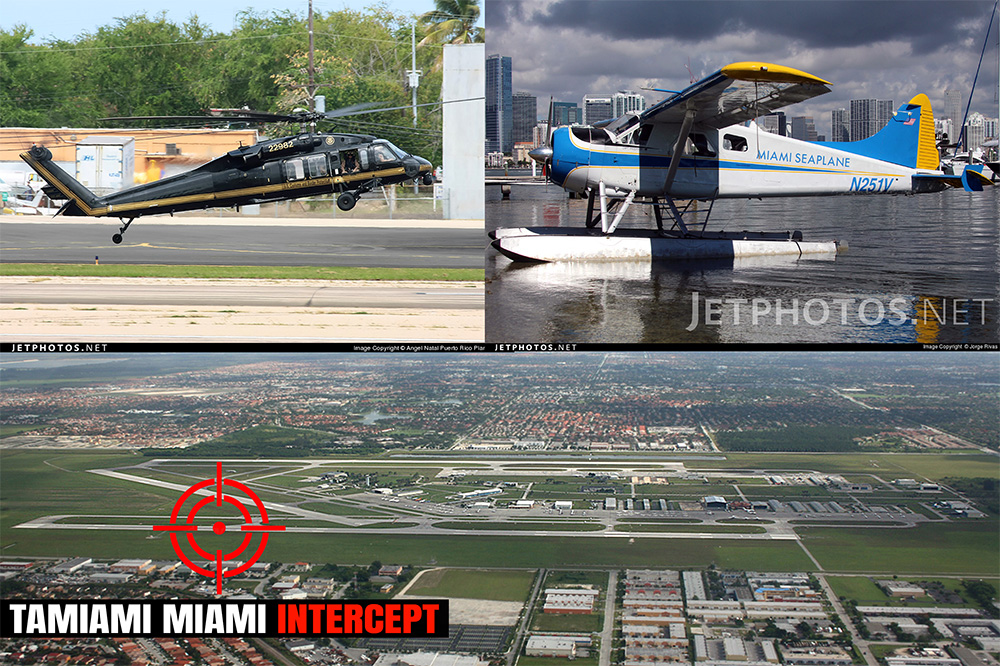
Recently published aviation radio communications document an extraordinary airborne law-enforcement operation over South Florida involving the interception of a de Havilland Canada DHC-2 Beaver amphibious floatplane by a United States Customs Black Hawk helicopter.
The operation culminated in a directed landing at Miami Executive Airport (KTMB), the deployment of federal law-enforcement personnel onto Runway 9R, the detention of the aircraft’s sole occupant, and arrangements for a K-9 examination and subsequent transfer of the aircraft to the airport’s United States Customs facility.
For aviation professionals, the recording provides an exceptional opportunity to examine the execution of an airborne interdiction within the National Airspace System, particularly the coordination between the intercepting aircraft, the intercepted pilot, civilian air traffic control, airport operations personnel and responding law-enforcement agencies.
While the precise circumstances that initiated the interception remain unconfirmed, the recorded communications establish a remarkably detailed account of the operation from initial air-to-air contact through the establishment of a secured ground operation.
“You Have Been Intercepted”
The recording opens with repeated attempts by the Black Hawk crew to establish communications with the Beaver on 121.5 MHz.
The helicopter identifies itself as a United States Customs aircraft and advises the Beaver that it has been intercepted. The crew repeatedly requests acknowledgment on the emergency frequency while attempting to obtain visual acknowledgment through the aircraft’s lights.
The communications indicate that the Black Hawk had already established visual contact and maneuvered into proximity with the Beaver before positive two-way radio communications were established.
Approximately one minute into the recording, the Beaver’s pilot acknowledges the interception and confirms that he is monitoring guard.
The helicopter crew then issues an unequivocal instruction:
“You have been intercepted, sir. I need you to land at the nearest airport that you find suitable ASAP.”
The pilot identifies Tamiami, the former name of Miami Executive Airport, as a suitable diversion airport. The Black Hawk crew accepts the proposed destination and advises that it will coordinate the arrival with the airport’s control tower.
Of particular interest is the pilot’s apparent composure throughout the exchange. There is no indication in the available communications of an attempt to evade the intercepting aircraft. The pilot acknowledges the instructions, participates in the selection of an appropriate landing facility and subsequently discusses runway selection and traffic considerations.
The operation then transitions from an airborne interception to a coordinated ground interdiction.
The Intercepted Aircraft
The aircraft appears to be N251V, a de Havilland Canada DHC-2 Mk. 1 Beaver manufactured in 1952 and registered in Miami, Florida.
Although the automated transcript accompanying the recording renders the aircraft’s registration inconsistently, the apparent callsign, aircraft type, amphibious float configuration and geographical location strongly correspond with N251V.
Federal Aviation Administration aircraft registration records provide the following information:
| Registration | N251V |
| Manufacturer | De Havilland Canada |
| Model | DHC-2 Mk. 1 Beaver |
| Serial Number | 413 |
| Year of Manufacture | 1952 |
| Engine | Pratt & Whitney R-985-AN-14B |
| Registered Owner | N251V LLC |
| Registration Location | Miami, Florida |
| ICAO 24-bit Address | A25D10 |
| ICAO Type Designator | DHC2 |
Publicly available aircraft records associate N251V with Miami Seaplane Tours, while flight-tracking records document previous operations involving Miami Executive Airport and Miami-Opa Locka Executive Airport (KOPF).
The aircraft also possesses a particularly interesting operational history. Historical airframe records associate serial number 413 with former United States Air Force aircraft 52-6068, subsequently operated under various civilian registrations before returning to the United States.
Its amphibious configuration permitted the pilot to comply with the direction to land at a conventional airport rather than requiring a suitable water landing area.
ASX News has not independently established the aircraft’s identity against official records of the interception. Its apparent identification as N251V should therefore be regarded as provisional.
TROY 226 — The Intercepting Black Hawk
The intercepting helicopter identifies itself as a United States Customs Black Hawk operating under the callsign TROY 226.
U.S. Customs and Border Protection’s Air and Marine Operations (AMO) employs Sikorsky UH-60 Black Hawk helicopters for airborne interdiction, surveillance, tactical law-enforcement support and the deployment of personnel during aviation, maritime and land-based operations.
The selection of a rotary-wing platform is operationally significant in an interception involving an aircraft such as the DHC-2 Beaver. A helicopter can maintain visual contact at comparatively low airspeeds, accompany the intercepted aircraft throughout its arrival sequence and subsequently deploy personnel directly at the landing site.
The Black Hawk’s role in this operation extended well beyond airborne identification and escort. Its crew coordinated the diversion, directed the intercepted aircraft’s post-landing actions, deployed law-enforcement personnel, established ground-security requirements and facilitated the subsequent movement of the aircraft and its occupant.
The exact registration and configuration of TROY 226 have not been established.
Coordination With Miami Executive Tower
Following the pilot’s acknowledgment of the interception and selection of Miami Executive Airport, TROY 226 establishes communications with the airport’s control tower.
The helicopter crew advises the controller that a Beaver has been intercepted and will be proceeding inbound for landing.
The initial runway preference is Runway 13. Subsequent communications concern the intercepted aircraft’s proposed arrival maneuver, its position relative to the Runway 9R traffic pattern and the operational requirements of the interception.
The tower ultimately requests that the aircraft accept Runway 9R.
The Beaver’s pilot agrees, explaining that his initial preference for Runway 13 was intended to minimize disruption to other airport traffic.
TROY 226 subsequently advises the tower that the aircraft will be required to remain on the runway following landing and that the law-enforcement operation will temporarily prevent its use by other traffic.
The tower issues landing clearance for Runway 9R, which is subsequently relayed to the intercepted pilot.
This exchange is particularly noteworthy from an air traffic management perspective. The intercepting agency determines the tactical requirements of the interdiction, while the tower coordinates runway availability, aircraft separation and the safe integration of the operation into the airport’s existing traffic environment.
The recording also illustrates the distinction between a law-enforcement direction to land and the ATC clearance required for the landing itself.
Engine Shutdown and Deployment of Law-Enforcement Personnel
As the Beaver approaches Miami Executive, TROY 226 issues increasingly specific instructions concerning the aircraft’s actions following touchdown.
The pilot is directed to bring the aircraft to a complete stop on Runway 9R, shut down the engine and remain stationary with his hands visible.
The helicopter crew also requests confirmation of the number of persons aboard.
The pilot reports one person aboard, establishing that he is the aircraft’s sole occupant.
TROY 226 then advises the tower that the helicopter intends to land ahead of the Beaver and deploy law-enforcement personnel.
The sequence represents the transition from airborne interdiction to the physical securing of the aircraft and its occupant.
Following the landing sequence, the helicopter crew reports personnel on the ground and advises the tower that it will conduct an orbit around the target aircraft.
The intercepted aircraft remains stationary on Runway 9R while the ground operation proceeds.
Runway 9R Withdrawn From Service
Miami Executive Tower subsequently confirms that Runway 9R will not be available for other aircraft operations during the interdiction.
Traffic is redirected to the airport’s remaining available runways, including Runway 9L and Runway 13.
The tower also broadcasts an updated ATIS designation and advises aircraft that Runway 9R is unusable.
The temporary withdrawal of an active runway from service introduces a secondary operational challenge. The controller must accommodate the law-enforcement operation while maintaining the safe and orderly movement of other airport traffic.
Subsequent communications concern the authorization of ground vehicles and personnel to enter the secured runway.
TROY 226 specifically advises that responding Miami-Dade law-enforcement personnel may be permitted access, while ordinary airport personnel are to remain clear pending further coordination.
The tower acknowledges the restriction and coordinates accordingly with airport operations personnel.
The available recording demonstrates how an airport can continue operating around a localized law-enforcement event without necessarily suspending all aircraft movements.
K-9 Examination and Additional Law-Enforcement Response
One of the more significant developments in the recording is the anticipated arrival of a K-9 unit.
TROY 226 advises the tower that responding personnel and a K-9 team are expected to approach the aircraft through the airport’s Reliance access point.
Subsequent exchanges concern coordination between the responding agencies, airport escort vehicles and the personnel already securing the Beaver on Runway 9R.
The helicopter crew indicates that the aircraft will remain in position until the K-9 examination has been completed, after which arrangements will be made to relocate it to the Customs ramp.
These communications establish that the operation involved more than a routine airborne identification or an escort resulting from a communications irregularity.
The instructions issued to the pilot, deployment of federal personnel, restrictions on ground access and requested K-9 examination are consistent with a law-enforcement interdiction involving an aircraft and individual of investigative interest.
However, the recording does not identify the K-9 unit’s detection specialty or establish whether the examination resulted in the discovery of prohibited material.
Consequently, the operation cannot presently be characterized as a confirmed narcotics interdiction, explosives investigation or other specific criminal enforcement action.
Transfer of the Aircraft to Customs
During the latter portion of the recording, TROY 226 requests assistance from Miami Executive Tower in establishing contact with the airport’s United States Customs facility.
The helicopter crew advises that arrangements are required to tow the Beaver from Runway 9R to the Customs ramp following the K-9 examination.
The aircraft’s amphibious float installation introduces additional ground-handling considerations, including the availability of suitable towing equipment and personnel familiar with the aircraft’s configuration.
The tower subsequently advises that contact has been initiated and that arrangements are being coordinated.
At approximately 10 minutes and 52 seconds into the recording, TROY 226 reports that the aircraft will be towed to the Customs ramp.
The helicopter crew further advises that a transport vehicle is not immediately available for the individual it describes as the suspect. Ground personnel will therefore escort the individual on foot to the Customs facility, with assistance requested from airport escort vehicles.
The Black Hawk is expected to reposition to the Customs area after the aircraft and ground personnel have completed their movement.
The communications establish the intended transfer of the aircraft and its sole occupant to Customs for further processing. They do not establish the subsequent disposition of either the individual or the aircraft.
Operational Chronology
The following chronology is derived from the elapsed recording times and should not be interpreted as a verified sequence of local or UTC incident times.
| Recording Time | Operational Development |
|---|---|
| 00:01–00:55 | Black Hawk attempts to establish communications with the Beaver on 121.5 MHz. |
| 00:55–01:18 | Pilot acknowledges interception and receives direction to land. |
| 01:18–02:00 | Miami Executive Airport selected as the diversion airport. |
| 02:08–03:36 | TROY 226 coordinates arrival with Miami Executive Tower; Runway 13 initially considered. |
| 03:44–04:22 | Runway 9R accepted and landing clearance issued. |
| 04:32–05:14 | Pilot directed to stop, shut down and keep hands visible; one person aboard confirmed. |
| 05:41–06:32 | Black Hawk coordinates landing and deployment of law-enforcement personnel. |
| 06:40–07:33 | Runway 9R withdrawn from normal operations; ground access restricted. |
| 07:40–08:42 | Coordination of responding personnel and K-9 unit. |
| 08:47 | ATIS updated to reflect Runway 9R unavailability. |
| 08:51–10:43 | Customs notification and aircraft towing arrangements coordinated. |
| 10:52–11:34 | Transfer of aircraft and suspect to the Customs ramp arranged. |
Flight-Tracking Evidence
Public flight-tracking records provide an additional investigative avenue concerning the aircraft provisionally identified as N251V.
Historical tracking information documents operations involving Miami Executive Airport and Miami-Opa Locka Executive Airport during October 2026.
More recent tracking information published by AeroPattern identifies N251V as operating a flight between Miami International Airport (KMIA) and Miami Executive Airport on November 5, 2026.
The recorded movement is listed as departing at approximately 12:43 p.m. EST and arriving at approximately 12:53 p.m. EST, based on received aircraft position reports.
This movement is potentially relevant to the investigation because it establishes recent recorded activity involving the likely aircraft and the airport at which the interdiction occurred.
However, the precise date of the recorded interception has not been independently established. The November 5 movement cannot therefore be conclusively associated with the operation described in the radio communications.
Establishing the incident date would permit a more meaningful examination of historical ADS-B data, aircraft movements, departure and arrival information, and the possible relationship between the intercepted flight and earlier aircraft activity.
Interception Procedures and Aviation Security
The operation provides a valuable practical example of procedures addressed in the Federal Aviation Administration’s Aeronautical Information Manual, Chapter 5, Section 6, concerning national security and interception procedures.
Aircraft interceptions may be conducted for identification, tracking, inspection, diversion or the establishment of communications.
The FAA’s published guidance directs intercepted aircraft to comply promptly with instructions communicated by the intercepting aircraft, establish radio communications on an appropriate emergency frequency and continue complying with instructions until positively released.
Where equipped, an intercepted aircraft should select transponder code 7700 unless otherwise directed by air traffic control.
In the event of conflicting instructions, the intercepted aircraft should seek immediate clarification.
The Miami Executive operation is particularly instructive because the recording documents not merely the initial interception but the subsequent integration of a tactical law-enforcement operation into civilian-controlled airport operations.
Several aspects warrant particular attention:
- Establishment of positive air-to-air communications on 121.5 MHz.
- Selection of a suitable diversion airport by the intercepted pilot.
- Coordination of arrival procedures between the intercepting aircraft and civilian ATC.
- Reconciliation of tactical requirements with runway availability and existing airport traffic.
- Explicit post-landing instructions concerning engine shutdown, aircraft security and occupant actions.
- Deployment of personnel and establishment of a secured area on an airport movement surface.
- Coordination of responding law-enforcement agencies and airport ground vehicles.
- Restoration of normal runway availability through removal of the intercepted aircraft.
For flight crews, the recording also reinforces the operational value of maintaining a listening watch on 121.5 MHz when equipment and circumstances permit.
What Prompted the Interception?
The central unanswered question remains the circumstances that led United States Customs authorities to intercept the Beaver.
The available communications provide substantial evidence of a coordinated law-enforcement operation, including the detention of the pilot, the requested K-9 examination and arrangements for transfer to Customs.
They do not, however, identify the underlying suspected offense.
ASX News has not independently identified an official CBP statement, criminal complaint, seizure notice or other public enforcement record establishing the reason for the interception.
The aircraft’s departure point, intended destination, original flight purpose and the identity of its pilot remain unconfirmed.
Whether the operation resulted in criminal charges, administrative enforcement action, the release of the pilot or the formal seizure of the aircraft is also unknown.
These are the principal outstanding questions in an otherwise remarkably well-documented operational sequence.
Must Watch — The Original Interception and ATC Communications
ASX News strongly recommends that aviation professionals review the original recording of this interception.
The approximately 11-minute sequence is an exceptional opportunity to examine the real-time coordination of an airborne law-enforcement interdiction, from the initial calls on guard through the directed landing, deployment of personnel, runway closure and arrangements for transfer to Customs.
Particularly noteworthy are the intercepted pilot’s communications, the negotiation of runway selection, the Black Hawk crew’s tactical instructions and the tower’s management of an extraordinary event within an otherwise functioning civilian airport.
ASX News Assessment
Regardless of the underlying investigative circumstances, the Miami Executive interception represents a compelling operational case study at the intersection of aviation security, air traffic management and federal law enforcement.
The available communications demonstrate the importance of effective coordination between agencies whose operational priorities, responsibilities and immediate objectives differ considerably.
The intercepting crew must maintain control of the target aircraft and execute the tactical requirements of the interdiction. The intercepted pilot must comply with instructions while maintaining safe operation of the aircraft. The controller must integrate the developing situation into the existing traffic environment. Ground personnel must establish a secure operational area without introducing additional hazards to airport movements.
In this instance, those responsibilities converged on Runway 9R at Miami Executive Airport.
The result was an extraordinary sequence of communications that aviation professionals rarely have an opportunity to examine in such detail.
While the circumstances behind the interception remain unresolved, the operational execution itself deserves considerable attention.
Sources and Technical References
- Original Interception and ATC Communications — YouTube
- Federal Aviation Administration — Aircraft Registry, N251V
- FAA Aeronautical Information Manual — Chapter 5, Section 6: National Security and Interception Procedures
- U.S. Customs and Border Protection — Air and Marine Operations
- Flightradar24 — N251V Aircraft and Flight History
- FlightAware — N251V Aircraft Registration
- eFlight — N251V Registration and Commercial Operator Information
- AeroPattern — Miami International to Miami Executive Airport Historical Aircraft Movements
ASX News will update this report should additional verified information become available concerning the circumstances of the interception, the identity of the aircraft or the subsequent disposition of its pilot.