


Deep in West Antarctica, an enormous glacier is undergoing changes that scientists are struggling to predict, and two major research announcements in October 2026 have delivered an unsettling message: the deterioration of Antarctica’s so-called Doomsday Glacier may be more difficult to reverse than previously understood. One investigation indicates that the glacier could continue losing ice for at least 150 years even if ocean-driven melting were somehow stopped. Another suggests that seawater penetrating beneath the glacier could substantially increase its contribution to global sea-level rise. Together, the findings raise an extraordinary question: Has one of Earth’s most consequential glaciers already entered a period of unavoidable retreat?
The glacier is officially known as Thwaites, a vast river of ice draining into the Amundsen Sea. It has acquired its ominous nickname because of the enormous quantity of water stored in its ice and its potential influence on global sea levels. According to the British Antarctic Survey, the complete loss of Thwaites would eventually contribute approximately 65 centimeters, or 26 inches, to global mean sea level. That figure represents the glacier’s long-term sea-level potential, not a prediction of what would happen immediately if its floating ice shelf broke apart.
The October Warning That Changes the Conversation
On October 13, 2026, the British Antarctic Survey announced findings from a study published in Geophysical Research Letters that examined how Thwaites Glacier and neighboring Pine Island Glacier might respond if the ocean stopped melting their floating ice shelves. Researchers used three independent computer models and simulated glacier behavior over 150 years under an extreme hypothetical condition: eliminating ocean-driven melting beneath both glaciers.
The results revealed a striking difference. Pine Island Glacier responded by thickening and beginning to advance toward an earlier position. Thwaites, however, continued losing ice throughout the simulation. Although its rate of loss slowed, the glacier did not recover.
For scientists investigating whether Antarctica’s ice loss can be reversed, that distinction is profound. It suggests that changes already experienced by Thwaites have altered its behavior in ways that cannot simply be undone by removing one major source of melting. The glacier’s present condition reflects decades of previous change, and the consequences may continue unfolding long into the future.
Lead researcher Rosie Williams of the British Antarctic Survey explained that earlier ocean-driven melting has committed Thwaites to future ice loss. The research does not establish that the entire glacier will disappear within 150 years, nor does it mean every future outcome is inevitable. It does, however, demonstrate that the glacier’s response to past environmental changes may persist even under conditions dramatically more favorable than anything expected in the real world.
NASA Finds Another Problem Beneath the Ice
Just one week later, on October 20, NASA published another troubling development. Researchers working with NASA’s Jet Propulsion Laboratory, the University of California, Irvine, and Dartmouth College developed an improved model of Thwaites Glacier that incorporates seawater moving beneath ice previously treated as firmly grounded.
Traditional glacier models often represent the boundary between grounded ice and floating ice as a relatively distinct line. In reality, tides can temporarily lift portions of the glacier, allowing seawater to penetrate several kilometers beneath the ice. This creates a more complicated transition region known as a grounding zone.
The new model accounts for that process. By incorporating the movement of seawater beneath grounded ice, researchers substantially improved their ability to reproduce historical glacier changes recorded by satellites since the 1990s. NASA reported that the model matched those observations approximately four times more closely than models that omitted the process.
That improvement matters because scientists rely on models to estimate how rapidly glaciers may retreat, how much ice may enter the ocean, and how coastal communities could be affected. If a model overlooks an important mechanism of melting, its projections may underestimate the glacier’s future contribution to rising seas.
Sea-Level Projections Could Be Twice as High
The new investigation, published October 12 in Nature Communications, produced scenarios in which Thwaites contributed substantially more to sea-level rise by 2100 than some earlier estimates. In one modeled scenario using extensive seawater intrusion beneath the glacier, its contribution approached 30 millimeters, or approximately 1.2 inches, by the end of the century.
That may sound modest compared with the glacier’s total long-term potential, but it concerns the contribution of a single glacier to global average sea level. Its effects would combine with those of other melting glaciers, ice sheets, and thermal expansion of warming seawater. The projected contribution is conditional on the model’s assumptions and should not be mistaken for a definitive forecast or an estimate of total global sea-level rise.
The distinction between centimeters and meters is also important. Scientists are not predicting that Thwaites will suddenly release its entire ice volume into the ocean this year or this century. They are identifying physical processes that could make the glacier’s continuing retreat more consequential than previously calculated.
The Ice Shelf That Once Helped Hold Everything Together
Another source of concern is the condition of the Thwaites Eastern Ice Shelf, a floating extension of the glacier that has developed extensive fractures. Floating ice shelves act as structural restraints, helping slow the movement of grounded ice toward the ocean. When those restraints weaken, the ice behind them can accelerate.
Research and scientific reporting have described an eastern ice shelf that has become increasingly fractured and structurally vulnerable. A submarine ridge that once helped stabilize the floating ice has also become associated with concentrated stresses as the ice thins, moves, and breaks apart.
This creates a particularly troubling mechanical situation. Ice that once resisted movement can develop fractures as its geometry changes, potentially reducing its ability to restrain the glacier behind it. The process involves more than melting alone: ice movement, fracture propagation, structural weakening, and interactions with the seafloor can all influence the shelf’s stability.
Scientists have warned that the remaining eastern ice shelf could undergo a relatively rapid breakup. However, the timing cannot be established from the available evidence, and a complete collapse has not been independently confirmed in the material examined for this report. The possibility of sudden structural failure should not be confused with the immediate disappearance of the much larger grounded glacier.
What Happens When an Ice Shelf Breaks Apart?
Antarctica has already demonstrated how quickly weakened floating ice can disintegrate. In 2002, the Larsen B Ice Shelf on the Antarctic Peninsula underwent a spectacular breakup, with thousands of square kilometers fragmenting over a comparatively short period. Satellite observations revealed an immense sheet of ice transforming into a field of separate icebergs.
The circumstances surrounding Larsen B and Thwaites are not identical, but the earlier collapse illustrates an important principle: the final fragmentation of a weakened ice shelf can occur much faster than the gradual deterioration that preceded it.
When floating ice breaks apart, it does not directly raise sea level by the equivalent of its entire volume because that ice already displaces seawater. The greater concern is what happens afterward. If the shelf had been restraining grounded ice, its disappearance can permit more ice to flow from land into the ocean, contributing to long-term sea-level rise.
Glacial Earthquakes and Underwater Disturbances
Another unusual phenomenon associated with Antarctica’s changing ice involves seismic events generated by the movement and breakup of enormous ice masses. Unlike conventional tectonic earthquakes, glacial seismic events can arise when icebergs fracture, overturn, collide, or displace surrounding water and ice.
The video report that prompted this investigation describes research identifying hundreds of such events in West Antarctica between 2010 and 2023, including a concentration near Thwaites. Those specific counts have not been independently confirmed for this article and are therefore not presented as established measurements. The broader physical phenomenon, however, is recognized in glaciological research.
Large iceberg movements can also generate powerful disturbances beneath the ocean surface. Some are internal waves traveling between layers of seawater with different densities. Such waves can produce substantial underwater turbulence without creating the familiar destructive surface wave associated with a major earthquake-generated tsunami.
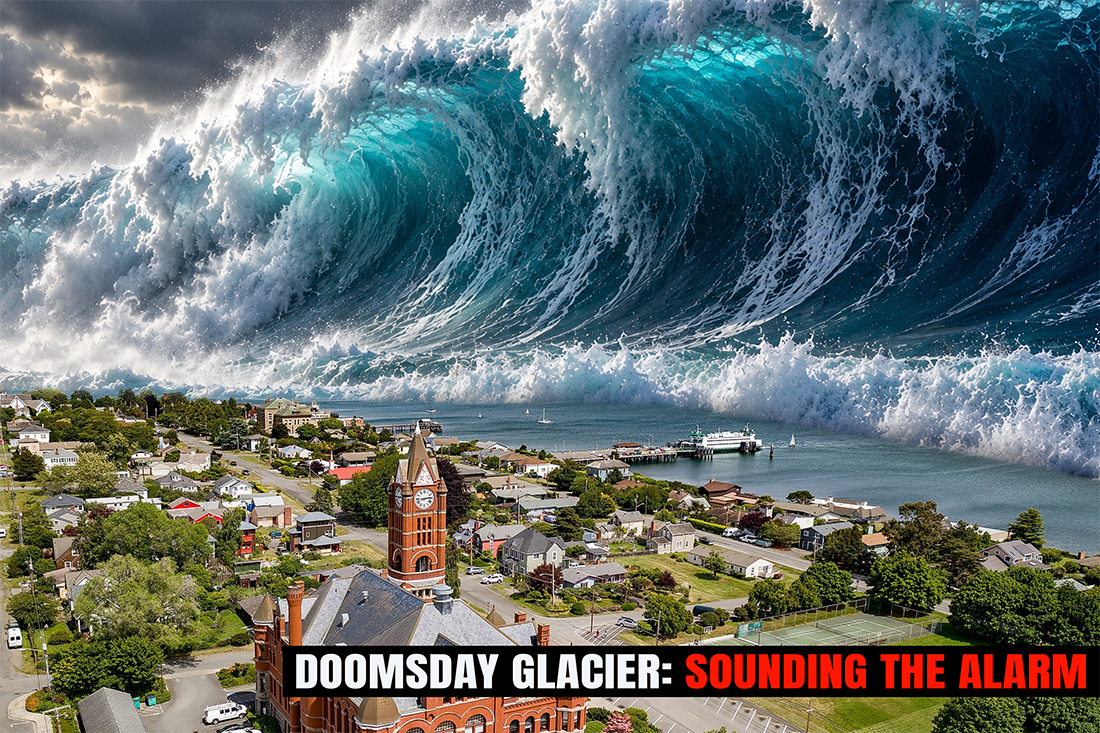
There is no verified basis in the evidence reviewed here for claiming that the anticipated breakup of Thwaites’ eastern ice shelf will generate a catastrophic tsunami crossing the ocean toward distant coastlines. The scientifically established concern is the glacier’s structural deterioration and its consequences for future ice discharge and sea-level rise.
The Real Threat May Be the Glacier’s Inability to Recover
The most unsettling implication of the October research is not that Antarctica will experience a single spectacular disaster tomorrow. It is that Thwaites may continue responding to changes that occurred decades ago, even if environmental conditions were suddenly and dramatically improved.
The British Antarctic Survey’s modeling demonstrates how the consequences of earlier melting can persist. NASA’s new modeling indicates that the movement of seawater beneath grounded ice may be a more important contributor to retreat than some previous simulations recognized. Meanwhile, the weakening eastern ice shelf raises questions about how effectively the glacier can continue resisting movement toward the sea.
These processes operate on different timescales. An ice shelf can fracture rapidly. Grounded ice can accelerate over years or decades. Sea-level contributions accumulate over decades and centuries. Confusing those timescales creates sensational predictions that obscure the real significance of the research.
Yet separating them does not make the findings reassuring. It reveals a glacier whose behavior depends on interacting processes that remain difficult to model and whose response to past changes may already be partly irreversible on human timescales.
Why the Rest of the World Should Care
Thwaites is geographically remote, but the ocean connects Antarctica to the world’s coastlines. Global mean sea-level rise increases the baseline upon which storm surges, extreme tides, and coastal flooding occur. Even relatively small increases can compound existing hazards in vulnerable coastal communities.
The wider West Antarctic Ice Sheet contains enough ice to raise global sea levels by several meters if it were ultimately lost. Scientists are not forecasting that outcome as an immediate event, but understanding the stability of major glaciers such as Thwaites is essential to assessing long-term risks.
For low-lying coastal regions, including parts of Southeast Asia and the Philippines, the implications extend beyond distant scientific curiosity. Coastal infrastructure, settlements, transportation systems, and disaster planning all depend upon understanding how sea levels may change over time.
Conclusion: The Clock Is Running, but Nobody Knows Its Exact Time
Two October 2026 investigations have sharpened the scientific picture of Antarctica’s Doomsday Glacier. One indicates that Thwaites could continue losing ice for at least 150 years even if ocean-driven melting were eliminated in a hypothetical experiment. The other demonstrates that accounting for seawater penetration beneath grounded ice can substantially improve historical simulations and increase projected contributions to future sea-level rise.
The eastern ice shelf’s fractures add another dimension to the problem, raising the possibility of a rapid structural breakup whose precise timing remains uncertain. Such an event would not instantly unleash the glacier’s full sea-level potential, but it could represent another important stage in the weakening of a system already undergoing profound change.
The real scientific warning is therefore more consequential than a prediction of catastrophe on a particular day. Researchers are finding that some of the processes driving Thwaites’ retreat may already be locked into motion, while others have been underestimated in earlier models.
Antarctica’s Doomsday Glacier does not need to collapse tomorrow to become one of the defining environmental challenges of the coming century. The disturbing possibility is that the process has already advanced far enough that even stopping the melting would not stop the loss.
Sources and Scientific References
British Antarctic Survey. (2026, October 13). Thwaites Glacier will keep losing ice even if oceans cool.
NASA. (2026, October 20). NASA study refines projections for Thwaites Glacier. NASA Science.
Williams, R., Trevers, M., Sun, S., Holland, P., Bett, D. T., Arthern, R., & Bradley, A. T. (2026). Mass loss from Thwaites Glacier continues even without ocean melting. Geophysical Research Letters.
National Aeronautics and Space Administration, Jet Propulsion Laboratory; University of California, Irvine; and Dartmouth College. (2026). Research on grounding-zone seawater intrusion and Thwaites Glacier projections, published October 12 in Nature Communications.
Rignot, E., and colleagues. (2024). Widespread seawater intrusions beneath the grounded ice of Thwaites Glacier, West Antarctica. Proceedings of the National Academy of Sciences.