


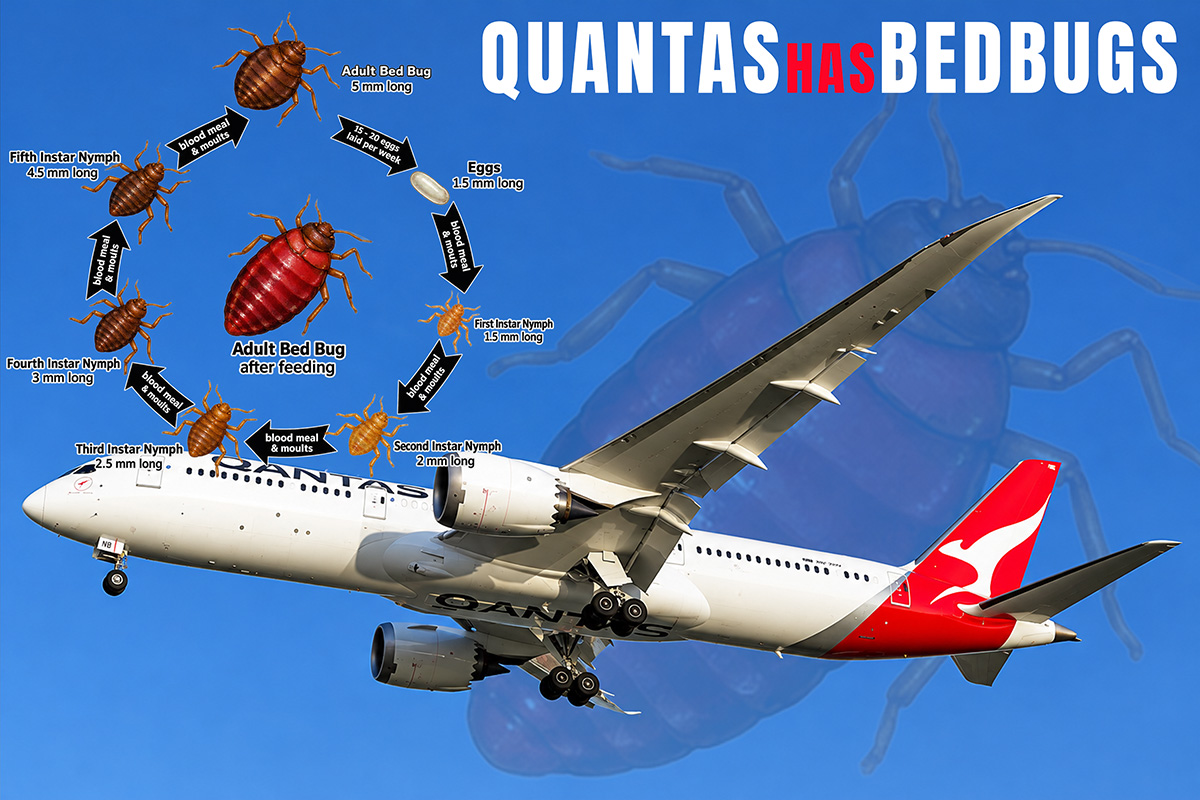
ROME, ITALY — October 13, 2026 — A Qantas Boeing 787 Dreamliner was withdrawn from service in Rome after passengers reported being bitten by bedbugs during a long-haul flight from Perth, Australia. The incident forced the cancellation of the aircraft’s return service, disrupted international travel plans, and raised questions about pest prevention, cabin hygiene, and the operational consequences of contamination aboard commercial aircraft.
Passengers Report Bites During Long-Haul Flight
The incident occurred aboard Qantas flight QF5, operating from Perth to Rome on Friday, October 9, 2026. During the approximately 17-hour journey, passengers in the economy cabin reported insect bites to flight attendants.
According to Australian media reports, affected passengers were given antihistamines following medical advice. However, available supplies reportedly ran out before the flight reached its destination. The precise number of passengers affected has not been publicly established.
Subsequent reporting identified the problem in a limited number of economy-class seats, with The Guardian reporting that the insects were discovered toward the front of the economy cabin.
Although the aircraft completed its journey to Rome, the discovery prompted Qantas to remove the Dreamliner from scheduled service for specialized cleaning.
Return Flight Cancelled as Aircraft Undergoes Treatment
Qantas cancelled flight QF6, scheduled to depart Rome for Perth on Saturday, October 10, allowing engineering and maintenance personnel to undertake a comprehensive cleaning operation.
The airline acknowledged that the problem involved a small number of economy seats and apologized to passengers affected by the cancellation.
According to Qantas, disrupted customers were provided with accommodation and rebooked on alternative services within 48 hours of their original scheduled departure.
The disruption illustrates how a problem confined to a relatively small section of an aircraft can have consequences extending well beyond the affected cabin. Removing an aircraft from service can interrupt its scheduled rotation, create additional passenger accommodation requirements, and require alternative transportation arrangements.
For long-haul international operations, where aircraft availability and scheduled connections are closely coordinated, an unexpected maintenance or sanitation event can affect travelers thousands of kilometers from their intended destinations.
Why Bedbugs Present a Difficult Aircraft Maintenance Problem
Bedbugs are small, wingless insects that feed on human blood. They can conceal themselves in narrow crevices, fabric seams, upholstered furnishings, luggage, and other protected spaces.
Commercial aircraft cabins present potential hiding places in seat upholstery, cushions, joints, and surrounding furnishings. However, the precise location and extent of the Qantas contamination beyond the reported affected seats have not been independently established.
Bedbugs can also be transported inadvertently through clothing and personal belongings. Their presence does not, by itself, establish inadequate cleaning or maintenance practices.
Professor Michelle Power, a parasitologist at Macquarie University, told The Guardian that the insects were likely introduced through a passenger’s luggage or clothing. This remains an expert explanation of a plausible transmission route rather than a confirmed finding about the Qantas aircraft.
Unlike ordinary cabin debris, a bedbug problem can require professional pest-control treatment because the insects are capable of hiding in difficult-to-access spaces and surviving extended periods without feeding.
Qantas said its aircraft cabins are cleaned regularly and that precautionary disinsection treatment is performed approximately every 50 days. Nevertheless, the reported incident required an unscheduled intervention that removed the aircraft from revenue service.
Health Risks and Passenger Welfare
Australian public-health authorities state that bedbugs are not known to transmit infectious diseases to humans. Their bites can nevertheless cause itching, inflammation, discomfort, sleep disruption, and, in some circumstances, secondary skin infections resulting from scratching.
The absence of a recognized disease-transmission risk does not eliminate the need for a prompt response. Passenger welfare, insect identification, contamination control, and appropriate treatment remain important considerations.
For passengers confined to an aircraft cabin for many hours, the inability to move away from an affected seating area can intensify discomfort and concern.
The reported distribution of antihistamines aboard QF5 indicates that cabin personnel attempted to provide symptomatic relief. However, reports that supplies were exhausted have not been accompanied by a publicly available accounting of the number of passengers treated or the quantity of medication carried.
Workplace Safety and Airline Responsibilities
The incident also highlights the occupational dimension of aircraft contamination. Cabin crews, cleaners, maintenance personnel, and other employees may encounter pests in the course of their duties.
Human Resources Director examined the Qantas incident in the context of workplace health and safety, emphasizing the importance of professional pest management, timely communication, and established organizational procedures.
In aviation, these considerations intersect with aircraft availability, maintenance coordination, passenger service, and operational planning.
An effective response involves identifying the problem, protecting affected people, arranging appropriate treatment, and ensuring that the aircraft can be returned to service without unnecessarily exposing subsequent passengers or employees.
The cancellation of QF6 demonstrates the operational cost of addressing a cabin-contamination concern rather than continuing the aircraft’s planned rotation.
An Important Route Between Australia and Europe
The Perth–Rome connection is part of Qantas’s long-haul international network and provides a nonstop link between Western Australia and continental Europe.
The service has particular significance because it eliminates the need for an intermediate connection on a journey that traditionally involved a stopover.
In September 2025, the Western Australian government announced an expansion of the route’s 2026 operating season, including additional flights and nearly 10,000 additional inbound seats.
Qantas subsequently confirmed further European network adjustments extending additional Perth–Rome services into October 2026.
The cancellation therefore affected an established international route during its extended seasonal operating period.
A Broader Challenge for International Aviation
Bedbug incidents are not unique to Qantas. Previous complaints involving other airlines and transport operators demonstrate that the insects can appear in passenger environments where people, luggage, and upholstered furnishings move continuously between destinations.
In 2017, a family traveling aboard a British Airways flight from Vancouver to London reported suffering bedbug bites. More recently, allegations involving another international airline became the subject of litigation, although such allegations should not be treated as established findings without supporting evidence.
The wider issue is not whether an airline can guarantee that a pest will never be carried aboard an aircraft. International transportation inevitably involves the movement of passengers and belongings through numerous environments.
The more meaningful operational question is how effectively an airline detects, contains, treats, and recovers from an unexpected contamination event.
In the Qantas case, the aircraft completed its inbound flight, but the return service was cancelled to permit treatment. Passengers were accommodated and rebooked, while maintenance teams addressed the reported problem.
The event underscores a practical reality of commercial aviation: aircraft operational readiness depends on more than mechanical condition. Cabin health, sanitation, passenger welfare, and effective maintenance responses are also essential to reliable international service.
As of October 13, Qantas had publicly confirmed the cancellation and cleaning response, but available reporting did not establish the aircraft’s registration, the exact number of affected passengers, or the definitive source of the insects.
Sources and Further Reading
BBC News — Qantas Flight Grounded After Bedbug Outbreak (October 13, 2026)
The Guardian — Bedbug Infestation Forces Qantas to Ground Plane in Rome (October 13, 2026)
PerthNow — Qantas Flight QF6 Cancelled After Reported Bedbug Outbreak
Irish Examiner — Bedbug Infestation Forces Qantas to Ground Plane in Rome
The Canberra Times — Bedbug Outbreak on Flight to Perth Forces Qantas to Ground Plane
Human Resources Director — Bedbugs at Qantas: The Role of HR in a Pest Outbreak
NSW Health — Bed Bugs: Public Health Information
Australian Healthdirect — Bed Bugs
Qantas — May 2026 Network Update
Western Australian Government — Expanded Rome–Perth Service (September 2025)