


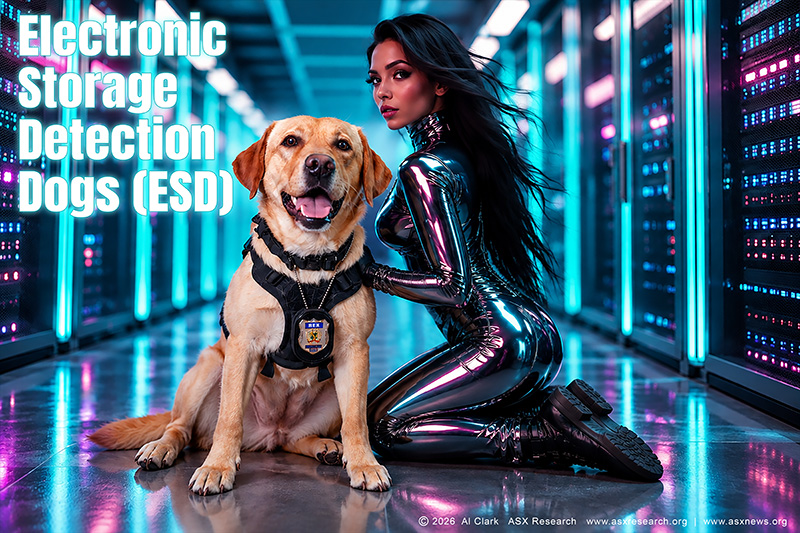
Dogs have been indispensable partners in law enforcement for generations, detecting narcotics, explosives, firearms, missing persons, and human remains. Now, specially trained electronic storage detection (ESD) dogs are extending that extraordinary capability into digital forensics. Their targets are not drugs or weapons, but concealed USB flash drives, memory cards, hard drives, and other electronic storage devices that may contain critical evidence.
The Extraordinary Canine Nose
A dog’s sense of smell is an exceptionally sophisticated biological detection system. Its nasal anatomy separates portions of inhaled air for respiration and olfactory analysis, while specialized airflow patterns help deliver odor molecules to sensory tissues. Dogs can distinguish complex chemical mixtures, follow faint scent trails, and recognize trained target odors amid substantial environmental interference.
These abilities have made detection dogs valuable across policing, border security, military operations, disaster response, and forensic investigations. Their effectiveness, however, depends on appropriate training, environmental conditions, handler performance, and scientifically validated procedures. No detection method, biological or technological, is infallible.
From Narcotics to Digital Evidence
Traditional detection dogs learn to associate particular odors with rewards. Electronic storage detection uses the same general principles, but directs the dog’s attention toward chemical signatures associated with electronic devices and their components. Rather than detecting the digital information itself, the animal responds to physical odors associated with the equipment.
Investigators increasingly recognize that a small storage device can contain an enormous quantity of evidence. A microSD card or USB flash drive can hold photographs, communications, financial records, intelligence material, and other digital information. Its compact dimensions make it particularly easy to conceal during a conventional visual search.
ESD dogs provide investigators with an additional search capability, potentially identifying devices hidden in furniture, clothing, containers, or other difficult-to-inspect locations. Their value lies in helping investigators locate physical evidence that might otherwise escape discovery.
The Chemistry of Electronic Storage Detection
The precise chemical basis of electronic storage detection remains an evolving area of forensic research. Electronic devices contain polymers, adhesives, circuit-board materials, coatings, and other manufactured components that can release volatile organic compounds. Dogs may learn to recognize characteristic odor profiles associated with these materials.
Importantly, there is no sound basis for claiming that ESD dogs literally smell stored computer files, electronic signals, or the information encoded in memory. Their detection capability concerns physical chemical cues associated with storage devices.
Differences in manufacturing materials, device age, contamination, packaging, temperature, and environmental conditions create challenges for training and operational reliability. Rigorous testing is necessary to determine how consistently dogs can generalize across different devices and search environments.
Espionage, Counterintelligence, and Hidden Data
Electronic storage detection has obvious implications for counterintelligence and criminal investigations. Intelligence information that once required substantial physical storage can now be transported on devices small enough to fit inside everyday objects. The same technology that enables convenient information exchange also creates opportunities for concealed data movement.
An ESD dog does not determine whether a device contains classified information, criminal evidence, or ordinary personal files. It helps locate the device. Establishing the significance of its contents requires lawful forensic examination, appropriate evidence handling, and independent investigative analysis.
Electronic storage detection therefore complements rather than replaces digital forensic specialists, conventional search techniques, and electronic detection equipment. Its effectiveness should be evaluated as part of a larger investigative system.
Can Dogs Detect Film, Microfiche, or Other Media?
Traditional photographic materials, including microfilm and microfiche, contain physical substrates and chemical components that may produce detectable odors. However, the ability of a dog trained for electronic storage detection to identify photographic media cannot be assumed. Reliable detection would require specific training and validation for those target materials.
Likewise, infrared scanning and other technical search methods operate according to different physical principles. Thermal imaging detects patterns of infrared radiation associated with surface temperatures; it does not directly reveal the contents of a memory device. Depending on circumstances, electronic detection technologies and canine searches may offer complementary capabilities.
Scientific Validation and Operational Limitations
Detection-dog research emphasizes the importance of controlled testing, appropriate odor samples, handler blinding, and realistic operational scenarios. Performance measured during training does not automatically establish equivalent reliability in an unfamiliar field environment.
Handler expectations can influence canine behavior, and poorly controlled testing can produce misleading results. Double-blind assessments, in which neither the handler nor the immediate evaluator knows the target location, are particularly valuable for reducing inadvertent cues.
Environmental conditions also matter. Air movement, humidity, temperature, competing odors, and physical barriers can affect odor availability and detection performance. A dog’s failure to alert does not conclusively establish that no storage device is present.
DARPA and the Future of Biological Detection
The Defense Advanced Research Projects Agency (DARPA) has investigated advanced sensing and biological technologies, but a direct DARPA role in developing operational electronic storage detection dogs has not been established by the evidence reviewed for this article. Such a connection should not be asserted without documentary support.
Broader research into canine olfaction, chemical sensing, biological detection, and machine-assisted analysis nevertheless illustrates the growing scientific interest in understanding and potentially reproducing aspects of animal sensory performance.
Beyond Electronic Storage
Specialized detection dogs are being investigated or deployed for tasks beyond conventional narcotics and explosives work, including certain medical conditions, biological threats, invasive species, agricultural pests, and environmental contaminants. Each application requires its own training standards and evidence of reliability.
Research into disease-associated odors is especially intriguing because metabolic processes can alter volatile chemical profiles. Nevertheless, promising experimental findings must be distinguished from clinically validated diagnostic procedures.
Future advances may involve improved odor characterization, more standardized training materials, automated monitoring of canine behavior, and better integration of biological detection with analytical instruments.
The Investigative Significance
Electronic storage detection dogs illustrate an unusual intersection of biology and modern information technology. Investigators seeking digital evidence can now employ an animal sensory system shaped by evolution long before computers existed.
The technology does not make concealed digital information universally discoverable, nor does it eliminate the need for investigative judgment. It does, however, introduce a potentially powerful additional means of locating the small physical objects on which modern information is stored.
As digital storage becomes smaller and more pervasive, the importance of scientifically validated detection methods is likely to increase. ESD dogs demonstrate that some of the most remarkable tools available to modern investigators are not manufactured in laboratories or semiconductor factories. They are trained, four-legged partners whose extraordinary noses can reveal what human eyes may overlook.
References
Bomers, M. K., van Agtmael, M. A., Luik, H., Vandenbroucke-Grauls, C. M. J. E., & Smulders, Y. M. (2014). A detection dog to identify patients with Clostridium difficile infection during a hospital outbreak. Journal of Infection, 69(5), 456–461.
Craven, B. A., Paterson, E. G., & Settles, G. S. (2010). The fluid dynamics of canine olfaction: Unique nasal airflow patterns as an explanation of macrosmia. Journal of the Royal Society Interface, 7(47), 933–943.
DeGreeff, L. E., Cerreta, M., & Rispoli, M. (2017). Feasibility of canine detection of mass storage devices: A study of volatile organic compounds emanating from electronic devices using solid phase microextraction. Journal of Forensic Sciences, 62(6), 1613–1616.
Gazit, I., & Terkel, J. (2003a). Domination of olfaction over vision in explosives detection by dogs. Applied Animal Behaviour Science, 82(1), 65–73.
Gazit, I., & Terkel, J. (2003b). Explosives detection by sniffer dogs following strenuous physical activity. Applied Animal Behaviour Science, 81(2), 149–161.
Guest, C., Pinder, M., Doggett, M., Squires, C., Affara, M., Kandeh, B., Dewhirst, S., Morant, S. V., D’Alessandro, U., Logan, J. G., & Lindsay, S. W. (2019). Trained dogs identify people with malaria parasites by their odour. The Lancet Infectious Diseases, 19(6), 578–580.
Hall, N. J., Smith, D. W., & Wynne, C. D. L. (2013). Training domestic dogs (Canis lupus familiaris) on a novel discrete trials odor-detection task. Learning and Motivation, 44(4), 218–228.
Hardin, D. S., Anderson, W., & Cattet, J. (2015). Dogs can be successfully trained to alert to hypoglycemia samples from patients with type 1 diabetes. Diabetes Therapy, 6(4), 509–517.
Jendrny, P., Twele, F., Meller, S., Osterhaus, A. D. M. E., Schalke, E., & Volk, H. A. (2021). Canine olfactory detection and its relevance to medical detection. BMC Infectious Diseases, 21, Article 838.
Jenkins, E. K., DeChant, M. T., & Perry, E. B. (2018). When the nose doesn’t know: Canine olfactory function associated with health, management, and potential links to microbiota. Frontiers in Veterinary Science, 5, Article 56.
Jezierski, T., Adamkiewicz, E., Walczak, M., Sobczyńska, M., Górecka-Bruzda, A., Ensminger, J., & Papet, E. (2014). Efficacy of drug detection by fully-trained police dogs varies by breed, training level, type of drug and search environment. Forensic Science International, 237, 112–118.
Kokocińska-Kusiak, A., Woszczyło, M., Zybala, M., Maciocha, J., Barłowska, K., & Dzięcioł, M. (2021). Canine olfaction: Physiology, behavior, and possibilities for practical applications. Animals, 11(8), Article 2463.
Lazarowski, L., & Dorman, D. C. (2014). Explosives detection by military working dogs: Olfactory generalization from components to mixtures. Applied Animal Behaviour Science, 151, 84–93.
Lazarowski, L., Krichbaum, S., DeGreeff, L. E., Simon, A., Singletary, M., Angle, C., & Waggoner, L. P. (2020). Methodological considerations in canine olfactory detection research. Frontiers in Veterinary Science, 7, Article 408.
Lit, L., Schweitzer, J. B., & Oberbauer, A. M. (2011). Handler beliefs affect scent detection dog outcomes. Animal Cognition, 14(3), 387–394.
Maurer, M., Seto, T., Guest, C., Somal, A., & Julian, C. (2022). Detection of SARS-CoV-2 by canine olfaction: A pilot study. Open Forum Infectious Diseases, 9(7), Article ofac226.
McKeague, B., Finlay, C., & Rooney, N. (2024). Conservation detection dogs: A critical review of efficacy and methodology. Ecology and Evolution, 14(2), Article e10866.
Rooney, N., Trivedi, D. K., Sinclair, E., Walton-Doyle, C., Silverdale, M., Barran, P., Kunath, T., Morant, S., Somerville, M., Smith, J., Jones-Diette, J., Corish, J., Milne, J., & Guest, C. (2025). Trained dogs can detect the odor of Parkinson’s disease. Journal of Parkinson’s Disease, 15(6), 1111–1115.
Weber, K. S., Roden, M., & Müssig, K. (2016). Do dogs sense hypoglycaemia? Diabetic Medicine, 33(7), 934–938.
Willis, C. M., Church, S. M., Guest, C. M., Cook, W. A., McCarthy, N., Bransbury, A. J., Church, M. R. T., & Church, J. C. T. (2004). Olfactory detection of human bladder cancer by dogs: Proof of principle study. BMJ, 329(7468), 712.
Additional Government and Operational Sources
Connecticut Department of Emergency Services and Public Protection. (n.d.). Division of Scientific Services.
Federal Bureau of Investigation. (2025). FBI Newark retires an exceptional K-9 officer, Iris the cyber dog.
Naval Criminal Investigative Service. (2025). NCIS adds three new noses to the ESD K9 program.