


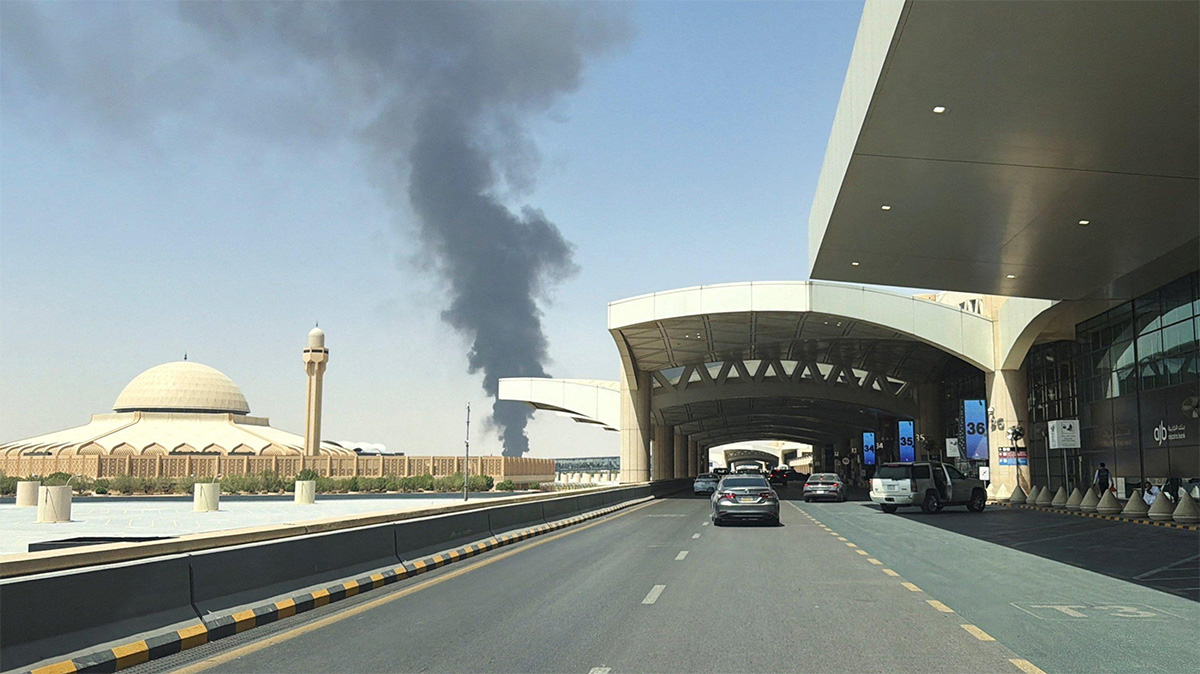
RIYADH, SAUDI ARABIA — October 11, 2026. A missile attack on King Khalid International Airport in Saudi Arabia’s capital killed at least 12 people and injured more than 300 others on Saturday, October 10, according to Saudi civil aviation authorities. The strike forced the suspension of airport operations and the diversion of commercial flights, marking a major escalation in a series of attacks against Saudi aviation infrastructure.
Missile Strikes Airport Passenger Terminal
The latest attack struck a complex housing Terminals 3 and 4, which serve domestic flights at King Khalid International Airport. Emergency services responded as casualties were transported to hospitals throughout Riyadh, with some victims reported to be in critical condition.
Saudi authorities identified the dead as four Saudi nationals, two Bangladeshi nationals, and one person each from the United States, Jordan, Palestine, Syria, Sudan, and Egypt.
The October 10 strike was the third attack against the airport during the week. Earlier attacks had already caused fatalities, damaged a commercial aircraft, and disrupted airline operations.
Airport Operations Suspended and Flights Diverted
Saudi Arabia’s General Authority of Civil Aviation suspended operations at King Khalid International Airport while emergency personnel assessed damage and addressed the immediate threat.
Incoming flights were diverted to other airports, while airlines canceled or suspended services to Riyadh. International flight disruptions extended beyond Saudi Arabia as carriers evaluated the security risks associated with operating in the affected airspace.
Travel advisories issued by several governments urged their citizens to avoid the airport and exercise caution in the region.
As of the latest reporting, the suspension and flight disruptions were continuing to affect travelers. Passengers should consult their airlines and official aviation authorities for current operational information rather than relying on previously published schedules.
Earlier Attacks Killed Airline Pilot and Damaged Aircraft
The latest attack followed missile strikes on Thursday, October 8, targeting airport facilities and a Saudia commercial aircraft on the ground.
Saudi aviation authorities initially confirmed three Saudi fatalities from those earlier attacks, including Saudia pilot Captain Hamoud Ali Alkalthami. Subsequent reporting described four fatalities associated with the earlier strikes.
A Saudia aircraft sustained substantial damage while parked at the airport. The airline reported that no passengers were aboard the aircraft at the time.
Yemen’s Iran-aligned Houthi movement claimed responsibility for earlier attacks against the airport. Although the group has conducted a broader campaign of missile strikes against Saudi Arabia, responsibility for the October 10 terminal strike had not been conclusively established in the initial official casualty announcement.
Escalating Conflict Threatens Civil Aviation
The attacks occurred amid intensified fighting between Saudi-backed Yemeni government forces and the Houthi movement. Saudi Arabia and its allies have conducted military operations against Houthi-controlled territory, while the Houthis have expanded attacks against Saudi targets.
The conflict has increasingly affected civilian aviation infrastructure, including passenger terminals, parked aircraft, and airspace used by international airlines.
The European Union Aviation Safety Agency has warned that recurring missile and drone attacks, air-defense interceptions, and falling debris create significant hazards for civil aviation. These risks can extend beyond the immediate locations of intended military targets.
The attacks have also raised concerns about the possibility of civilian aircraft being misidentified during active military operations or exposed to weapons and debris while approaching or departing airports.
International Response and Regional Implications
The United States and several European governments have issued security warnings concerning travel to Riyadh. Airlines have adjusted their operations, including temporary suspensions and cancellations affecting Saudi destinations.
U.S. President Donald Trump indicated that his administration was considering whether to participate in Saudi military operations against Houthi forces, although no final decision had been announced in the reporting available at publication.
The airport attacks occurred as Riyadh prepared to host major international energy and investment events, creating additional logistical and security concerns for organizers and participants.
Aviation Safety Perspective
International airports are particularly vulnerable during armed conflict because they concentrate large numbers of passengers, aircraft, ground personnel, fuel infrastructure, and essential transportation services within geographically confined areas.
Even when a missile or drone attack does not directly strike an aircraft in flight, the consequences can include mass casualties, damage to parked aircraft, runway and terminal closures, emergency diversions, and substantial disruption to regional air transportation.
For airline operators, flight crews, and aviation authorities, the immediate safety priorities include evaluating conflict-zone airspace restrictions, maintaining reliable threat intelligence, coordinating diversion procedures, and ensuring that operational decisions reflect rapidly changing security conditions.
The October 10 attack demonstrates that the threat to civil aviation in conflict-affected regions extends beyond aircraft operating in the air. Passenger terminals and supporting airport infrastructure can themselves become targets, placing travelers and airport personnel at risk.
ASX News will continue monitoring the casualty figures, airport operating status, airline disruptions, and official developments concerning the attacks on King Khalid International Airport.
Sources
Reuters — Attack on Saudi airport leaves 12 dead, October 10, 2026
Associated Press — Riyadh airport attack kills 12 and injures more than 300, October 10–11, 2026
Reuters — Saudi conferences and flight disruptions, October 10, 2026
Associated Press — Earlier attacks on Riyadh airport and Saudia aircraft, October 9, 2026
Financial Times — Airport closure and international aviation disruption, October 10, 2026