


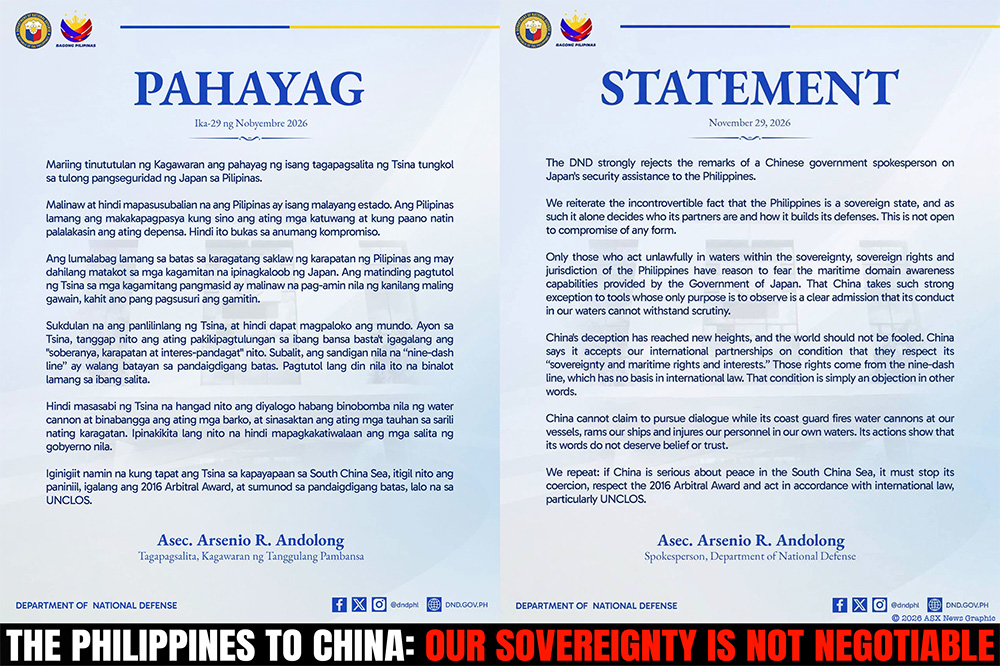
MANILA, Philippines — In an exceptionally forceful statement issued Sunday, November 29, 2026, the Philippine Department of National Defense (DND) delivered a scathing condemnation of the People’s Republic of China, categorically rejecting Beijing’s objections to Japanese security assistance and reaffirming the Philippines’ sovereign authority to determine its own national defense policies and international partnerships.
The statement, issued by DND spokesperson Assistant Secretary Arsenio R. Andolong, represents far more than a routine diplomatic disagreement. It directly challenges China’s credibility, condemns its maritime conduct, rejects its expansive territorial assertions, and communicates an increasingly uncompromising position concerning the independence and national security of the Republic of the Philippines.
Perhaps most significantly, Manila is no longer simply defending its maritime rights against Chinese encroachment. It is explicitly rejecting Beijing’s apparent belief that China possesses any authority whatsoever over the Philippines’ relationships with other sovereign nations.
Manila Draws a Line
In its November 29 statement, the Department of National Defense declared:
“We reiterate the incontrovertible fact that the Philippines is a sovereign state, and as such it alone decides who its partners are and how it builds its defenses. This is not open to compromise of any form.”
The language is deliberate, unequivocal, and remarkably direct. There is no invitation to negotiate the principle of Philippine sovereignty, no acknowledgment of Chinese authority over Philippine defense policy, and no suggestion that Manila intends to accommodate Beijing’s objections to its increasingly extensive international security relationships.
The statement follows an earlier condemnation issued on November 27, when Andolong similarly rejected China’s criticism of Philippine defense cooperation with Japan and Australia. The issuance of two strongly worded statements within approximately 48 hours illustrates the increasingly contentious nature of relations between Manila and Beijing.
What Triggered China’s Latest Objections?
On November 9, 2026, Japanese Ambassador to the Philippines Katsuro Kitagawa and Philippine Secretary of Foreign Affairs Maria Theresa Lazaro signed and exchanged diplomatic notes in Manila establishing a ¥4.3 billion security assistance package under Japan’s Official Security Assistance (OSA) program. The package is valued at approximately ₱1.72 billion, or US$27 million.
Under the agreement, Japan will provide the Philippine Navy with a coastal radar system and the Philippine Air Force with unmanned aerial vehicles designed for monitoring and surveillance. The agreement also represents the first transfer of defense equipment under Japan’s Official Security Assistance framework, marking a significant development in Tokyo’s evolving international security policy.
Japan’s Ministry of Foreign Affairs identified the Philippines’ geographical position alongside strategically important maritime corridors, including the South China Sea and the Luzon Strait, as a fundamental consideration underlying the agreement.
On November 26, Chinese Ministry of National Defense spokesperson Chen Xi publicly criticized Japan’s involvement, arguing that Tokyo had no legitimate role in South China Sea disputes and that its growing security cooperation with Manila threatened regional stability. Beijing also criticized the Philippines’ expanding defense relationship with Australia.
Manila responded by turning China’s argument against it.
Why Would China Object to Being Observed?
One of the most compelling elements of Sunday’s statement concerns the nature of the equipment Japan is providing. The announced systems are intended to enhance surveillance and maritime awareness, enabling Philippine authorities to better understand activities occurring within and around the country’s maritime jurisdiction.
The Department of National Defense addressed this issue directly:
“Only those who act unlawfully in waters within the sovereignty, sovereign rights and jurisdiction of the Philippines have reason to fear the maritime domain awareness capabilities provided by the Government of Japan. That China takes such strong exception to tools whose only purpose is to observe is a clear admission that its conduct in our waters cannot withstand scrutiny.”
These remarks introduce an important dimension to the confrontation. Modern surveillance capabilities are not merely instruments of military awareness. They are increasingly instruments of transparency, accountability, diplomacy, and the documentation of potentially unlawful activities.
Coastal radar systems and aerial surveillance platforms can assist Philippine authorities in identifying vessels, monitoring maritime activity, documenting encounters, supporting search and rescue operations, detecting unauthorized fishing, and establishing more comprehensive records of incidents occurring throughout the country’s maritime domain.
Such information can support diplomatic protests, international legal proceedings, public reporting, and coordination with international partners. Improved surveillance also makes it considerably more difficult for competing parties to control the narrative surrounding controversial maritime encounters.
Although Beijing characterizes foreign defense assistance as a threat to regional stability, Manila’s position is that improved surveillance is necessary precisely because existing maritime confrontations have repeatedly demonstrated the consequences of inadequate monitoring and enforcement capabilities.
China’s Nine-Dash Line and International Law
At the center of the continuing confrontation lies China’s expansive claim to maritime rights throughout much of the South China Sea, historically represented by its controversial nine-dash line.
On July 12, 2016, an arbitral tribunal constituted under Annex VII of the United Nations Convention on the Law of the Sea (UNCLOS), with the Permanent Court of Arbitration serving as registry, issued its landmark award in the South China Sea arbitration between the Philippines and China.
The tribunal determined that China’s claims to historic rights over maritime resources within the nine-dash line had no legal basis insofar as they exceeded the geographical and substantive limits of maritime entitlements established by UNCLOS. The tribunal also concluded that none of the maritime features in the Spratly Islands examined in the arbitration was capable of generating an exclusive economic zone of its own.
The award did not determine sovereignty over disputed land territory or delimit maritime boundaries between the countries. It did, however, establish critical legal findings concerning maritime entitlements, historic rights, and specific Chinese activities affecting Philippine rights under the convention.
The award is final and binding on the parties under UNCLOS. Beijing continues to reject its legitimacy and findings.
China’s continued assertion of expansive maritime rights creates a fundamental contradiction between Beijing’s interpretation of regional sovereignty and the framework established by international maritime law.
Sunday’s Philippine statement rejected the notion that Manila’s international partnerships should be conditioned upon recognition of Chinese maritime claims that the Philippines considers unlawful.
China’s Actions Versus China’s Words
Perhaps the most politically consequential portion of the November 29 statement was Manila’s direct attack on Beijing’s credibility.
“China’s deception has reached new heights, and the world should not be fooled.”
Andolong subsequently addressed the contradiction between Beijing’s repeated calls for peaceful dialogue and the conduct of Chinese maritime forces during encounters with Philippine vessels.
“China cannot claim to pursue dialogue while its coast guard fires water cannons at our vessels, rams our ships and injures our personnel in our own waters. Its actions show that its words do not deserve belief or trust.”
These accusations reflect years of confrontations involving Philippine government vessels, military personnel, fishermen, and Chinese maritime forces in the West Philippine Sea. Water cannon incidents, dangerous maneuvering, collisions, and interference with Philippine maritime operations have become recurring sources of diplomatic tension.
Beijing maintains that its maritime enforcement activities are legitimate exercises of Chinese jurisdiction and has repeatedly accused Philippine authorities and their international partners of provocation. Manila rejects that characterization, pointing to its internationally recognized maritime entitlements and the findings of the 2016 arbitral tribunal.
The significance of Sunday’s statement is that Philippine defense officials are explicitly challenging not only China’s actions but also the credibility of its diplomatic assurances.
The Philippines Is No Longer Standing Alone
The confrontation cannot be adequately understood without examining the extraordinary expansion of Philippine international defense relationships during recent years, particularly the developments that have occurred throughout November 2026.
On October 28, defense leaders representing the Philippines, the United States, Japan, and Australia met in Cebu on the sidelines of the ASEAN Defense Ministers’ Meeting-Plus.
Philippine Secretary of National Defense Gilberto Teodoro Jr., United States Secretary of War Pete Hegseth, Japanese Minister of Defense Shinjiro Koizumi, and Australian Deputy Prime Minister and Minister for Defence Richard Marles discussed expanding interoperability, strengthening deterrence, improving coordination, and advancing their collective commitment to regional security.
A joint statement released on November 10 identified several significant initiatives, including establishing a Combined Coordination Center in the Philippines, aligning defense investments to strengthen Philippine archipelagic defense, expanding senior-level security consultations, and increasing the frequency and sophistication of multinational military exercises.
On November 11, Teodoro confirmed that the coordination mechanism associated with the planned center was already operating. Among its priorities are maritime awareness, information consolidation, and improved interoperability between the participating armed forces.
Four days later, on November 15, the Philippines and Australia signed an updated Defense Cooperation Arrangement during Australian Prime Minister Anthony Albanese’s visit to Manila. A subsequent joint leaders’ statement reaffirmed their strategic partnership and commitment to expanding bilateral security cooperation.
These developments collectively illustrate the emergence of an increasingly interconnected regional security architecture in which the Philippines occupies a central geographical and political position.
Beijing’s Strategic Dilemma
China’s attempts to discourage Philippine security partnerships may ultimately produce precisely the geopolitical outcome Beijing seeks to prevent.
Every maritime confrontation, diplomatic threat, and perceived infringement upon Philippine sovereignty creates an additional incentive for Manila to accelerate its military modernization and cultivate stronger relationships with other nations.
Japan’s surveillance assistance, Australia’s expanding defense cooperation, and America’s longstanding security relationship with the Philippines cannot be understood independently of the environment in which those relationships are developing.
From Beijing’s perspective, increasing cooperation among these countries risks complicating China’s strategic freedom of action throughout the Western Pacific. From Manila’s perspective, the same cooperation represents an opportunity to strengthen deterrence, improve national defense capabilities, and reduce the substantial military imbalance between the Philippines and China.
This is a classic example of a geopolitical security dilemma. Actions undertaken by one country to expand its influence or enforce its perceived security interests can cause neighboring countries to adopt defensive measures that the original country subsequently interprets as threatening.
However, the circumstances surrounding the West Philippine Sea introduce an important distinction: the Philippines is responding to documented maritime confrontations and a dispute in which an international tribunal has already addressed the legal basis of China’s expansive historic-rights claims.
Beijing’s efforts to discourage Philippine defense cooperation through diplomatic pressure may therefore strengthen Manila’s determination to pursue it.
The Taiwan Connection
As ASX News examined in its November 27 analysis of the potential consequences of a Chinese invasion of Taiwan, the geographical position of the Philippines creates extraordinary strategic implications for the future of Southeast Asian security.
The northern Philippine archipelago lies immediately south of Taiwan, while the western Philippines faces the South China Sea. Between these two regions lies the Luzon Strait, one of the most strategically consequential maritime corridors in the Western Pacific.
Japan, Taiwan, and the Philippines occupy vital geographical positions along what military strategists commonly describe as the First Island Chain. The security of these territories, the navigability of adjacent maritime corridors, and the ability of regional governments to maintain awareness of military activity throughout these waters are interconnected considerations.
Consequently, Japan’s investment in Philippine maritime surveillance has strategic significance extending beyond individual confrontations in the West Philippine Sea. It contributes to the Philippines’ ability to understand its broader security environment during a period of increasing geopolitical uncertainty throughout the Western Pacific.
That does not mean the Philippines has committed itself to entering a future war over Taiwan. Decisions concerning any such involvement remain matters of Philippine national policy, constitutional authority, treaty obligations, and the circumstances of a potential conflict.
Nevertheless, the accelerating integration of regional defense relationships demonstrates that the security challenges confronting Japan, the Philippines, Australia, and the United States are increasingly being treated as interconnected rather than isolated national concerns.
For Ordinary Filipinos, Sovereignty Is Not an Abstract Concept
The consequences of Chinese maritime pressure extend considerably beyond diplomatic exchanges between government officials.
For Filipino fishermen, maritime security concerns their ability to earn a living and access traditional fishing grounds. For coastal communities, it concerns food security, economic stability, and the protection of natural resources. For Philippine military and coast guard personnel, it concerns their ability to perform legitimate national duties without exposure to intimidation or physical harm.
For the broader Philippine population, the confrontation raises fundamental questions concerning national independence, the protection of maritime resources, and the right of future generations to benefit from the country’s geographical and economic inheritance.
Philippine sovereignty cannot be reduced to an argument between Washington and Beijing. The Philippines is not merely a strategic geographical asset to be contested by competing global powers. It is an independent republic whose citizens possess the right to determine their country’s political, economic, and national security future.
The strengthening of Philippine defense capabilities is consequently not simply a matter of military modernization. It is also an investment in the country’s ability to make sovereign decisions without being compelled to accommodate the demands of a substantially more powerful neighbor.
Peace Does Not Require Submission
Sunday’s statement concluded with another unequivocal demand:
“We repeat: if China is serious about peace in the South China Sea, it must stop its coercion, respect the 2016 Arbitral Award and act in accordance with international law, particularly UNCLOS.”
The distinction between peace and submission is fundamental to understanding the Philippines’ evolving national security posture. Peace achieved through the voluntary cooperation of sovereign nations is fundamentally different from apparent stability maintained through the intimidation of militarily weaker countries.
The Philippines has legitimate reasons to maintain peaceful economic and diplomatic relations with China. China remains a consequential regional economic power, and armed confrontation would carry enormous human, economic, and political consequences for every nation involved.
However, constructive relations cannot reasonably be predicated upon the Philippines surrendering its right to select international partners, modernize its defenses, monitor activities within its maritime jurisdiction, or exercise rights established under international law.
The November 29 statement is therefore significant not because it announces an imminent military confrontation, but because it demonstrates Manila’s increasingly explicit determination to resist external interference in its national decision-making.
China is free to determine its own defense policies, establish international partnerships, and pursue legitimate national interests within the framework of international law. The Republic of the Philippines possesses precisely the same rights.
Beijing may disagree with the direction in which Philippine defense policy is evolving. It may object to Japan’s expanding regional security relationships, Australia’s growing involvement, and the United States’ longstanding military partnership with Manila.
But disagreement does not confer authority.
The Philippines is not a Chinese province, a Chinese protectorate, or a subordinate participant in Beijing’s vision of regional security. It is an independent, sovereign republic.
And on November 29, 2026, Manila made it abundantly clear that it has no intention of asking Beijing’s permission to remain one.
Sources and Official Documentation
Department of National Defense, Republic of the Philippines. Official statement issued by Assistant Secretary Arsenio R. Andolong, November 29, 2026.
Daily Tribune — DND Rejects China’s Criticism of Japan’s Security Assistance to Philippines.
ABS-CBN News — PH-US-Japan-Australia Defense Coordination Mechanism Already Operating.