


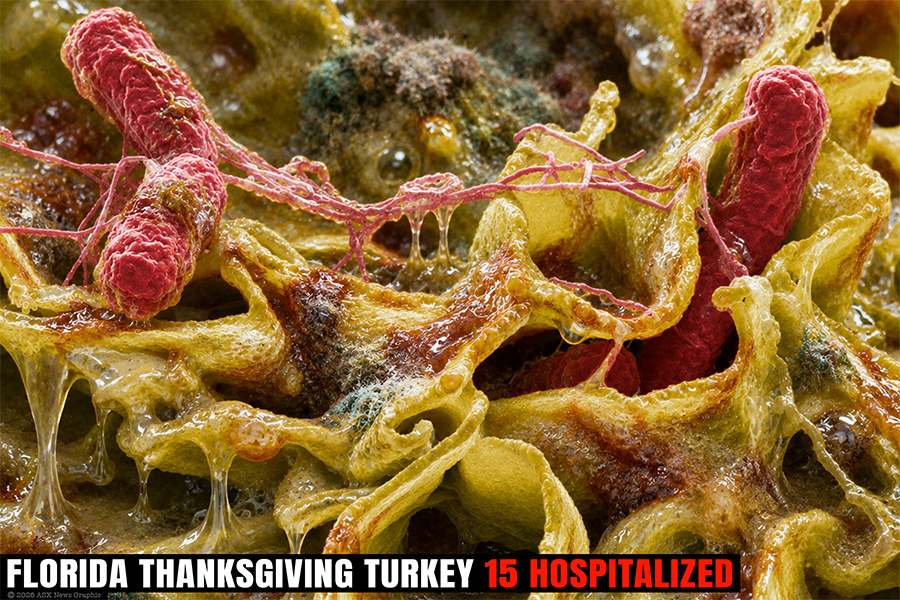
November 28, 2026 — Perhaps America’s turkeys have finally figured out how to fight back. What began as an annual Thanksgiving celebration at the corporate headquarters of Leon Medical Centers in Doral, Florida, deteriorated into a gastrointestinal nightmare on Wednesday, November 25, when 18 employees became ill following a catered holiday luncheon. Fifteen were reportedly transported to local hospitals, prompting Miami-Dade Fire Rescue to escalate its emergency response to a mass casualty incident.
In an ironic twist, the suspected food poisoning occurred at the headquarters of a healthcare organization. The employees had gathered to celebrate Thanksgiving, presumably expecting an enjoyable afternoon with their colleagues. Instead, emergency medical personnel arrived to deal with an unexpected medical crisis.
Leon Medical Centers confirmed that employees developed gastrointestinal symptoms shortly after the luncheon, which had been provided by an outside catering company. The organization is working with the caterer to establish what caused the illnesses. No patients receiving medical care through the organization were reported affected.
The Turkey Is a Suspect, Not a Convict
While the Thanksgiving turkey makes an irresistible target for holiday humor, investigators have not publicly identified the specific food responsible for the illnesses. Stuffing, gravy, vegetables, salads, desserts and other foods can become vehicles for foodborne pathogens when improperly prepared, handled or stored.
Unlike the dramatic green slime and obvious decomposition frequently associated with spoiled food, dangerous bacterial contamination can be virtually impossible to detect without laboratory analysis. Contaminated food can look delicious, smell perfectly normal and taste exactly as expected.
The Invisible Thanksgiving Guests
Among the microorganisms commonly associated with foodborne illness are Salmonella, Campylobacter, Clostridium perfringens and Staphylococcus aureus. Norovirus, although not a bacterium, is another significant cause of gastrointestinal outbreaks associated with communal dining and food handling.
Salmonella and Campylobacter are particularly relevant to poultry preparation. Raw poultry can harbor potentially dangerous microorganisms that may subsequently contaminate kitchen surfaces, utensils and other foods through improper handling.
Clostridium perfringens presents a particular concern during large catered events. Its spores can survive cooking, and the bacteria can multiply when prepared meats, poultry and gravy remain at unsuitable temperatures for extended periods.
Staphylococcus aureus can produce toxins in improperly handled foods. Some of these toxins are resistant to temperatures ordinarily used to reheat meals. Consequently, reheating contaminated food does not necessarily make it safe to consume.
The relatively rapid appearance of gastrointestinal symptoms following the Florida luncheon makes toxin-mediated foodborne illness one possibility worth examining. However, the timing of symptoms alone cannot establish which organism, toxin or food item was responsible.
When Dinner Becomes a Medical Emergency
Foodborne illness can produce nausea, vomiting, abdominal cramps, diarrhea, fever and profound weakness. In severe cases, the rapid loss of fluids and electrolytes can result in dehydration, low blood pressure, kidney complications and the need for intravenous fluid replacement.
Older adults, young children, pregnant women and individuals with compromised immune systems are particularly vulnerable to serious complications.
When numerous people become ill simultaneously, emergency personnel must manage not only the individual medical conditions but also the logistical demands of patient assessment, transportation and hospital coordination. The designation of a mass casualty incident reflects these operational demands rather than necessarily indicating fatalities or life-threatening injuries.
Why Thanksgiving Is Particularly Vulnerable
Thanksgiving frequently involves large quantities of food being prepared in advance, transported between locations, held at serving temperatures and subsequently stored as leftovers. Each stage introduces opportunities for bacterial contamination and proliferation.
The United States Department of Agriculture recommends cooking poultry to a minimum internal temperature of 165 degrees Fahrenheit (74 degrees Celsius), verified using a food thermometer. Stuffing prepared inside a turkey must also reach this temperature.
Perishable food should generally be refrigerated within two hours of preparation or removal from temperature-controlled storage, or within one hour when ambient temperatures exceed 90 degrees Fahrenheit (32 degrees Celsius).
Hot foods should be maintained at or above 140 degrees Fahrenheit (60 degrees Celsius), while cold foods should remain at or below 40 degrees Fahrenheit (4 degrees Celsius) under USDA consumer food-safety guidance.
Large quantities of leftovers should be divided into shallow containers to accelerate cooling. Refrigerated Thanksgiving leftovers should generally be consumed within three to four days or frozen for longer storage.
A Microscopic Enemy
The Centers for Disease Control and Prevention estimates that foodborne diseases cause approximately 48 million illnesses, 128,000 hospitalizations and 3,000 deaths annually in the United States. Behind these statistics are microscopic organisms and biological toxins capable of transforming an otherwise ordinary meal into a serious medical emergency.
Understanding the biological mechanisms behind food poisoning is important because the absence of visible contamination provides no assurance of food safety. Temperature control, sanitation, proper cooking and the prevention of cross-contamination remain fundamental defenses against foodborne disease.
Revenge of the Turkeys?
The Florida incident provides an unfortunate reminder that even professionally catered celebrations are not immune to suspected foodborne illness. What should have been an occasion for gratitude instead resulted in emergency medical treatment for numerous employees.
America’s turkeys may not have organized a coordinated rebellion against their annual Thanksgiving execution, but the microorganisms potentially accompanying their journey from farm to dinner table require considerably less organization to wreak havoc.
For the employees in Doral, Thanksgiving 2026 will undoubtedly be remembered for considerably more than the stuffing.
Sources and Additional Food Safety Information
The Guardian — Florida Thanksgiving food poisoning incident
New York Post — Thanksgiving feast sends 15 people to hospital
Centers for Disease Control and Prevention — Food Safety
USDA Food Safety and Inspection Service