


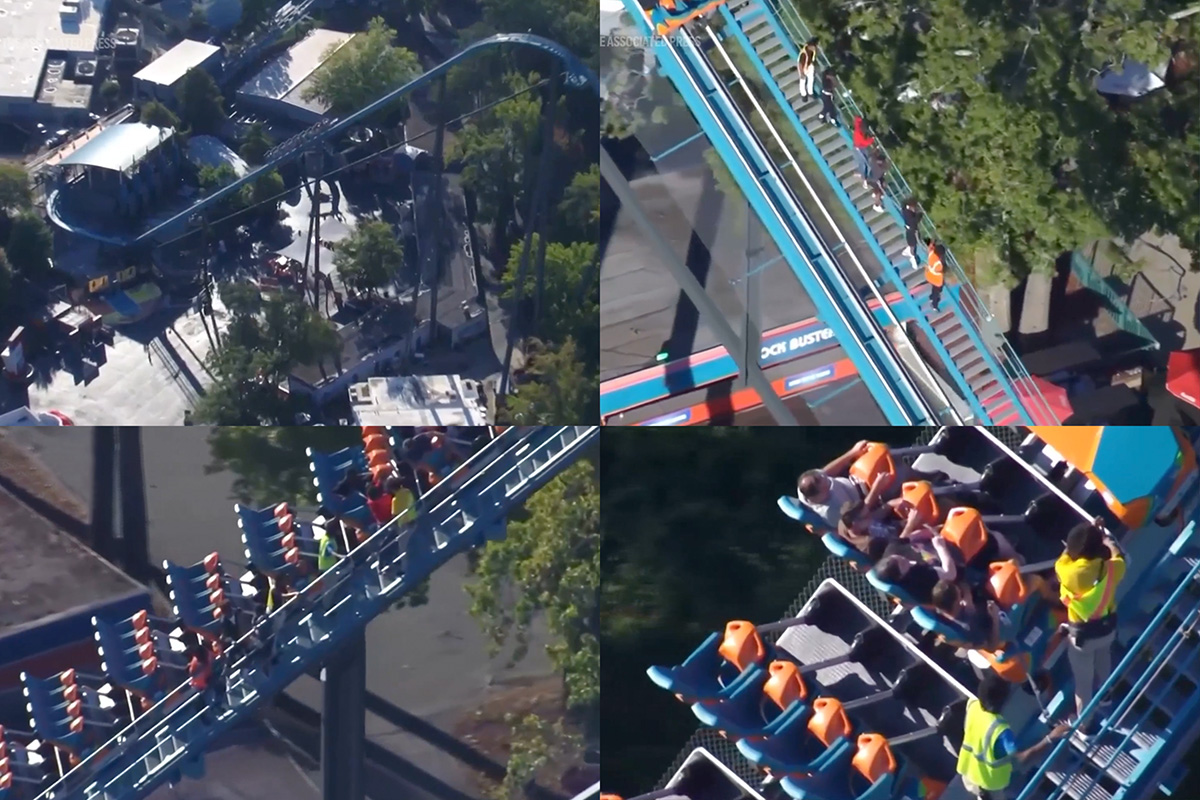
ATLANTA, GEORGIA — October 14, 2026 — Six Flags Entertainment Corporation has temporarily closed nine roller coasters across six amusement parks in the United States and Canada following a fatal accident at Six Flags Over Georgia on October 12. A 42-year-old man died after being thrown from the Goliath roller coaster, reportedly striking other park visitors before falling to the ground. Several additional people were injured, prompting police and state investigators to examine the circumstances of the accident, including the operation of the ride’s passenger restraint system.
Fatal Accident at Six Flags Over Georgia
The incident occurred Monday afternoon at Six Flags Over Georgia, located approximately 15 miles northwest of Atlanta. Emergency personnel responded after a passenger was ejected from the Goliath roller coaster, one of the park’s largest and most recognizable attractions.
Cobb County police subsequently identified the deceased passenger as 42-year-old Hassan Jihad Ibn Kariem, an Atlanta-area school employee who worked as an information technology manager at Wesley International Academy and had previously served as a technology teacher.
Witnesses described seeing the passenger rise out of his seat while the roller coaster was moving. According to the Associated Press, one witness said the man appeared momentarily suspended above the moving train before falling back into the vehicle and subsequently being thrown from the ride during its final turn.
Investigators reported that the victim struck other park visitors during the incident. Authorities confirmed additional injuries but had not publicly established the number of injured individuals, their medical conditions, or the precise mechanisms of their injuries.
The fatality has left investigators examining how a passenger could become separated from a moving roller coaster equipped with a restraint system intended to keep occupants secured throughout the ride.
Goliath: A High-Speed Roller Coaster
Goliath opened at Six Flags Over Georgia in 2006 and is classified as a hypercoaster, a type of steel roller coaster emphasizing substantial height, high speeds, steep descents, and periods of reduced apparent weight commonly described as airtime.
The attraction reaches approximately 200 feet in height and operates at speeds approaching 70 miles per hour. Its ride cycle lasts approximately three and a half minutes and includes a series of large hills and high-speed turns.
Unlike roller coasters incorporating inverted track elements, Goliath does not turn passengers upside down. Its passenger restraint system uses lap bars that secure riders around the waist and upper legs rather than conventional over-the-shoulder restraints.
Such restraint arrangements are used on numerous modern roller coasters and are engineered for the forces and occupant movements anticipated during normal operation. Their effectiveness depends on proper design, adjustment, engagement, inspection, maintenance, and passenger positioning.
The existence of a lap-bar restraint does not establish that a mechanical malfunction occurred. Investigators must determine whether the system was properly engaged, whether its components functioned as intended, and whether any other circumstances contributed to the passenger’s ejection.
Nine Additional Roller Coasters Closed Across North America
Following the fatal accident, Six Flags announced the temporary closure of nine additional roller coasters at six amusement parks across the United States and Canada.
The company described the closures as precautionary while the incident remained under investigation. Including the accident ride in Georgia, ten roller coasters were affected.
The closures include attractions at Six Flags Magic Mountain in California, Six Flags Great America in Illinois, Six Flags Great Adventure in New Jersey, Carowinds in North Carolina, Canada’s Wonderland in Ontario, and Kings Island in Ohio.
Among the affected attractions are Raging Bull, Nitro, Fury 325, Thunder Striker, Leviathan, Behemoth, Orion, Diamondback, and another roller coaster named Goliath at Six Flags Magic Mountain.
The affected rides differ in their dimensions, operating speeds, manufacturers, and passenger restraint arrangements. Consequently, the precautionary closures should not be interpreted as evidence that every affected attraction shares an identical technical defect.
Six Flags had not publicly established a timetable for reopening the attractions or identified a specific mechanical condition responsible for the Georgia accident.
Manufacturer Participates in Investigation
The Goliath roller coaster at Six Flags Over Georgia was manufactured by Bolliger & Mabillard, a Swiss company responsible for numerous large steel roller coasters operating internationally.
The manufacturer confirmed that it was investigating the incident and expressed sympathy for the victim’s family and others affected.
Most of the roller coasters included in the precautionary closures were manufactured by Bolliger & Mabillard, although the similarly named Goliath attraction at Six Flags Magic Mountain was produced by a different manufacturer, Giovanola.
The participation of the manufacturer may provide investigators with access to original design specifications, restraint-system documentation, inspection requirements, operating parameters, and engineering expertise.
However, the investigation’s technical findings have not been released. Any conclusion regarding a design deficiency, maintenance failure, operational error, or other causal factor would therefore be premature.
Passenger Restraints and the Physics of Roller Coaster Safety
Roller coaster passenger restraints must accommodate a wide range of body dimensions while maintaining occupant security during acceleration, braking, turns, and changes in vertical loading.
On hypercoasters, large hills can produce periods in which passengers experience reduced apparent weight or forces that tend to lift the body relative to the seat. These sensations are an intentional element of the ride experience, but the restraint system must continue to prevent unintended occupant movement.
Effective restraint performance depends on several interacting factors, including the geometry of the restraint, the position of the passenger, the mechanical locking system, the condition of its components, and the forces encountered during operation.
A properly conducted technical investigation may examine restraint engagement and locking mechanisms, maintenance and inspection records, operating procedures, passenger loading practices, and available witness accounts or video evidence.
Investigators may also consider whether the forces experienced during the ride were consistent with its intended operating envelope. Such an assessment requires engineering data and cannot be determined from witness descriptions alone.
Witness testimony concerning a restraint that felt loose or insufficiently secure may be relevant to investigators, but subjective impressions do not independently establish a mechanical defect or demonstrate what occurred during the fatal ride.
Georgia Authorities Investigate the Fatality
Detectives assigned to the Cobb County Police Department’s major crimes unit are investigating the death, while Georgia’s Office of Insurance and Safety Fire Commissioner is conducting a separate review of the amusement ride incident.
The state agency oversees amusement ride inspections and has indicated that its examination will be comprehensive.
Investigators must distinguish between the immediate physical circumstances of the passenger’s ejection and the underlying factors that may have permitted it to occur.
Determining those factors may require examination of the ride vehicle, restraint components, maintenance records, operating procedures, employee statements, and other available evidence.
The findings could influence decisions regarding the reopening of Goliath and potentially inform inspection or operating practices at other attractions.
Amusement Park Safety Oversight Varies Across the United States
The accident has renewed attention to the regulatory structure governing amusement rides in the United States.
Unlike many transportation systems operating under nationwide federal safety regulation, fixed-site amusement rides at major theme parks are primarily regulated at the state level.
Federal law generally excludes fixed-site amusement park rides from the Consumer Product Safety Commission’s jurisdiction over amusement ride hazards, while mobile rides remain subject to federal oversight.
As a result, inspection requirements, reporting procedures, enforcement mechanisms, and regulatory responsibilities can differ substantially between states.
Georgia maintains a state-level amusement ride inspection program, while other states employ different arrangements. Some large theme parks operate under special statutory provisions affecting the extent of direct government inspection.
Supporters of additional federal oversight argue that national requirements could improve consistency in accident reporting and safety accountability. Industry representatives emphasize existing inspection systems, manufacturer standards, operational procedures, and the comparatively low frequency of serious amusement ride accidents.
The Georgia investigation may provide additional evidence relevant to that ongoing discussion, although the available facts do not yet establish whether a regulatory deficiency contributed to this incident.
Financial and Operational Consequences
The fatal accident and subsequent ride closures have also created uncertainty for Six Flags Entertainment Corporation, which operates amusement parks across North America.
Forbes reported that Six Flags shares fell sharply following news of the accident and the temporary suspension of additional attractions.
The immediate operational effects extend beyond the loss of individual ride capacity. Major roller coasters are prominent attractions that influence visitor expectations, park attendance, staffing requirements, and the distribution of guests throughout a property.
Temporary closures may also require engineering inspections, technical evaluations, employee briefings, and coordination with manufacturers and regulatory authorities before the affected rides return to service.
The financial consequences will depend in part on the duration of the closures, subsequent investigative findings, and the company’s decisions regarding additional inspections or modifications.
What Happens Next?
The central unresolved question is how a passenger became separated from a moving roller coaster that was equipped with a dedicated occupant restraint system.
Authorities have not publicly established whether the accident resulted from a mechanical failure, restraint engagement problem, operating procedure, passenger-related circumstance, or a combination of factors.
Investigators will also seek to establish the sequence of events that resulted in injuries to other visitors and determine whether additional preventive measures are necessary.
Six Flags and the ride manufacturer are expected to continue cooperating with the investigation as authorities evaluate the evidence and determine what conditions must be satisfied before the affected attractions resume operation.
For the amusement park industry, the incident underscores the importance of reliable passenger restraint systems, rigorous inspections, documented maintenance practices, and effective accident investigation procedures.
For the family of Hassan Jihad Ibn Kariem, however, the consequences are already irreversible. A recreational experience intended to provide excitement ended in a fatal tragedy, leaving investigators with the responsibility of establishing what happened and whether it could have been prevented.
This is a developing story. The investigation remains active, and additional findings may change the understanding of the accident and the status of the affected roller coasters.
Sources and Further Reading
People — Six Flags Closes Nine Rides Across Six Parks After Fatal Incident (October 13, 2026)
ABC News — Six Flags Temporarily Closes Nine Roller Coasters After Fatal Incident in Georgia